

On this page
An alkyl halide meets a reagent with a lone pair. Two things can happen. In substitution, the reagent acts as a nucleophile and replaces the halogen. In elimination, it acts as a base, pulls off a hydrogen from the carbon next door and leaves a C=C double bond. Exam questions ask which route wins and whether it goes in one step (SN2, E2) or through a carbocation (SN1, E1).
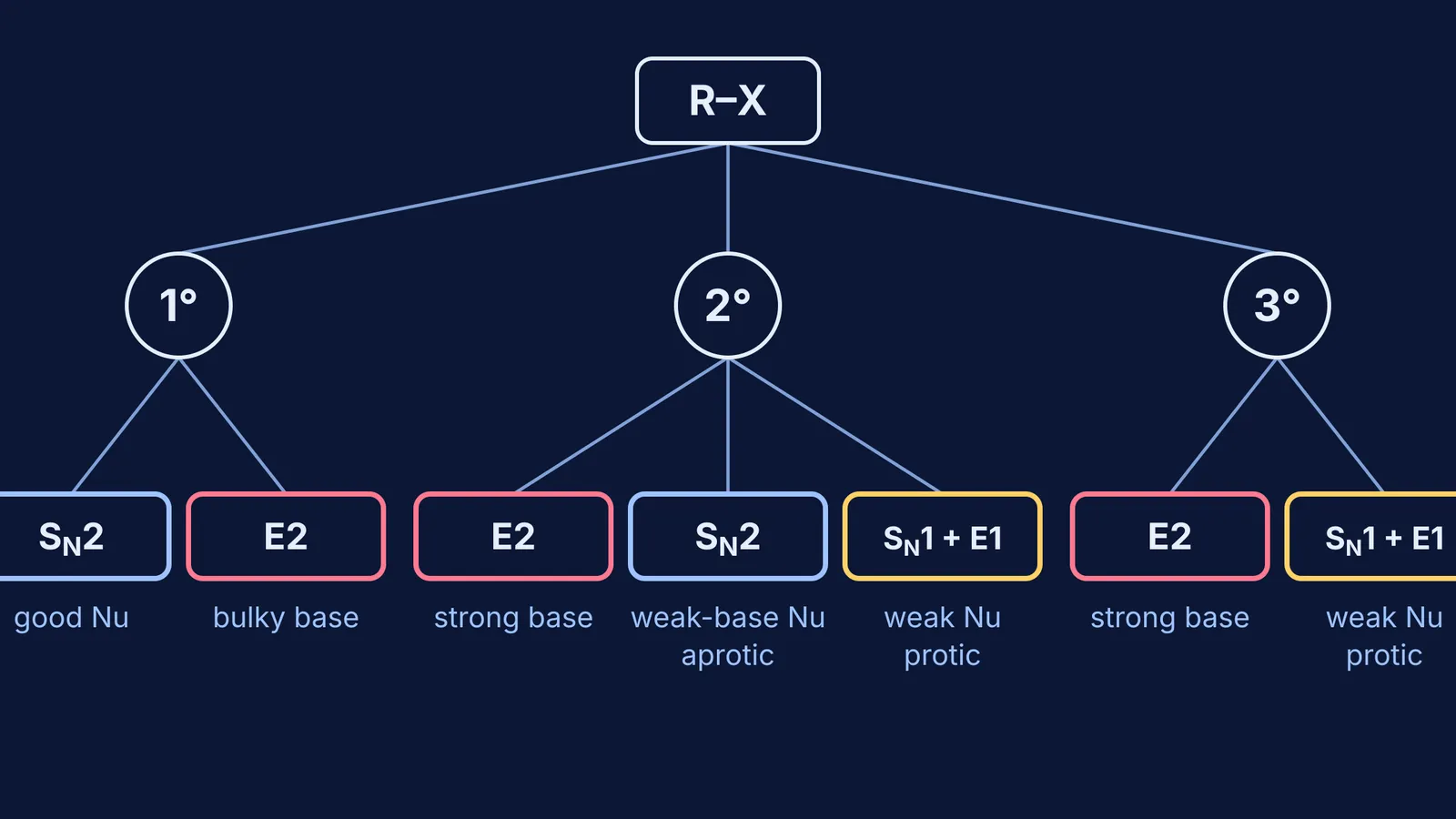
The good news is that four checks settle most textbook cases. The chart below follows the summary in the open OpenStax organic chemistry text on LibreTexts/11%3A_Reactions_of_Alkyl_Halides-_Nucleophilic_Substitutions_and_Eliminations/11.12%3A_A_Summary_of_Reactivity_-_SN1_SN2_E1_E1cB_and_E2) and the rules in Walker's Organic Chemistry I notes/08%3A_NUCLEOPHILIC_SUBSTITUTIONS_AND_ELIMINATIONS/8.06%3A_Assessing_SN1_SN2_E1_E2-_Which_will_happen).
How do you decide between SN1, SN2, E1 and E2?
Work through these four questions in order. Stop as soon as one gives you the answer.
What is the substrate? Methyl and primary halides go SN2, or E2 if the base is bulky; they do not ionise to give SN1 or E1 unless resonance stabilises the carbocation. Tertiary halides never go SN2, because the back of the carbon is blocked. Secondary halides are the hard case, so go on to question 2.
Is the reagent a strong base? Hydroxide and alkoxides such as ethoxide favour E2 with secondary and tertiary halides, and a bulky base such as potassium tert-butoxide gives E2 even with a primary halide. A good nucleophile that is a weak base, such as azide or cyanide, favours SN2. Neutral water or alcohol is a weak nucleophile and a weak base, which points to SN1 and E1 together; with secondary halides OpenStax expects this mainly when the carbocation is stabilised, as in allylic and benzylic halides.
What is the solvent? Polar aprotic solvents such as acetonitrile, DMF and DMSO speed up SN2. Polar protic solvents such as water and alcohols stabilise the carbocation and favour SN1 and E1.
Is it heated? Heat favours elimination and cold favours substitution, as Walker's notes/08%3A_NUCLEOPHILIC_SUBSTITUTIONS_AND_ELIMINATIONS/8.06%3A_Assessing_SN1_SN2_E1_E2-_Which_will_happen) put it. Elimination turns two particles into three (the alkene, the protonated base and the halide ion), so it gains more entropy, and that gain counts for more at higher temperature.
Solvent choice is not a small effect. The OpenStax chapter on SN2 reactions/11%3A_Reactions_of_Alkyl_Halides-_Nucleophilic_Substitutions_and_Eliminations/11.03%3A_Characteristics_of_the_SN2_Reaction) reports a 200,000-fold rate increase for azide ion with 1-bromobutane when methanol is replaced by the aprotic solvent HMPA.
Practice cases: which mechanism happens?
Cover the answers and try each one first.
1-Bromobutane with sodium azide in DMSO. Primary substrate, good nucleophile, weak base, aprotic solvent. Answer: SN2, giving 1-azidobutane.
1-Bromobutane with potassium tert-butoxide. Primary, but the base is strong and bulky. Answer: E2, giving but-1-ene.
2-Bromobutane with sodium cyanide in DMSO. Secondary, weakly basic nucleophile, aprotic solvent. Answer: SN2, giving 2-methylbutanenitrile with inversion at the carbon that is attacked.
2-Bromopropane with sodium ethoxide in ethanol, heated. Secondary, strong base, heat. Answer: mainly E2 to propene. Roberts and Caserio/08%3A_Nucleophilic_Substitution_and_Elimination_Reactions/8.09%3A_The_E2_Reaction) use this reaction to show E2 competing with SN2, which gives some ethyl isopropyl ether, and note that raising the temperature generally increases elimination at the expense of substitution.
tert-Butyl chloride in 80% aqueous ethanol at 25 °C. Tertiary, no strong base, protic solvent. Answer: SN1 and E1 together. Roberts and Caserio's E1 section/08%3A_Nucleophilic_Substitution_and_Elimination_Reactions/8.10%3A_The_E1_Reaction) gives the result as 83% tert-butyl alcohol and 17% 2-methylpropene.
tert-Butyl bromide with sodium ethoxide in ethanol. Tertiary, strong base. Answer: E2, giving 2-methylpropene.
If an elimination can form more than one alkene, the more substituted alkene is usually the major product. Our guide to E1, E2 and Saytzeff's rule works through those cases.
Why do students pick the wrong mechanism?
Most errors come from skipping a step on the chart, not from forgetting the mechanisms.
Reading hydroxide as only a nucleophile. The same KOH gives mainly substitution in water and mainly elimination in ethanol. Our post on aqueous vs alcoholic KOH with haloalkanes explains why.
Treating secondary halides as easy. Secondary is the one class where reagent and solvent decide everything.
Expecting one clean product. Case 5 shows that substitution and elimination often run side by side. Exam questions ask for the major product.
Forgetting the carbocation. SN1 and E1 go through a carbocation, which can rearrange before the product forms.
For the substitution half alone, with rate laws and stereochemistry, see SN1 vs SN2 in haloalkanes.
If you keep choosing the wrong route, try more cases in the Fermi Problem Library, where a step-by-step solver explains the reasoning rather than printing an answer. If the gap is earlier, such as why a tertiary carbocation is more stable than a primary one, the Fermi Concept Library gives each concept its own lesson.
Next time you meet an alkyl halide in a question, run the four checks before you look at the options.


