

On this page
If you add hydrochloric acid (HCl) to ethanol, the chlorine easily swaps places with the hydroxyl (–OH) group to make ethyl chloride. Try the same thing with phenol, and the substitution fails. While the aromatic ring itself is highly reactive—which is why the bromination of phenol and the Reimer-Tiemann and Kolbe reactions happen so easily—the –OH group is firmly locked in place. To understand why chlorobenzene cannot be made from phenol and HCl, we have to look closely at the carbon-oxygen bond.
Why does phenol not react with HCl?
Unlike in a simple alcohol, the oxygen atom in phenol sits directly on an aromatic ring. The oxygen has two lone pairs of electrons. Instead of staying entirely on the oxygen, one of these pairs shifts into the ring's π electron system.
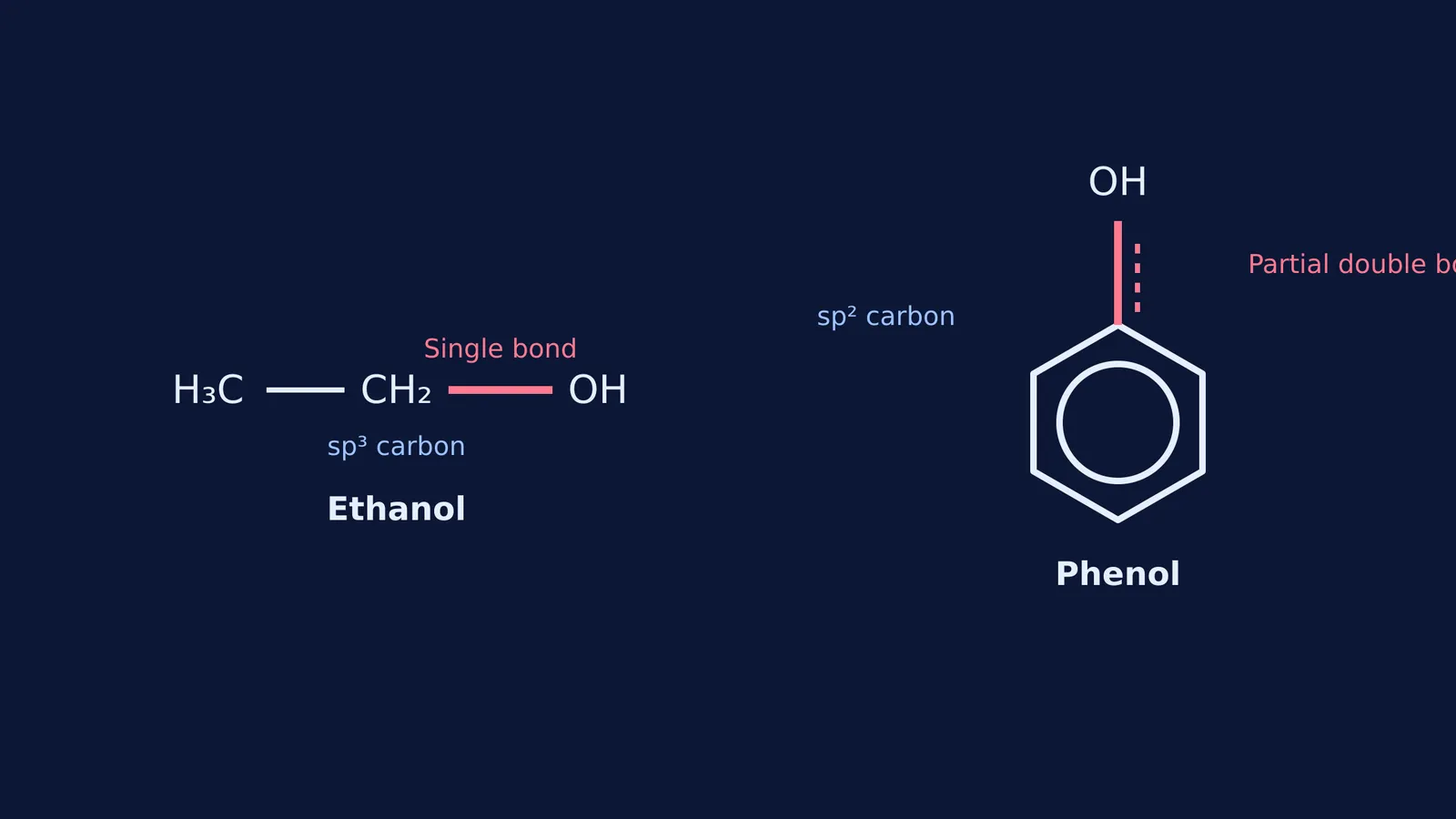
This sharing of electrons, known as resonance, means the carbon-oxygen bond is not a simple single bond. It takes on a partial double-bond character. According to the standard structural data for phenol, this pulls the oxygen closer to the carbon: the C–O bond in phenol is shorter than in an aliphatic alcohol like ethanol (Wikipedia). A double bond is much stronger and harder to break than a single bond, making it nearly impossible for HCl to force the –OH group out. This delocalisation of electrons provides extra stability to the molecule as a whole, but it also fundamentally changes the reactivity of the attached hydroxyl group.
How does the carbon atom hold on so tightly?
The geometry of the benzene ring also makes the bond stronger. The carbon atom attached to the –OH group in phenol is sp² hybridised. In contrast, the carbon in an aliphatic alcohol like ethanol is sp³ hybridised.
Because an sp² carbon is more electronegative, it pulls the shared electrons in the C–O bond more tightly toward itself, reinforcing the bond and resisting cleavage.
Why can't the phenyl cation form?
For HCl to substitute the –OH group, the reaction would have to follow a nucleophilic substitution mechanism. Both standard routes fail completely on phenol.
If the C–O bond were to break on its own (the SN1 mechanism), it would leave behind a phenyl cation (C₆H₅⁺). Unlike typical carbocations, the empty orbital of an aryl cation sits in the plane of the ring and cannot overlap with the π system. Because it cannot be stabilised by resonance, it is so high in energy that it practically never forms.
Alternatively, the chloride ion (Cl⁻) could try to attack the carbon from the back, pushing the –OH group off (the SN2 mechanism). However, the benzene ring itself is a dense cloud of π electrons. Since the incoming nucleophile is also electron-rich, the ring strongly repels it.
Checklist: When substitution fails on a benzene ring
When you see a halogen or an –OH group attached directly to an aromatic ring, you cannot easily replace it with another group using standard reagents. Remember these four blockers:
Resonance: Lone pairs delocalise into the ring, strengthening the bond to the leaving group.
Hybridisation: The sp² carbon is more electronegative and holds the group tightly.
Unstable intermediate: Aryl cations cannot be stabilised by resonance.
Electronic repulsion: The π cloud pushes incoming nucleophiles away.
Mastering organic conversions
Whether you are studying how to make phenol from cumene or planning a complex multi-step synthesis, organic chemistry is full of rules and exceptions like this one. If you try to memorise them all, the reactions soon blend together. The key to mastering these conversions is understanding why a reaction happens, which usually comes down to electron density and bond strength.
If you are struggling to picture how electrons move in resonance structures, the Fermi Concept Library breaks down nucleophilic aromatic substitution and delocalisation step by step. When you are ready to test yourself, the Fermi Problem Library will walk you through conversion problems, explaining the chemical reasoning behind each reagent rather than just printing the final product.


