On this page
A common organic chemistry question gives you a benzene ring with one group on it and asks where the next group will attach. Phenol and nitrobenzene behave in opposite ways, so learn them first. Make a prediction, then check it against resonance structures and real data.
What are ortho, para and meta positions on a benzene ring?
Call the ring carbon that carries the existing group C1. The ortho positions are C2 and C6 (next door), the meta positions are C3 and C5 (one carbon further away), and the para position is C4 (directly opposite).
The NCERT Class 11 chemistry textbook calls this the directive influence of a group. Its Hydrocarbons chapter (section 9.5.6) says the outcome "depends on the nature of the substituent already present in the benzene ring and not on the nature of the entering group". So you work out the answer from the group already on the ring, not from the group being added.
Try it first: where does the second group go?
Before reading on, write down your answers. Where does –NO2 go when phenol is nitrated? Where does a second –NO2 go on nitrobenzene? Then use this check:
Look at the atom joined directly to the ring.
If that atom has a lone pair it can share with the ring (the O in –OH or –OCH3, the N in –NH2), it gives electrons to the ring by resonance. Predict ortho and para, with a faster reaction than benzene.
If that atom carries a positive charge or is part of a polar multiple bond (the N in –NO2, the C in –CHO, –COOH or –CN), it pulls electrons out of the ring. Predict meta, with a slower reaction than benzene.
Halogens are the exception: they send the new group to ortho and para but make the reaction slower. Our post on why chlorine is deactivating but ortho-para directing explains this.
Check your prediction with resonance structures, as below.
Phenol fits step 2 (ortho and para). Nitrobenzene fits step 3 (meta).
Why does –OH direct ortho and para?
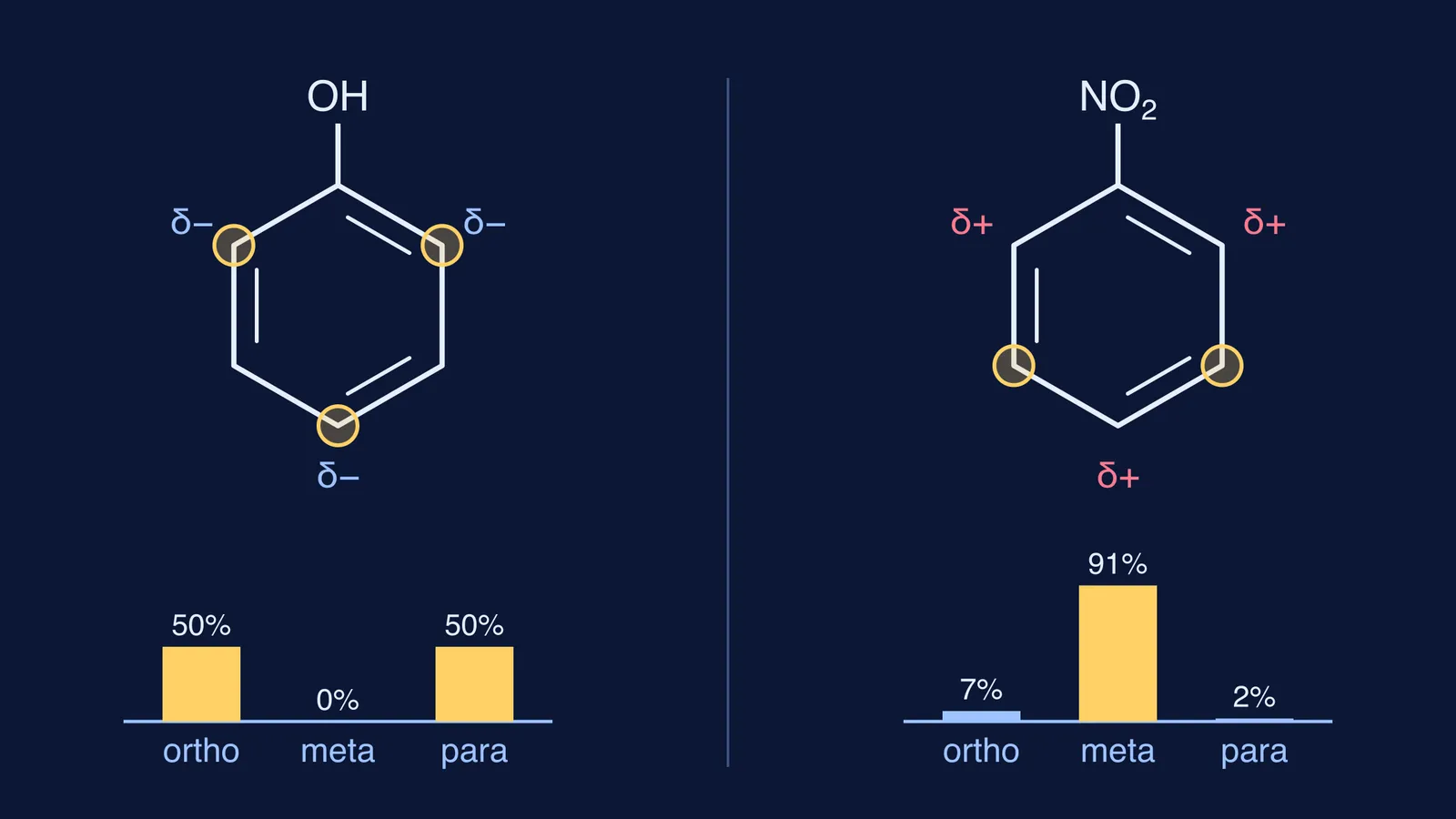
The NCERT chapter draws phenol as a resonance hybrid of five structures. In three of them, oxygen has shared a lone pair with the ring and carries a positive charge, and the negative charge sits on an ortho carbon, the para carbon or the other ortho carbon. No structure puts a negative charge on a meta carbon. So the ortho and para carbons are richer in electrons, and an electrophile (an electron-seeking reagent such as NO2+) attacks them.
The OpenStax text on substituent effects/16%3A_Chemistry_of_Benzene_-_Electrophilic_Aromatic_Substitution/16.04%3A_Substituent_Effects_in_Electrophilic_Substitutions) gives a second explanation based on the intermediate. When the electrophile attacks ortho or para, the positively charged intermediate has an extra resonance form in which the oxygen helps stabilise the positive charge. Attack at meta does not get this extra form. NCERT also points out that oxygen pulls electrons through the sigma bond (the –I effect), but the resonance effect is stronger, so overall –OH activates the ring.
Why does –NO2 direct meta?
Now do the same with nitrobenzene. In the NCERT resonance structures, the nitro group pulls ring electrons onto its oxygen, which leaves a positive charge on the ortho and para carbons. The meta carbons lose less electron density, so the textbook describes them as "comparatively electron rich". Overall the ring has less electron density than benzene, which is why NCERT calls nitro a deactivating group.
The intermediate tells the same story. OpenStax/16%3A_Chemistry_of_Benzene_-_Electrophilic_Aromatic_Substitution/16.04%3A_Substituent_Effects_in_Electrophilic_Substitutions) shows it for benzaldehyde: if the electrophile attacks ortho or para, one resonance form puts the positive charge on the carbon that carries the group, next to an atom that is already electron-poor. Attack at meta never creates that form. The same reasoning applies to nitrobenzene, where the nitrogen joined to the ring carries a formal positive charge.
To make sure you find every structure without counting any twice, see our guide to counting resonance structures.
Do the real numbers match the prediction?
They do. The table of nitration results in the OpenStax organic chemistry text/16%3A_Chemistry_of_Benzene_-_Electrophilic_Aromatic_Substitution/16.04%3A_Substituent_Effects_in_Electrophilic_Substitutions) gives these product mixtures:
Phenol (–OH): 50% ortho, 0% meta, 50% para.
Nitrobenzene (–NO2): 7% ortho, 91% meta, 2% para.
The groups also change how fast the reaction goes. The same source says that in nitration an –OH group makes the ring 1000 times more reactive than benzene, while an –NO2 group makes it more than 10 million times less reactive.
So "meta directing" means meta is the major product, not the only one.
If you learn better from pictures than from text, the Fermi Simulation Lab has interactive simulations for ideas that are easier to see than to read. If your arrows keep landing on the wrong carbon, the Fermi Problem Library has a step-by-step solver that explains the reasoning rather than printing an answer.
Next, try a ring with two groups: our guide to where a third group goes on a disubstituted benzene uses the same reasoning.