

On this page
Ask how many resonance structures the phenoxide ion has and you may hear four or five. The method below gives one answer you can defend.
What counts as a resonance structure?
NCERT's Class 11 text says that when one Lewis structure cannot describe a molecule, "a number of structures with similar energy, positions of nuclei, bonding and non-bonding pairs of electrons are taken as the canonical structures of the hybrid" (NCERT Class 11 Chemistry, Unit 4). Resonance forms differ only in the placement of their π or nonbonding electrons, and no atom changes position or hybridisation (LibreTexts, Rules for Resonance Forms/02%3A_Polar_Covalent_Bonds_Acids_and_Bases/2.05%3A_Rules_for_Resonance_Forms)). So every drawing must pass three rules:
Atoms stay put. If a hydrogen moves, you have drawn a different compound.
Only π electrons and lone pairs move. σ bonds never break.
Same total charge, and no carbon, nitrogen or oxygen with more than eight electrons.
How do you count resonance structures step by step?
Draw one correct Lewis structure with every lone pair and formal charge.
Number the atoms in π bonds or carrying a lone pair or charge next to one.
Push one electron pair at a time: a lone pair next to a π bond becomes a π bond, and that π pair moves on.
Check the new drawing against the three rules.
Write it as a code: the numbered bonds that are double, plus the numbered atoms that carry a charge.
Stop when every push gives a code already on your list. The number of different codes is your answer.
How many resonance structures do carbonate and benzene have?
The carbonate ion has three. Number the oxygens 1, 2 and 3. Start with C=O1 and charges on O2 and O3. Push a lone pair from O2 into the C–O2 bond while the C=O1 π pair moves onto O1: the code is now C=O2, charges on O1 and O3. One more push gives C=O3; the next returns to C=O1. That is three, matching Fig. 4.4 of NCERT Class 11 Chemistry, Unit 4.
Benzene has two Kekulé structures. Number the carbons 1 to 6 and start with 1=2, 3=4, 5=6. Slide one π bond on its own and a carbon gets five bonds, so all three move together, giving 2=3, 4=5, 6=1. NCERT names these two Kekulé structures as the main contributors; X-ray data show all six C–C bonds are 139 pm, between a single bond (154 pm) and a double bond (133 pm) (NCERT Class 11 Chemistry, Unit 9). The extra stability is worked out in our post on calculating the resonance energy of benzene.
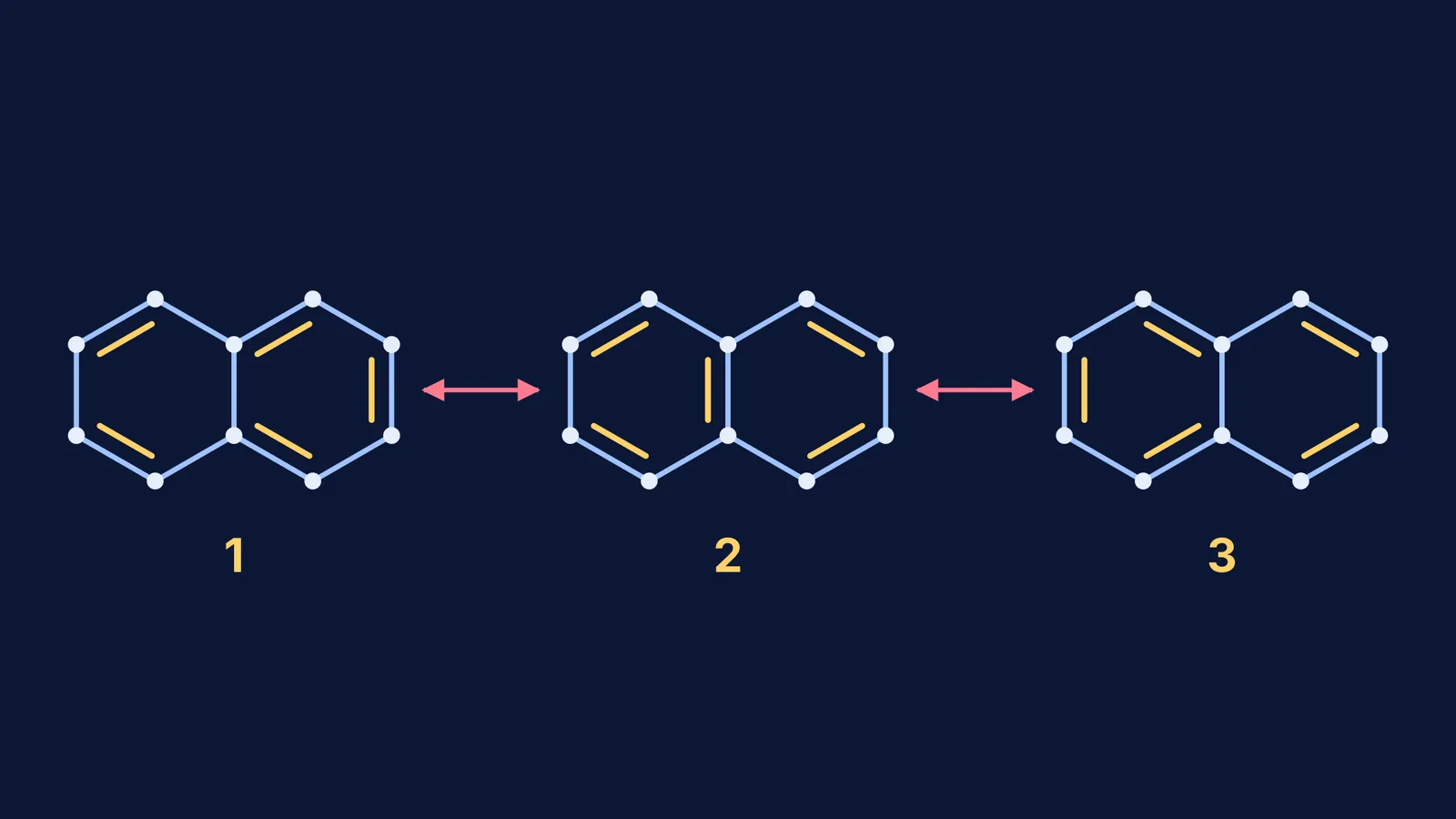
How many resonance structures does naphthalene have?
Naphthalene has 10 π electrons across two fused rings, so you are placing 5 double bonds on 10 carbons (NCERT Class 11 Chemistry, Unit 9). Split by the shared bond so you miss none. Number the outer carbons 1 to 8, with 4a and 8a for the shared carbons.
Shared bond 4a=8a double: the only way to finish is 1=2, 3=4, 5=6, 7=8. One structure.
Shared bond single: 8a pairs with C1 or C8, and 4a with C4 or C5. 8a=1 with 4a=4 forces 2=3, 5=6, 7=8. 8a=8 with 4a=5 forces 6=7, 1=2, 3=4. The mixed choices leave three carbons in a row in each ring, which cannot all pair. Two structures.
That makes three, matching the three canonical contributors on LibreTexts, Reactions of Fused Benzene Rings/Arenes/Reactivity_of_Arenes/Benzene/Reactions_of_Fused_Benzene_Rings). For why 10 π electrons make the rings aromatic, see predicting aromatic rings with Hückel's rule.
How many resonance structures does the phenoxide ion have?
NCERT's Class 12 text draws five, labelled I to V (NCERT Class 12 Chemistry, Unit 7). Number the ring carbons 1 to 6, with C1 holding the oxygen. Start with the charge on oxygen and the ring as 1=2, 3=4, 5=6. Push an oxygen lone pair into the C–O bond and the 1=2 π pair onto C2: the charge sits on an ortho carbon. Keep pushing and it moves to C4 (para), then C6 (ortho), and the last push returns it to oxygen with the other Kekulé ring, 2=3, 4=5, 6=1. No push puts the charge on a meta carbon.
So I and V both carry the charge on oxygen and differ only in their Kekulé ring. Draw the oxygen-charged form only once and you get four. The same delocalisation in phenol helps explain why the C–O bond in phenol is shorter than in methanol.
Which mistakes give the wrong count?
Moving a hydrogen or breaking a σ bond.
Counting the same code twice because you reached it by a different route.
Dropping a structure that only looks like a rotated copy.
If your counts change from one attempt to the next, the Fermi Problem Library has worked problems with a step-by-step solver that explains the reasoning rather than printing an answer. If delocalisation itself feels shaky, the Fermi Concept Library gives each chemistry concept its own lesson.
For practice, try chlorobenzene and nitrobenzene: NCERT draws five structures for each in Class 11 Chemistry, Unit 9.


