

On this page
What is Hückel's 4n + 2 rule for aromaticity?
In 1931, Erich Hückel showed that planar, cyclic conjugated molecules attain exceptional thermodynamic stability when their π electron system fills all bonding molecular orbitals (Zeitschrift für Physik). According to IUPAC criteria, a monocyclic, planar, fully conjugated ring is aromatic if it contains (4n + 2) delocalised π electrons, where n is a non-negative integer (0, 1, 2, 3...) (Pure and Applied Chemistry). For n = 0, 1, 2, and 3, these Hückel counts equal 2, 6, 10, and 14 π electrons.
Aromatic rings display large negative resonance energies, uniform carbon-carbon bond lengths, and diatropic ring currents in NMR spectra. Conversely, planar conjugated rings with 4n π electrons (such as 4, 8, or 12) suffer antiaromatic destabilisation, a state defined by Ronald Breslow in 1965 and documented in 1973 (Accounts of Chemical Research). If a ring lacks continuous p-orbital overlap or twists out of planarity, it is non-aromatic. This distinction builds on Kathleen Lonsdale's crystal structure analysis of benzene, confirming that aromatic rings maintain a flat geometry.
How do you count π electrons in cyclic systems?
Predicting aromaticity requires counting only the electrons in the delocalised π framework under IUPAC guidelines (Pure and Applied Chemistry):
Each carbon-carbon double bond in the ring contributes 2 π electrons.
A heteroatom or carbanion lone pair contributes 2 π electrons only if it occupies an unhybridised p orbital perpendicular to the ring.
If an atom already participates in a ring double bond, its extra lone pair sits in a coplanar sp² hybrid orbital and contributes 0 π electrons.
An sp² carbocation or boron atom provides an empty p orbital for continuous overlap but contributes 0 π electrons.
Any sp³ ring carbon with four single bonds disrupts conjugation, making the system non-aromatic.
This explains why pyridine and pyrrole treat nitrogen lone pairs differently. In pyridine, the nitrogen already provides 1 p electron to a ring double bond; its lone pair stays in a coplanar sp² hybrid orbital, leaving 6 π electrons in the ring. In pyrrole, nitrogen forms three single bonds, rehybridising to sp² so its lone pair enters the p system to provide the needed 6 π electrons. This evaluation mirrors principles used when ranking resonance structures.
How do benzene, cyclobutadiene, and the cyclopentadienyl anion compare?
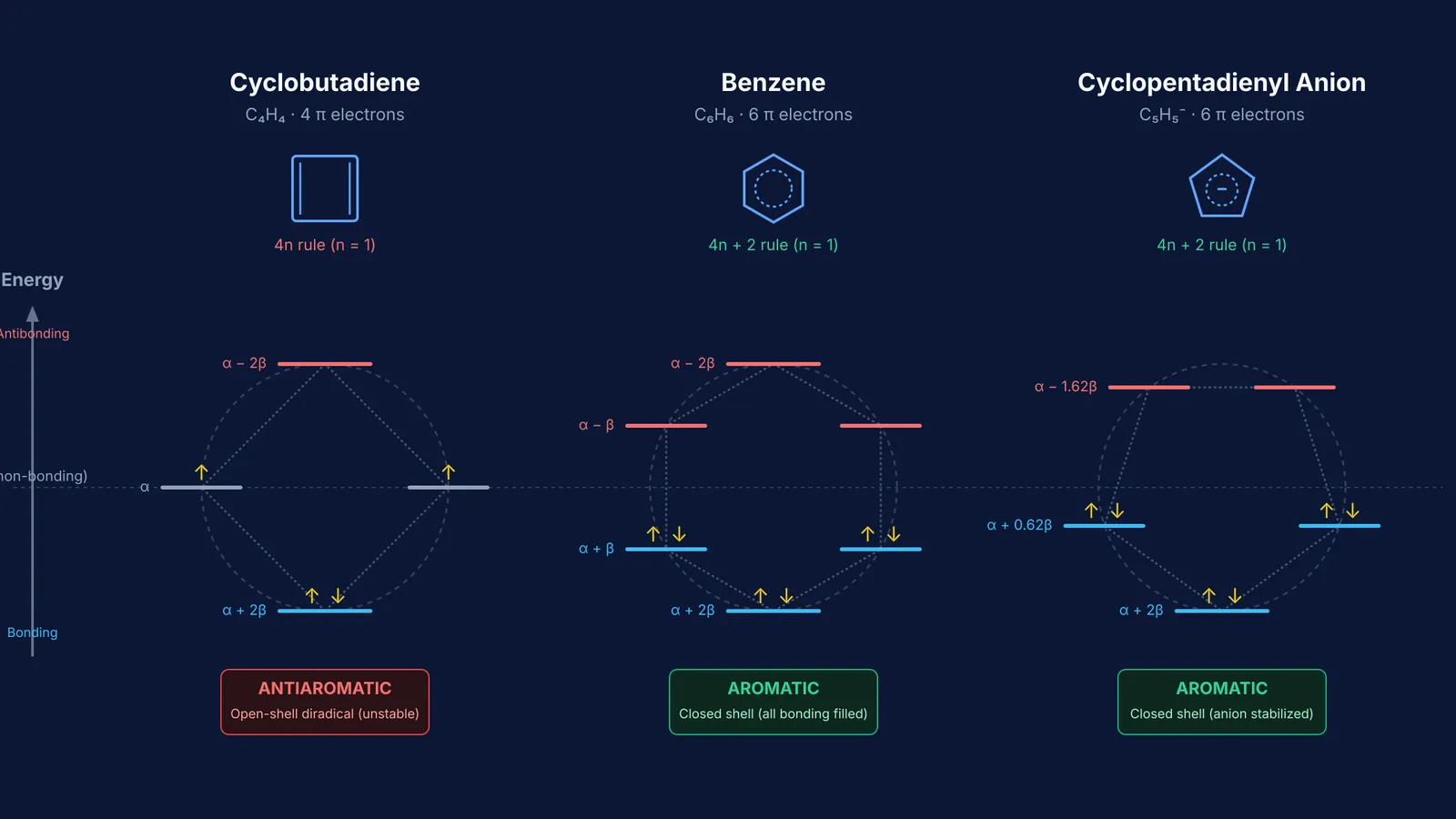
Benzene (C₆H₆) is the benchmark aromatic ring. Its six sp² carbons provide 6 π electrons (4n + 2, where n = 1). In 1953, Arthur Frost and Boris Musulin introduced a geometric mnemonic—inscribing a polygon vertex-down in a circle of radius 2|β|—showing that benzene's 6 electrons completely fill all three bonding molecular orbitals (The Journal of Chemical Physics). This closed shell explains the stability that puzzled chemists studying August Kekulé's oscillating ring model.
Cyclobutadiene (C₄H₄) illustrates antiaromaticity. Its two conjugated double bonds supply 4 π electrons (4n, where n = 1). In a Frost circle, 2 electrons fill the lowest bonding level, leaving 2 unpaired electrons in degenerate non-bonding orbitals. This diradical configuration creates intense instability. In 1991, Donald Cram trapped cyclobutadiene at room temperature inside a molecular hemicarceplex, confirming its rectangular distortion to alleviate orbital degeneracy (Angewandte Chemie International Edition in English).
The cyclopentadienyl anion (C₅H₅⁻) shows how ionization creates aromaticity. Neutral cyclopentadiene is non-aromatic due to its saturated sp³ –CH₂– carbon. Deprotonation converts that carbon to sp², placing the lone pair into an unhybridised p orbital. Together with the two double bonds, the ring gains 6 π electrons (n = 1). Frederick Bordwell measured cyclopentadiene's pKa at 18.0 in dimethyl sulfoxide (Accounts of Chemical Research). Compared to non-conjugated cyclopentane with a pKa exceeding 50, this 32-unit gap demonstrates the powerful stabilisation of forming an aromatic ring.
How does active visualisation help master aromaticity?
Treating electron counting as routine arithmetic often leads to mistakes on substituted heterocycles or tub-shaped rings like cyclooctatetraene. Active visualisation helps students rotate rings in three dimensions, track p-orbital orientation, and see why geometry governs orbital overlap.
The Fermi Simulation Lab provides interactive simulations for the ideas that are easier to see than to read, so you can explore cyclic geometry and orbital overlap. For targeted practice, the Fermi Problem Library offers worked problems with a step-by-step solver that explains the reasoning rather than printing an answer. When working through ambiguous ring systems, Fermi's AI tutor notices where you are stuck, draws the figure, and checks understanding as it goes.


