

On this page
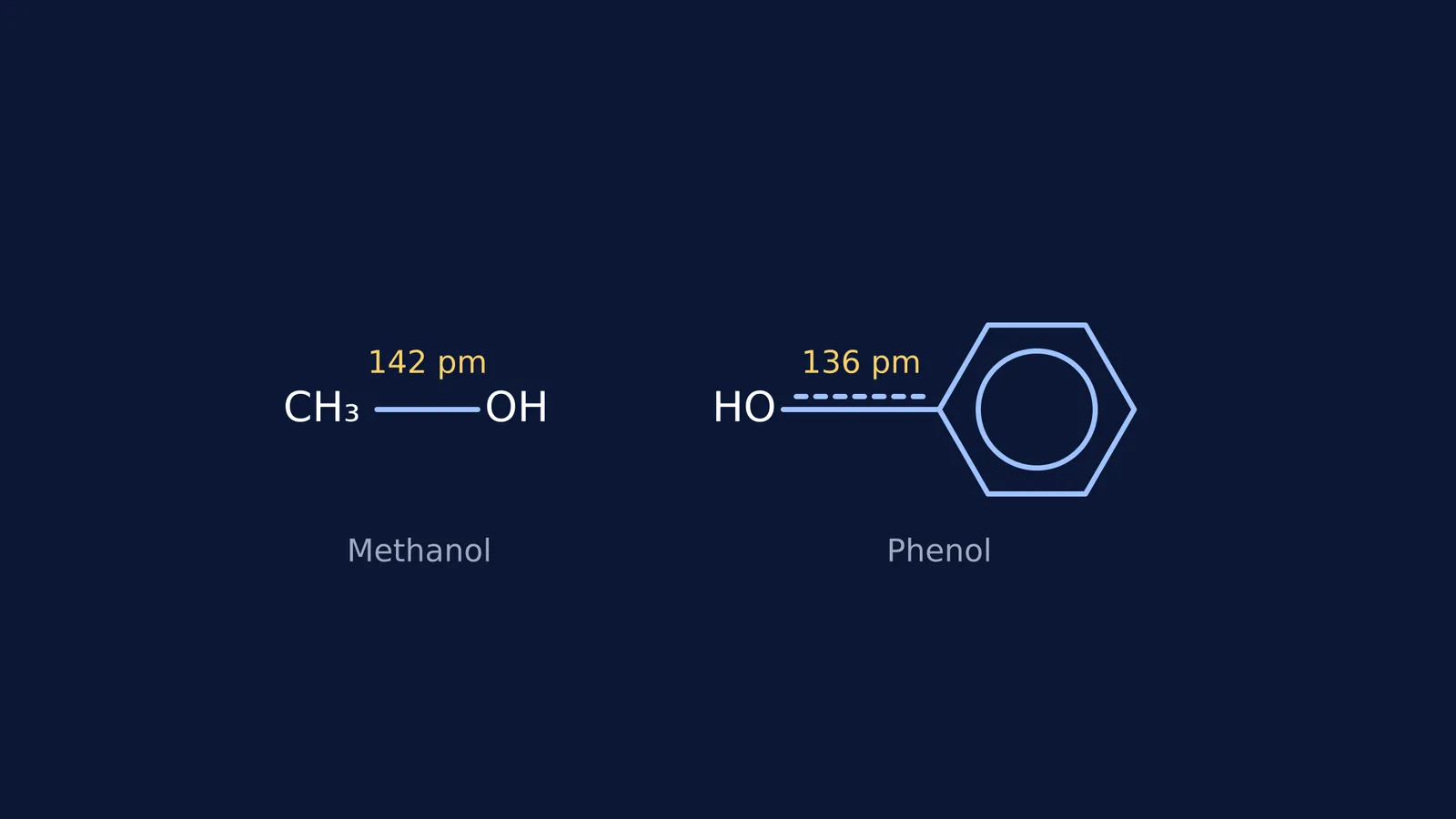
If you are preparing for JEE or NEET-UG, you will often find questions asking you to compare bond lengths or reactivities of organic compounds. A classic example is the carbon-oxygen (C–O) bond. Even though both methanol and phenol contain a hydroxyl (–OH) group, the C–O bond length in phenol is noticeably shorter than in methanol.
This is not a random fact to memorise. It happens because of two predictable electronic effects: resonance and hybridisation. Understanding them will help you solve dozens of similar questions about bond lengths and bond strengths without guessing.
Why is the C–O bond length in phenol shorter than in methanol?
The C–O bond length is 142 pm in methanol, but only 136 pm in phenol (NCERT Class 12 Chemistry). The main reason for this shrinking is resonance.
In phenol, the oxygen atom is attached directly to a benzene ring. Oxygen has two lone pairs of electrons. One of these lone pairs is conjugated with the π-electron system of the benzene ring. This means the electrons delocalise (spread out) into the ring.
When you draw the resonance structures for phenol, you will see that the C–O bond becomes a double bond in three of the structures. As a result, the C–O bond in the actual phenol molecule is not a pure single bond. It has partial double bond character. Since double bonds are always shorter and stronger than single bonds, the C–O bond length shrinks.
In methanol, the oxygen is attached to a methyl group (CH₃). There is no π-system for the lone pairs to interact with, so there is no resonance. The C–O bond remains a pure single bond.
If resonance structures feel like guesswork, the Fermi Concept Library has a lesson for every concept in chemistry, showing you exactly how and where electrons move.
Why does the hybridisation of carbon matter?
The second reason comes down to the hybridisation of the carbon atom attached to the oxygen.
In methanol: The carbon atom is sp³ hybridised.
In phenol: The carbon atom of the benzene ring is sp² hybridised.
An sp² hybridised orbital has more s-character than an sp³ orbital. Because s-orbitals are spherical and closer to the positively charged nucleus, a carbon atom with more s-character is effectively more electronegative. This means it has a stronger tendency to attract the shared pair of electrons in the covalent bond towards itself.
This tighter pull from the sp² carbon in phenol draws the oxygen atom closer, shortening the bond length even further.
How does this affect chemical reactions?
The shorter, stronger C–O bond in phenol explains a major difference in how these two molecules react.
If you treat methanol with hydrogen chloride (HCl) and a zinc chloride catalyst, the C–O bond breaks easily to form chloromethane. But if you try the same nucleophilic substitution reaction with phenol, nothing happens. The C–O bond is simply too strong to break under normal conditions. This is why the hydroxyl group behaves differently depending on what it is attached to, a pattern you will also see when deciding leaving group ability in organic chemistry.
If you are stuck on why a reaction does not work the way you expect, Fermi's AI tutor can work out what you already know and build a plan for the session to clear up the confusion.
A checklist for bond length questions
When you face a question asking you to compare bond lengths, use this three-step framework:
Draw the structure: Identify the atoms forming the bond.
Look for resonance: Can lone pairs or π-electrons delocalise? If yes, expect partial double bond character (which shortens the bond).
Check hybridisation: Find the hybridisation (sp, sp², sp³) of the atoms. More s-character means a shorter bond.
Applying these rules will help you predict properties accurately, just as you use data like the heat of hydrogenation to rank alkene stability. Instead of rote learning, trust the structural rules. If you want to explore more organic chemistry mechanisms, learn how asking AI the 'why' behind named organic reactions can improve your understanding.


