

On this page
When a molecule undergoes a nucleophilic substitution or an elimination reaction, a bond breaks and one fragment takes both electrons from that broken bond. The fragment that departs is known as the leaving group. In organic chemistry, identifying a good leaving group is the first and most critical step to predicting whether a chemical reaction will happen at all, and by which pathway.
So, how do you evaluate these molecules? The rule is surprisingly simple: a good leaving group is a weak conjugate base.
What makes a good leaving group?
A leaving group is essentially a nucleophile acting in reverse. When it departs from the carbon skeleton, it has to carry away an extra pair of electrons. Good leaving groups are chemical species that are stable with that extra electron pair.
Because strong acids readily give up their protons, their conjugate bases are very stable and unreactive. Therefore, the weaker the base (and the stronger its conjugate acid), the better the leaving group. You can predict leaving group ability directly from an acid dissociation constant table; the lower the pKa of the conjugate acid, the better the leaving group according to Master Organic Chemistry. For instance, strong acids like hydrobromic acid or sulfuric acid produce exceptionally stable conjugate bases that have no desire to re-bond to carbon.
What is the leaving group ability order for halogens?
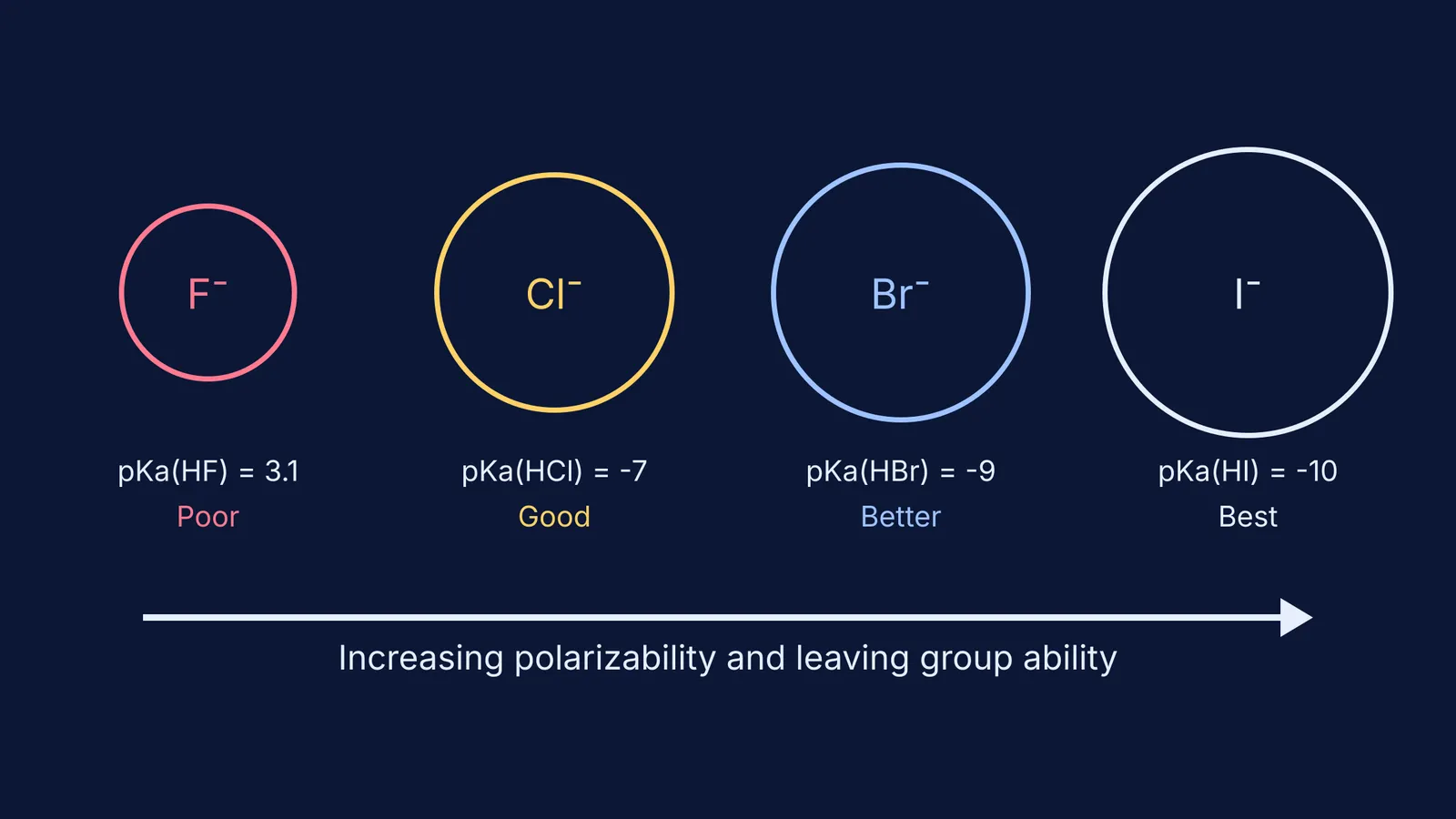
The halogens provide the clearest example of how basicity and polarizability affect a group's ability to leave. As you move down group 17 of the periodic table, the atoms get physically larger. A larger atom can spread its negative charge over a greater volume, making it more stable and a significantly weaker base.
Based on the pKa values of their conjugate acids (according to Master Organic Chemistry), the leaving group ability order for the halogens is I⁻ > Br⁻ > Cl⁻ > F⁻.
Iodide (I⁻): Its conjugate acid is hydroiodic acid (HI), which has a pKa of roughly -10, making iodide an excellent leaving group.
Bromide (Br⁻): Coming from hydrobromic acid (HBr, pKa ≈ -9), it is also an excellent leaving group.
Chloride (Cl⁻): Derived from hydrochloric acid (HCl, pKa ≈ -7), it is a reliable and good leaving group.
Fluoride (F⁻): Despite hydrofluoric acid (HF, pKa 3.1, per Wikipedia) being an acid, the C–F bond is extremely strong (around 130 kcal/mol), and fluoride is a relatively strong base compared to the heavier halides. This makes fluoride a notoriously poor leaving group in standard substitution reactions.
Why must -OH be protonated first?
If you try to react an alcohol (R–OH) with a nucleophile directly under neutral or basic conditions, nothing happens. The leaving group would be the hydroxide ion (-OH). Hydroxide is a strong base—its conjugate acid is water (H₂O), which has a pKa of approximately 15.7 (as listed by Master Organic Chemistry). Strong bases are highly reactive and unstable on their own, making them terrible leaving groups.
To make an alcohol react, you must add a strong acid to the mixture. The acid donates a proton to the oxygen atom, converting the -OH group into -OH₂⁺. Now, when the carbon-oxygen bond breaks, the leaving group is a neutral water molecule (H₂O). Water is a very weak base (its conjugate acid, the hydronium ion H₃O⁺, has a pKa of -1.7), making it a fantastic leaving group. Acid-base reactions are generally much faster than substitution reactions, so this protonation step happens almost instantly.
Why do tosylate groups leave easily?
Tosylates (TsO⁻), mesylates (MsO⁻), and triflates (TfO⁻) are some of the best leaving groups in synthetic organic chemistry. They are frequently used by chemists to turn a stubborn alcohol into a highly reactive molecule without needing to run the reaction in a strongly acidic environment.
A tosylate is a fantastic leaving group because its negative charge is intensely stabilised by resonance. When the tosylate group leaves, its extra electrons are delocalised and shared equally across three different oxygen atoms attached to a central sulfur atom. This massive distribution of charge makes it an incredibly weak base. For context, its conjugate acid, p-toluenesulfonic acid, is a strong acid.
If you are trying to memorise these rules and keep getting confused by the exceptions, the Fermi Concept Library breaks down the underlying acid-base principles step by step, so you can reason your way to the right mechanism instead of relying on pure memorisation.
A checklist for predicting leaving groups
When you encounter an unfamiliar molecule in an exam, use this three-step framework to decide if a group will successfully leave:
Find the conjugate acid: Imagine adding a proton (H⁺) to the group that is leaving.
Check the pKa: Is that conjugate acid strong (pKa < 0) or weak? A strong conjugate acid means the original group is a weak base, which makes it a good leaving group.
Look for resonance: Can the leaving group spread its negative charge across multiple electronegative atoms? If yes (like in a tosylate or a phosphate), it will be unusually stable and highly likely to leave.
Understanding leaving groups will immediately help you make sense of complex reaction mechanisms. For more practice on how these groups behave in real exam problems, read our guides on SN1 vs SN2 in haloalkanes and aqueous vs alcoholic KOH with haloalkanes.


