On this page
Castor oil is an odd vegetable oil. Almost all of its fatty acid is one compound, ricinoleic acid, which carries an OH group in the middle of its chain. With heat and a catalyst, that OH leaves as water. The product, dehydrated castor oil (DCO), is a paint oil with its own Indian Standard, IS 81:1989. The chemistry is a Class 12 alcohol dehydration, and the numbers in the Bureau of Indian Standards (BIS) specifications let you check every step with a formula.
What makes castor oil different from other vegetable oils?
Most vegetable oils are mixtures of palmitic, stearic, oleic and linoleic acids. Castor oil is dominated by ricinoleic acid. IS 11486:2021, the BIS standard for castor oil used in cosmetics, sets its gas chromatography limits at 84 to 92% ricinoleic acid, with oleic acid 2.5 to 6.0% and every other acid at 2.5% or less.
PubChem gives ricinoleic acid as (9Z,12R)-12-hydroxyoctadec-9-enoic acid, C₁₈H₃₄O₃, molar mass 298.5 g/mol. Number the chain from the COOH carbon as C1:
a cis double bond between C9 and C10
an OH on C12, with R configuration
a CH₂ (C11) between them, so the OH is not on an allylic carbon.
The HSDB record in PubChem lists industrial uses such as Turkey red oil, textile finishing and plasticisers.
How many stereoisomers does ricinoleic acid have?
Count the stereogenic units.
C12 has four different groups: H, OH, the C1–C11 chain and the C13–C18 hexyl chain. One stereocentre, R or S.
C9=C10 has two different groups on each carbon, so it can be E or Z.
Two independent units give 2 × 2 = 4 stereoisomers: (9Z,12R), (9Z,12S), (9E,12R) and (9E,12S). The natural acid is (9Z,12R).
Because C12 is a stereocentre, castor oil rotates plane-polarised light. IS 11486 sets the optical rotation of cosmetic castor oil at +3.5 to +6.0. HSDB gives the specific rotation of ricinoleic acid as +6.67° at 22 °C (c = 5 in acetone).
What happens when castor oil is dehydrated?
At NCERT level, treat each ricinoleate chain as a secondary alcohol undergoing acid-catalysed dehydration, and follow the carbocation route in dehydration of alcohols: the carbocation route and major alkene.
Acid protonates the C12 OH, turning it into a good leaving group, H₂O.
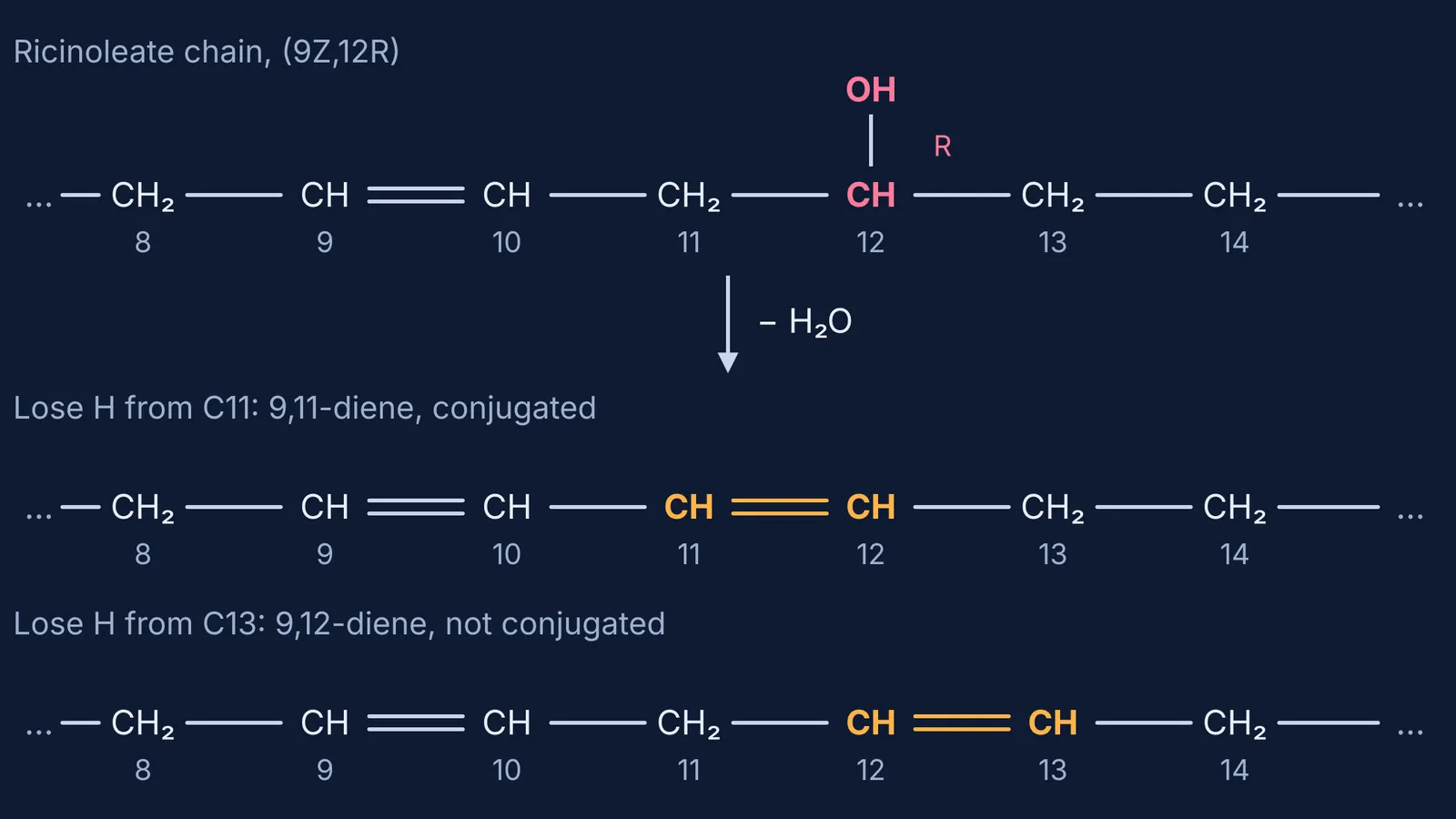
Water leaves, giving a secondary carbocation at C12. The stereocentre is gone: C12 is now sp² and flat.
A proton is lost from a neighbouring carbon, and there are two choices.
Lose H from C11: the new C11=C12 bond sits next to C9=C10. The product is a 9,11-diene, conjugated.
Lose H from C13: the new C12=C13 bond is separated from C9=C10 by CH₂ (C11). The product is a 9,12-diene, not conjugated, with the same skeleton as linoleic acid.
Both new double bonds are disubstituted, so Saytzeff's rule (most substituted alkene) does not separate them. What does separate them is conjugation. A conjugated diene is lower in energy than an isolated one, so on stability grounds the 9,11 product is favoured. The actual ratio, and which E/Z form the new bond takes, are not given in the standards we read, so we do not quote them. Each new C=C is another E/Z site.
For one chain: C₁₈H₃₄O₃ → C₁₈H₃₂O₂ + H₂O (C 18 = 18, H 34 = 32 + 2, O 3 = 2 + 1).
For the whole triglyceride: C₅₇H₁₀₄O₉ → C₅₇H₉₈O₆ + 3H₂O (H 104 = 98 + 6, O 9 = 6 + 3).
The dehydrated chains have no stereocentre left, so they cannot cause optical activity. That is our inference; IS 81 does not specify a rotation for DCO.
Why does dehydration make castor oil a paint oil?
An oil paint hardens by oxidative cross-linking at its C=C bonds, as explained in how paint dries on walls. Each ricinoleate chain has only one C=C. Dehydration gives each chain a second one, and often makes the pair conjugated.
IS 81 describes DCO as "genuine castor oil (conforming to commercial grade of IS 435 : 1973) which has been suitably dehydrated and, if required, further heat treated for polymerization". It is tested as a film: with a cobalt drier added, the film must be clear and "surface dry" in under 3 hours.
Worked example: predict the BIS numbers from the formula
Model castor oil as pure triricinolein, glycerol esterified with three ricinoleic acids. We use K = 39.098, I = 126.904 (I₂ = 253.81), KOH = 56.106. The formulas are the ones in saponification value and iodine value of fats, worked out.
Molar mass. C₃H₈O₃ + 3C₁₈H₃₄O₃ − 3H₂O = C₅₇H₁₀₄O₉, M = 933.45 g/mol.
Saponification value. C₅₇H₁₀₄O₉ + 3KOH → C₃H₈O₃ + 3C₁₈H₃₃O₃K. SV = 3 × 56.106 × 1000 / 933.45 = 180.3. IS 11486 range: 177 to 185.
Iodine value (3 C=C). IV = 3 × 253.81 × 100 / 933.45 = 81.6. IS 11486 (Wijs): 82 to 90. The real oil reads slightly higher because its oleic and linoleic chains carry more C=C per gram.
Acetyl value. Acetylation turns each OH into OCOCH₃ (R−OH + (CH₃CO)₂O → R−OCOCH₃ + CH₃COOH), adding 42.04 per OH. Acetylated M = 933.45 + 3 × 42.04 = 1059.56. The acetyl value is mg KOH for the acetic acid released from 1 g of the acetylated fat: 3 × 56.106 × 1000 / 1059.56 = 158.9.
Ricinoleic content from the BIS minimum. IS 11486 requires an acetyl value of at least 143.0. As a first estimate, 143.0 / 158.9 = 0.90, about 90% triricinolein. Treating the remainder as triolein and correcting for the acetyl mass gives 88.8%. Both sit inside the 84 to 92% GC limit.
After full dehydration. C₅₇H₉₈O₆, M = 879.41. Mass lost = 3 × 18.015 / 933.45 = 5.79%. SV = 3 × 56.106 × 1000 / 879.41 = 191.4, inside IS 81's 188 to 195. IV with 6 C=C = 6 × 253.81 × 100 / 879.41 = 173.2, the theoretical ceiling. IS 81 Grade 1 sets minimums of 127 (Wijs) and 145 (Woburn).
How complete is dehydration? An 88.8% triricinolein oil has a hydroxyl value of about 160. IS 81 allows at most 15 in DCO. Allowing for the mass lost as water, that means at least 91% of the OH groups are gone.
C₅₇H₉₈O₆ is also the formula of trilinolein, because dehydration toward C13 rebuilds linoleic acid's 9,12 pattern. For more problems like these, the Fermi Problem Library has a step-by-step solver that explains the reasoning.
If you are preparing for JEE, Fermi Test Prep is JEE Main and Advanced preparation with an AI tutor.
Quick checklist
Ricinoleic acid: (9Z,12R)-12-hydroxyoctadec-9-enoic acid, 4 stereoisomers.
Acid dehydration: protonate OH, lose water, lose H from C11 (conjugated 9,11) or C13 (isolated 9,12).
The C12 stereocentre disappears; each new C=C is an E/Z site.
Triricinolein: SV 180.3, IV 81.6, acetyl value 158.9.
Dehydrated: SV 191.4, IV 173.2, 5.79% mass loss.
IS 11486 acetyl value minimum 143 implies about 89 to 90% ricinoleic.