

On this page
Have you ever painted a wall and wondered why it feels dry to the touch so quickly, yet takes much longer to become truly hard? Or why a painting from a master artist might take a long time to cure completely? The secret is that "drying" and "hardening" are two entirely different processes. What happens on the wall depends entirely on whether you are using a water-based emulsion or an oil-based enamel.
The physics and chemistry of how paint dries offers a surprising analogy for how students form durable memories. Just as a strong coat of paint needs time to interlock its molecules, robust learning requires time to build connections.
How does wall paint dry and harden?
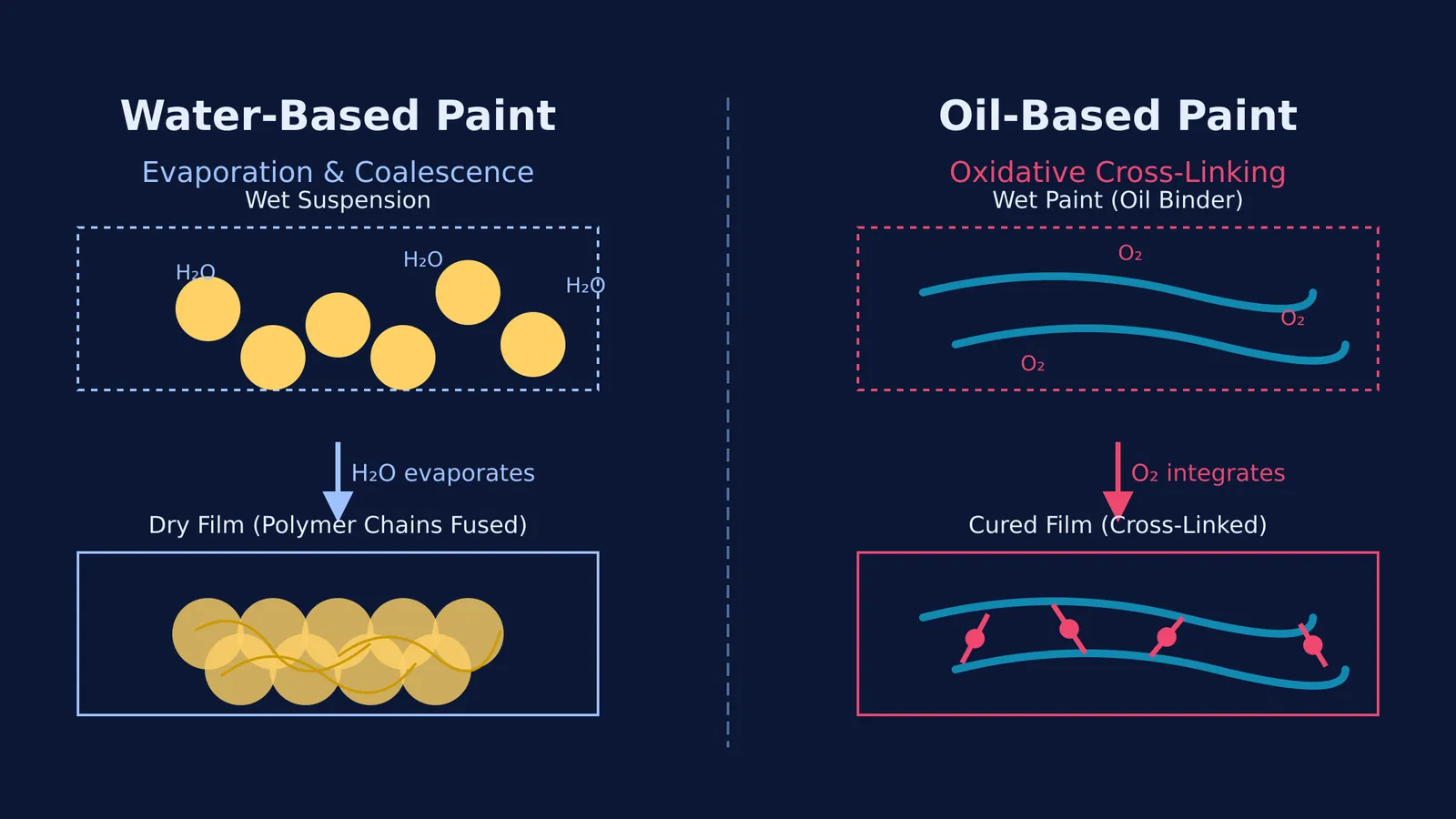
Water-based paints, such as latex and acrylics, dry through a physical process called coalescence. When you first apply the paint, it is not a solution but a suspension. It consists of tiny, solid polymer spheres and pigment particles floating in water.
As the water evaporates into the room, these polymer spheres are forced tightly together. Surface tension and capillary forces begin to deform these soft spheres, squeezing them from round droplets into a packed honeycomb structure. Finally, the boundaries between the particles disappear altogether. The polymer chains from adjacent spheres entangle with one another, forming a continuous plastic film, according to research from the Technical University of Denmark.
This evaporation is relatively fast; a water-based paint can feel dry to the touch within an hour or two. However, the fusion is highly dependent on the environment.
How do oil paints cross-link and cure?
Oil paints, such as traditional alkyds or the linseed oil paints used by artists, do not dry by losing moisture. Instead, they harden through a slow chemical reaction known as oxidative cross-linking.
When you apply an oil paint, the volatile organic solvents evaporate first, leaving the paint feeling tacky. But the real work has only just begun. The oil binder begins to absorb oxygen from the air. This oxygen reacts with the unsaturated fatty acid chains in the oil, forming chemical bridges—or cross-links—between the distinct molecules. (We see a simpler, unwanted form of this reaction in everyday oxidation in Class 10 science.)
Because it relies on oxygen slowly penetrating the layers, this process takes significant time. While the surface might form a thin skin in a few days, an oil painting typically takes between 6 and 12 months to cure completely, according to Mont Carta. In fact, unlike water-based paints which lose volume as they dry, oil paints actually gain weight initially as they take up atmospheric oxygen, building a massive, three-dimensional molecular network.
Why is learning like curing, not drying?
Many students treat exam preparation like water-based paint: a quick coat of facts left to dry overnight. Cramming works in the short term, much like latex paint drying to the touch very quickly. The facts are present, packed tightly together on the surface, but the underlying connections are weak. Like a poorly fused acrylic film applied in a cold room, this knowledge easily peels away under the stress of a difficult exam.
Deep learning, on the other hand, resembles the oxidative cross-linking of oil paints. It takes time, exposure to new problems, and a slow, deliberate building of chemical bonds between different concepts in the brain. When a student learns a concept and revisits it later, they are not just re-reading; they are adding structural cross-links that make the memory durable and resistant to forgetting.
How can you build robust knowledge?
If you want your knowledge to cure into a permanent structure rather than just drying on the surface, you have to change how you study.
Space your learning: Just as thick oil paint needs time to absorb oxygen from the air, your brain needs time to consolidate memories. Reviewing a topic over multiple sessions is far more effective than reading it repeatedly in a single long sitting. The gaps between study sessions allow the cross-linking to take place.
Build cross-links deliberately: Connect new facts to things you already know. If you are learning about enthalpies of atomisation and phase change, do not just memorise the formula. Link it to the physical evaporation you see in boiling water or the drying of a latex paint.
Learn interactively: Passive reading is like staring at wet paint. Instead, you need to test how the variables interact and see what happens when the conditions change. In the Fermi Simulation Lab, you can manipulate interactive simulations for the ideas that are easier to see than to read, building a stronger intuitive grasp of the physics.
Real knowledge, like a durable enamel, is not something you can rush. Give it the time and the connections it needs to cure, and it will last long after the exam is over.


