On this page
Hang a plumb line from the top of a tall tower and mark where it touches the ground. Now let a small stone fall from the same point, with no wind at all. It does not land on the mark. It lands a little to the east, in both hemispheres, by about 12 mm for a tower as tall as the Qutub Minar. The cause is the Earth's spin, and the size of the drift hides a neat factor of 2/3 that the first estimate most people make gets wrong.
This is a thought experiment. Never drop anything from a monument, a building or a balcony: it can kill someone below. The real measurements were made by scientists in closed, deep mine shafts.
Why does a falling stone drift east at all?
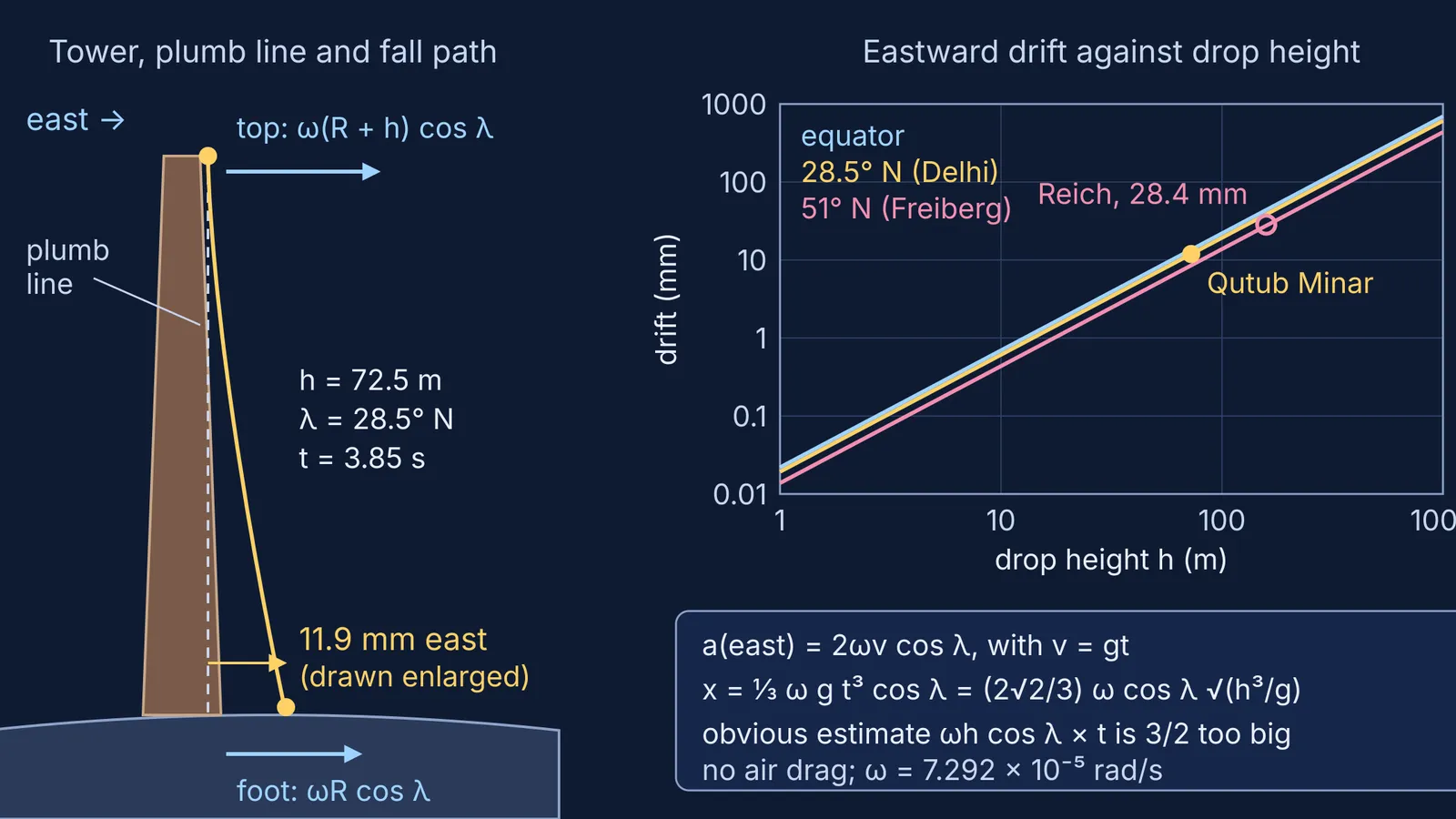
The Earth turns west to east once a sidereal day, ω = 7.292 × 10⁻⁵ rad/s. A point at latitude λ and distance r from the centre goes round a circle of radius r cos λ, so it moves east at ωr cos λ. That is why ISRO launches eastward from Sriharikota: the ground already carries the rocket east.
The top of a tower of height h is further from the axis than its foot. So the top moves east faster, by ωh cos λ. A stone let go at the top starts with that extra eastward speed. It seems natural to say: the stone keeps its head start, so it gets ahead of the foot by
ωh cos λ × t
where t is the fall time. That is the obvious estimate. It gives the right direction but the wrong size.
Why is the obvious estimate too big by 3/2?
The flaw is subtle. The extra speed ωh cos λ is not a lead over the tower. It is exactly the speed a point at the top needs to go round with the Earth. Watched from the tower, the stone starts at rest. It gets ahead only as it falls inward, to where the ground moves more slowly.
You can see the same thing with a spinning skater who pulls in her arms. As the stone moves closer to the Earth's axis, its angular momentum about the axis stays the same, so it turns a little faster than the Earth and slowly runs ahead.
In the frame that turns with the Earth, the bookkeeping is done by the Coriolis acceleration, 2ω × v. For a body falling straight down at speed v, it points east and has size
a(east) = 2ωv cos λ
You met this sideways push in the ball rolled across a turning merry-go-round. Here v = gt grows as the stone falls, so the push grows too. Integrate once for the eastward speed:
v(east) = ωgt² cos λ
and once more for the drift:
x = ⅓ ωg t³ cos λ
The obvious estimate, with h = ½gt², is ωh cos λ × t = ½ ωg t³ cos λ. The ratio is (1/3) ÷ (1/2) = 2/3. The eastward speed relative to the ground starts at zero and grows like t², and the average of t² over the fall is one third of its final value. Laplace (1803) and Gauss (1804) both found the 2/3 result, correcting an earlier estimate by Guglielmini, as Roberto Mantovani describes in a peer-reviewed history of the proofs of the Earth's rotation. For the same drift seen from the non-rotating frame, see Stirling in the American Journal of Physics.
Put t = √(2h/g) to write it in terms of the height:
x = (2√2/3) ω cos λ √(h³/g)
The drift grows as h^(3/2). It is zero at the poles, where the fall is along the axis, and largest at the equator. Because cos λ is positive in both hemispheres, the drift is east in both. There is also a much smaller drift towards the equator; at this level you can ignore it.
How far east would a stone dropped from the Qutub Minar land?
The Qutub Minar is 72.5 m tall and stands at about 28°31′ N, according to the Indira Gandhi National Centre for the Arts' documentation of the monument. Its engineering is in how the Qutub Minar was built. Take h = 72.5 m, λ = 28.5°, g = 9.81 m/s², and no air.
Fall time. t = √(2h/g) = √(2 × 72.5 ÷ 9.81) = 3.845 s.
Latitude factor. cos 28.5° = 0.879.
Drift. x = ⅓ × 7.292 × 10⁻⁵ × 9.81 × 3.845³ × 0.879 = 0.0119 m, about 11.9 mm east.
Units. (rad/s) × (m/s²) × s³ gives metres. Good.
The obvious estimate. The top moves faster by ωh cos λ = 7.292 × 10⁻⁵ × 72.5 × 0.879 = 4.65 mm/s. Times 3.845 s, that is 17.9 mm. And 11.9 ÷ 17.9 = 0.667, the factor 2/3.
At the moment it lands, the stone is moving east relative to the ground at 2ωh cos λ, about 9.3 mm/s, twice the obvious head start. It starts at zero and ends at twice the naive value, and the average works out to two thirds of it.
Some other cases from the same formula, all without air:
A 1 m drop at Delhi: 0.02 mm. You will never see it on a table.
A 100 m drop on the equator: 22 mm.
A 1,000 m vacuum drop at 13° N: about 68 cm, because x grows as h^(3/2).
Has anyone actually measured it?
Yes. In 1831 Ferdinand Reich dropped balls 106 times down the Drei-Brüder shaft of a mine at Freiberg in Saxony, a fall of 158.5 m, through a wooden tube that kept out draughts. Mantovani's paper reports his mean eastward drift as about 28.4 mm, against a predicted 27.5 mm. Our formula at 50.9° N gives 27.6 mm, the same within rounding.
Reich's result was a mean over many drops. Single drops scattered by much more than the effect, because tiny air currents and the wake behind the ball push it sideways at random. That is why the experiment needs a deep, still shaft and many repeats. In open air on a tower, wind would swamp 12 mm completely, and drag would also slow the fall.
Where does this fit in JEE and NEET physics?
The Coriolis term is beyond the JEE and NEET syllabus. Treat this as a Class 11 extension of relative motion and rotation: speeds that depend on distance from an axis, and a sideways acceleration you have to integrate. The related syllabus effect is how the spin lowers the apparent weight of a body at rest, covered in effective g at latitude.
If rotating frames feel slippery, the Concept Library covers relative motion and rotation concept by concept, and the Simulation Lab has interactive simulations for ideas that are easier to see than read.
Quick checklist
A body dropped in still air lands east of the plumb line, in both hemispheres.
Eastward Coriolis acceleration: 2ωv cos λ, with v = gt.
Drift x = ⅓ωgt³ cos λ = (2√2/3)ω cos λ √(h³/g).
The obvious estimate ωh cos λ × t is 3/2 too big: the eastward speed starts at zero.
Qutub Minar height, 72.5 m at 28.5° N: about 11.9 mm.
Reich, 1831, 158.5 m shaft: about 28.4 mm measured, 27.5 mm predicted.
Wind and drag are far larger than the effect in open air.