

On this page
What is effective gravity?
When you stand on Earth, two main factors determine how heavy you feel. True gravitation pulls you toward the planet's centre. However, because the Earth rotates, you move in a circle, creating an outward centrifugal force. The net result of these two forces is your effective gravity (g_eff).
Under the World Geodetic System 1984, sea-level gravity is about 9.780 m/s² at the equator and 9.832 m/s² at the poles 1. Part of this difference comes from the equatorial bulge, but Earth's rotation alone reduces the apparent downward acceleration by approximately 0.3%.
How does latitude affect effective g?
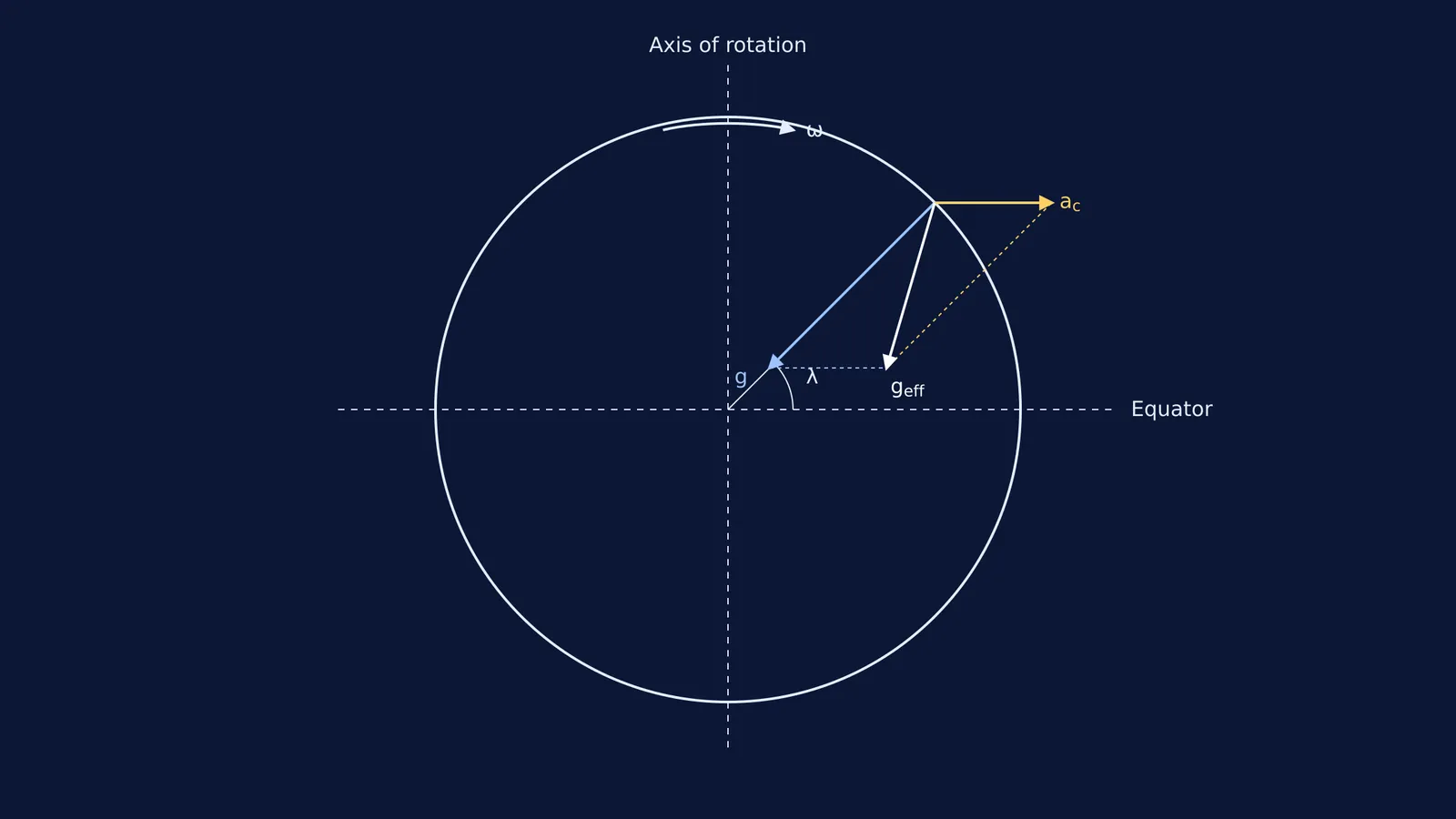
To find the exact effect of rotation, consider a point at latitude λ. As the Earth spins with angular velocity ω, this point travels in a circle. The radius of this circle (r) is not the full radius of the Earth (R), but rather r = R cos λ.
The centrifugal acceleration acting on an object at this latitude is a_c = ω²r = ω² R cos λ. This vector points perpendicularly outward from the axis of rotation.
Since gravity pulls toward the Earth's centre, we only care about the centrifugal acceleration's radial component—the part pointing directly away from the centre: Radial outward component = a_c cos λ = (ω² R cos λ) × cos λ = ω² R cos² λ.
Assuming the Earth is a perfect sphere, the effective gravity is the true gravity (g) minus this outward radial component: g_eff = g − ω² R cos² λ
At the poles (λ = 90°), cos 90° is 0, so rotation has no effect and g_eff = g. At the equator (λ = 0°), cos 0° is 1, so the outward force is at its maximum and g_eff = g − ω² R.
If you are reviewing gravitation for exams, you can trace the derivation of this formula step by step using the Fermi Concept Library.
Does a plumb line point to the centre of the Earth?
Because of the centrifugal force, the effective gravity vector (g_eff) does not point exactly toward the centre of the Earth unless you are standing exactly at the equator or one of the poles.
A plumb line—a string with a weight on the end used by builders to find the true vertical—hangs along the line of effective gravity. Since g_eff is the vector sum of true gravity pointing inward and centrifugal acceleration pointing outward from the axis, the resulting g_eff vector is slightly deflected away from the poles and toward the equator.
At middle latitudes, the effective vertical tilts away from the true centre. Because the Earth has bulged into an oblate spheroid precisely due to this rotation, the physical surface of the oceans remains perpendicular to g_eff. The ground feels flat, and a dropped object falls straight down relative to the floor, even though "down" is slightly off-centre.
Why would a 1.4-hour day make you weightless?
What happens if the Earth spins much faster? The angular velocity ω would increase, causing the subtracted centrifugal term (ω² R) to grow.
If the Earth spun so fast that g_eff = 0 at the equator, objects would lose all their apparent weight. Setting the equation to zero gives: g = ω² R ω = √(g / R)
The time taken for one full rotation (a day) would be the period T = 2π / ω: T = 2π √(R / g)
Using the Earth's radius R ≈ 6.37 × 10⁶ m and standard gravity g ≈ 9.81 m/s², this period works out to approximately 5,063 seconds, or 84.4 minutes (about 1.4 hours). This duration is known in physics as the Schuler period 2. If the Earth's day were only 1.4 hours long, the ground at the equator would effectively be moving at orbital velocity. Anything sitting on the equator would be in a continuous state of free-fall, hovering weightlessly just above the surface.
How do you calculate the difference?
Let's calculate the exact reduction in g at the equator due to our current 24-hour rotation 1. Earth's angular velocity is ω = 2π / (24 × 3600) ≈ 7.27 × 10⁻⁵ rad/s. The centrifugal term is ω² R = (7.27 × 10⁻⁵)² × (6.37 × 10⁶) ≈ 0.0337 m/s².
This means rotation reduces gravity at the equator by about 0.034 m/s² (roughly 0.3% of 9.8 m/s²). It is a small difference, but enough to make a measurable change in weight between the equator and the poles.
Vector addition in rotational systems is vital for physics. This principle finds the net force in a Simple pendulum string tension at any angle: mg cos θ + mv²/l. You can also explore how variations in g affect timekeeping in our guide to the Seconds pendulum: how its period changes with length and g. If you want to practice circular motion problems, the Fermi Problem Library has step-by-step solvers that explain the reasoning.


