On this page
Qutub Minar in Mehrauli, Delhi, has stood since the early 1200s in a city that shakes. A steep taper, a thick layered wall and a deep, wide base all help, and the tower has been repaired after earthquake damage. Here is how each part works, with numbers you can check.
Who built Qutub Minar, and how long did it take?
An IGNCA heritage record, based on the Archaeological Survey of India's inventory, says Qutubuddin Aibak is said to have built the first storey, Iltutmish the second, third and fourth, and Firoz Shah Tughlaq repaired the fourth and built the fifth. Engineers who studied the tower date the work from around 1200 to 1368 (Peña, Lourenço and Mendes, 2008). Each ruler added height to a tower already carrying its own weight.
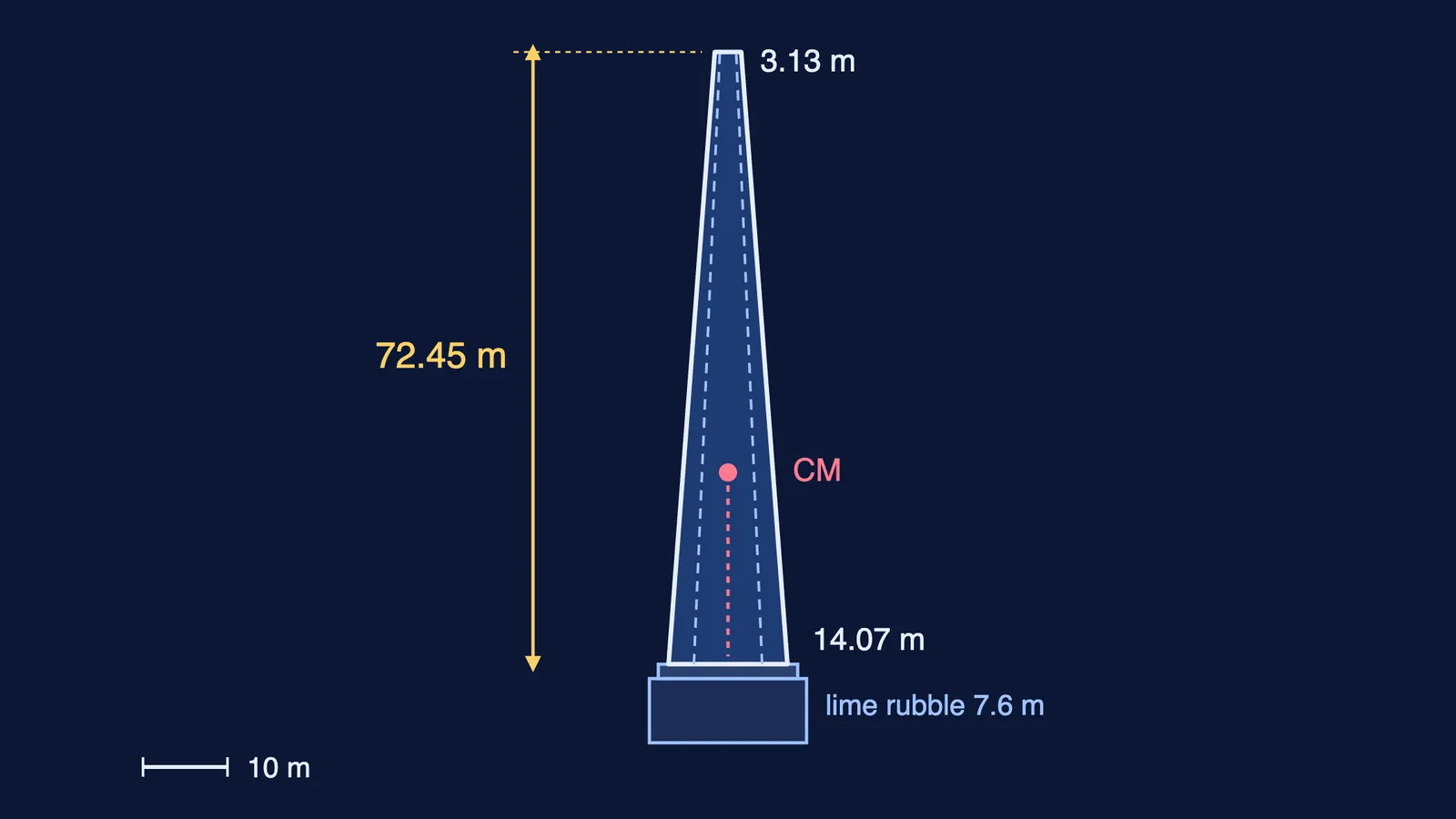
The same record gives the size. Qutub Minar is 72.5 m tall, with a diameter of 14.32 m at the base and about 2.75 m at the top, and 379 steps (IGNCA record). The 2008 study measured 72.45 m, 14.07 m and 3.13 m (Peña et al., 2008).
How is the tower put together inside?
It is not a solid stone pillar. The 2008 study describes an outer shell of three-leaf masonry: red and buff sandstone outside and Delhi quartzite inside in the first three storeys, white marble outside and red sandstone inside in the top two, and rubble stone packed between, held with iron dowels and a lime mortar (Peña et al., 2008). A central shaft runs up the middle, linked to the shell by the spiral staircase and 27 stone lintels.
The shell is about 3 m thick at the base and thins to 0.6 m at the top (Peña et al., 2008). That is the taper doing its job twice: less stone high up means less weight to carry and less mass to swing in an earthquake.
The flutes may do more than decorate. The first storey is a polygon of 24 facets with alternating angular and semicircular flutes, the second has semicircular flutes and the third angular ones again (IGNCA record). In general, ribs like these stiffen a wall, the same reason corrugated sheets bend less than flat ones.
What is under Qutub Minar?
The tower rests on a square ashlar platform about 1.7 m deep and 16.5 m a side, which sits on a lime-and-rubble layer about 7.6 m deep and 18.6 m a side (Peña et al., 2008). Each layer is wider than the one above, so the load spreads over more soil as it goes down.
The authors found the maximum stresses at the base were around 24% of the masonry's compressive strength (Peña et al., 2008). Crushing is not the danger. Shaking is.
Why hasn't Qutub Minar fallen in earthquakes?
Delhi lies in Indian seismic zone IV (Peña et al., 2008). In computer models shaken with simulated earthquakes matched to India's design code, the top two storeys took the worst of it: the shaking is amplified towards the top of a tall, slender tower. The authors note this matches history, as earthquake damage has been concentrated in the upper levels.
The repair record shows the same pattern. A major earthquake on 1 September 1803 badly damaged the tower; Major Robert Smith restored it in 1828 and added a cupola on top, which was taken down in 1848 and now stands on the lawn as "Smith's Folly" (Qutb Minar, Wikipedia). Today's buildings handle shaking differently, as our explainer on how earthquake-resistant buildings are made shows.
Is Qutub Minar tilting?
Slightly, and slowly. In 2016 the culture minister told the Rajya Sabha, citing the Survey of India, that "the mean rate of annual change in tilt is 3.5 seconds per year", and that the base had been made watertight so water does not seep into the foundation (Business Standard, 2016). An arc second is 1/3600 of a degree.
Try the maths yourself:
If that rate held for 100 years, the tilt would grow by 350 arc seconds, which is about 0.0017 radians.
Multiply by the height: 72.5 m × 0.0017 is about 0.12 m of extra lean at the top.
Now the toppling limit. Model the tower as a solid stone frustum with the study's radii (7.0 m at the base, 1.6 m at the top). Its centre of mass sits about 22.7 m up, under a third of the height, against 36 m for a straight cylinder.
It would only tip once the centre of mass passed the base edge, at roughly 17° (tan θ = 7.0 / 22.7). The tower is nowhere near that; cracking from shaking is the real risk.
The same centre-of-mass rule explains why double-decker buses don't topple. The Fermi Concept Library covers centre of mass, and the Fermi Simulation Lab has interactive simulations for ideas that are easier to see than read.
The iron pillar stands in the same courtyard; read why the Delhi iron pillar doesn't rust.