On this page
On a road that slopes sideways, a double-decker can look ready to fall over. It doesn't, because before a design is approved it has to be shown to survive a sideways tilt, either on a tilting platform or by calculation. Here is the physics, and a check you can do for any box-shaped vehicle.
What is the centre of gravity, and why does it decide toppling?
The centre of gravity (G) is the point where the whole weight of an object can be taken to act. For a uniform box it sits at the geometric centre; put heavy things on top and it moves up. Our explainer on finding the centre of gravity with a plumb line shows how to locate it for irregular shapes.
The toppling rule comes from torque. Draw a vertical line down from G. If it lands between the tyres, the weight turns the vehicle back onto all its wheels. If it lands outside the outer tyre, the weight turns the vehicle about that tyre's contact line and it rolls over.
What tilt test must a double-decker bus pass?
UN Regulation No. 107 says in paragraph 7.4.1 of Annex 3 that a bus must not pass the point of overturning when the surface it stands on is tilted to each side in turn to 28 degrees from the horizontal. For a double-decker, the passenger loads go on the upper-deck seats only. A low step may stop the wheels sliding sideways, and the regulation also allows a calculation instead of a physical tilt.
The UK's 1981 regulations for public service vehicles set the same 28 degrees for a double-decked vehicle loaded with upper-deck passengers only, and 35 degrees for a fully loaded single-decked vehicle, counting 63.5 kilograms as the weight of one person.
The calculation route in UN R107 must include the height of the centre of gravity, spring rates, tyre rates and the body's torsion resistance. That list is a clue: a real bus is not a rigid box. Springs and tyres squash on the low side, the body leans further than the platform, and G swings outwards, so a real bus can tip at a smaller angle than the box model below predicts.
At what angle would a box-shaped vehicle tip over?
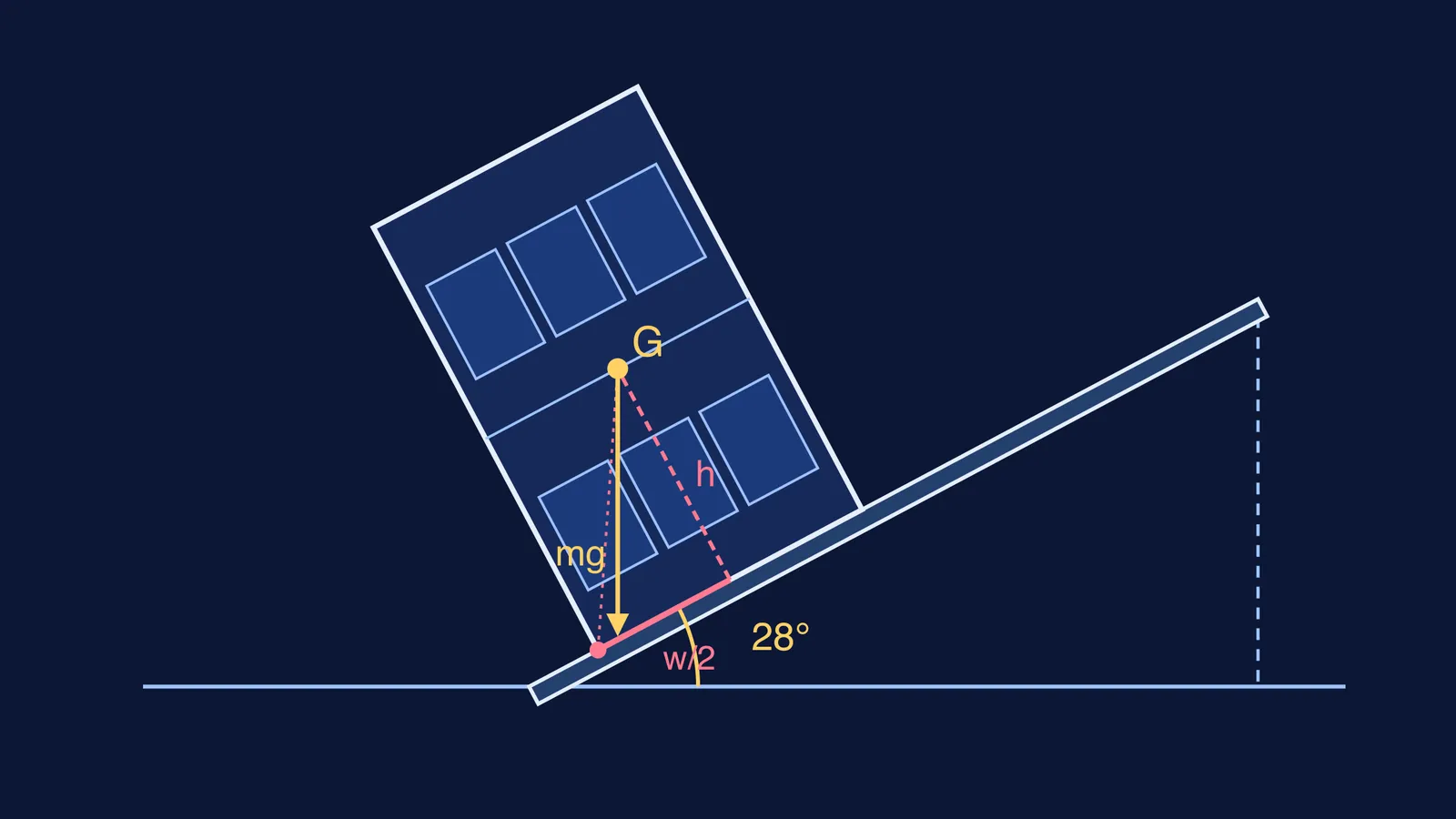
Model the vehicle as a rigid box on a platform tilted at angle θ, as in the diagram above. Let w be the track width (the distance between the outer tyre contact lines) and h the height of G above the platform, with G midway across.
Split the weight mg into mg sin θ along the slope and mg cos θ into it, then take torques about the low-side tyre edge:
Tipping torque: mg sin θ × h
Restoring torque: mg cos θ × w/2
The box tips when the first beats the second, that is when tan θ > (w/2)/h. So the critical angle is θc = tan⁻¹(w/2h). Mass cancels: a heavier box of the same shape tips at the same angle. If the vehicle could slide before it tips, you have a different problem, covered in our post on toppling versus sliding.
Would a sample box pass the 28 degree test?
Take a box with track width w = 2.0 m. These are round practice numbers, not the measurements of a real bus.
G at h = 1.5 m: tan θc = 1.0/1.5 = 0.667, so θc = 33.7°. It passes with 5.7° to spare.
Fill the top deck so G rises to h = 2.0 m: tan θc = 1.0/2.0 = 0.5, so θc = 26.6°. It fails.
Work backwards: to survive 28°, h can be at most 1.0/tan 28° = 1.0/0.532 = 1.88 m. In general, h ≤ 0.94w passes 28° and h ≤ 0.71w passes 35°.
The design lesson falls out of the formula: widen the track or lower G.
How does the tilt test relate to buses turning corners?
On a flat bend there is no tilt, but in the bus's own frame a pseudo force mv²/r acts sideways at G. The same torque balance gives tipping when v²/(rg) > (w/2)/h. So a rigid box that just survives a 28° tilt can take a sideways acceleration of up to g tan 28°, about 0.53g, before its inner wheels lift. Our post on why autos topple on sharp turns applies the same balance to a three-wheeler.
How can you practise toppling problems?
On any toppling question:
Mark G and the edge the body would tip about.
Draw the vertical through G (on a curve, the resultant of mg and the pseudo force).
Check whether it lands inside the base, then write tan θ = (w/2)/h.
If the force picture is what's missing, the Fermi Concept Library gives every concept in physics its own lesson and its place in the map. For practice, the Fermi Problem Library has worked problems with a step-by-step solver that explains the reasoning rather than printing an answer.