

On this page
If you have ever taken a sharp corner in an auto rickshaw, you have probably felt the vehicle tilt and held on tight. Three-wheeled vehicles are notoriously unstable during turns. While a car can corner aggressively without lifting a wheel, a three-wheeler operates on a much tighter margin.
The physics behind this comes down to circular motion, the centre of gravity, and a concept called the stability triangle.
What is the stability triangle of a three-wheeler?
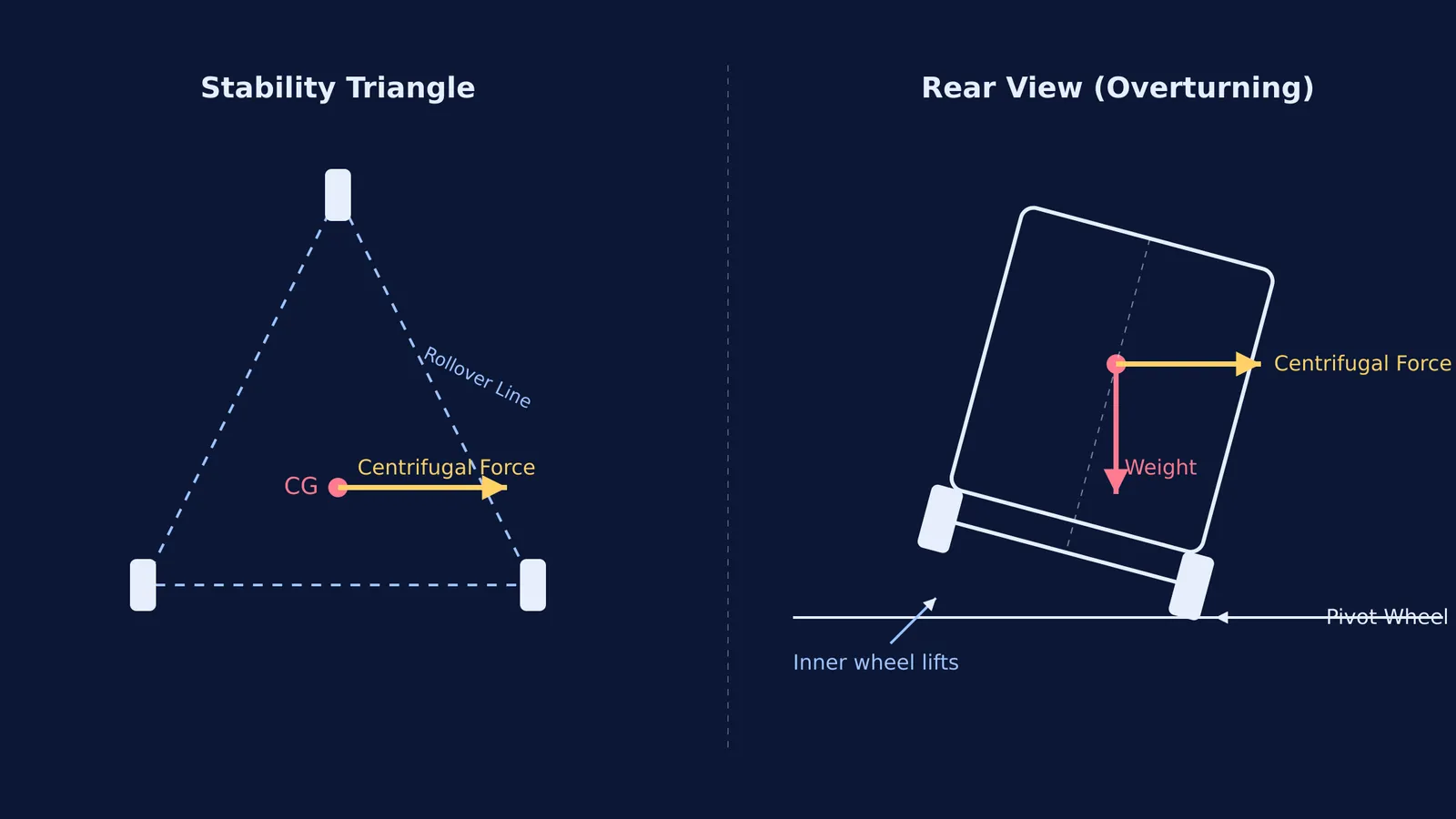
Any vehicle is stable as long as its centre of gravity (the point where its weight is balanced) stays directly above the area mapped out by its wheels.
For a car, this base is a rectangle. For an auto rickshaw—which has one wheel at the front and two at the back—this base is a triangle. The lines connecting the front wheel to the rear wheels are the rollover lines.
Because the front is narrow, the distance from the centre of gravity to the side rollover line is much shorter than it is in a car. If the centre of gravity shifts outside this triangle, the vehicle tips.
Why do three-wheelers topple on sharp turns?
When a vehicle takes a turn, it undergoes circular motion. From the frame of reference of the passengers inside, an outward pseudo-force called centrifugal force pushes them away from the centre of the turn. The magnitude of this force is Fc = mv²/r, where m is the mass of the vehicle, v is the velocity, and r is the radius of the turn.
This outward force acts on the vehicle's centre of gravity. Meanwhile, gravity pulls straight down. When the vehicle turns, the centrifugal force creates an overturning torque (a turning force) around the outer rear wheel. The vehicle's weight creates a restoring torque that tries to pull it back down.
If the overturning torque becomes larger than the restoring torque, the inner wheel lifts off the ground. Because the rollover line is diagonal in a three-wheeler, the centrifugal force does not have to push as hard to cross it. A high centre of gravity and a narrow base let the turning force tip the vehicle easily.
If you struggle to picture how these forces balance, you can test changing the track width and speed yourself in the Fermi Simulation Lab to see exactly when the inner wheel lifts.
How does track width affect the rollover threshold?
Engineers measure stability using the rollover threshold, which is the lateral acceleration required to tip the vehicle.
Research on vehicle dynamics shows that narrow three-wheelers typically reach their rollover limit at lateral accelerations as low as 0.2g to 0.3g (Vehicle System Dynamics). For comparison, standard four-wheeled passenger cars often withstand 0.6g to 0.8g before wheel lift occurs.
Because the track width (the distance between the two rear wheels) is narrow and the engine and passengers sit high up, the centre of gravity is elevated. The Static Stability Factor (SSF) is defined as half the track width divided by the height of the centre of gravity. A higher centre of gravity directly lowers the SSF, meaning a larger overturning torque for the same speed.
How do you solve toppling problems for the JEE?
In physics exams like the JEE, you will often need to calculate the maximum safe speed for a turning vehicle. The steps are always the same:
Draw the free-body diagram: Identify the centre of gravity. Draw the weight (mg) acting downwards and the centrifugal force (mv²/r) acting horizontally outwards.
Find the pivot: The vehicle will always tip around the outer wheel.
Calculate the torques:
Overturning torque = Centrifugal force × Height of the centre of gravity (h).
Restoring torque = Weight × Distance from the centre of gravity to the pivot point horizontally (x).
Set the limit: At the exact moment of toppling, the normal reaction on the inner wheel is zero, and the two torques are equal:
(mv²/r) × h = mg × x
From this, you can find that the maximum safe speed is v = √(xrg/h).
This formula shows why a wider base (larger x) and a lower centre of gravity (smaller h) allow for faster, safer turns. If you get stuck applying this to non-uniform objects, the Fermi Problem Library has worked examples that explain the reasoning rather than just printing the final speed. Fermi's AI tutor can also help you draw the figure and check your understanding step-by-step.
Understanding this torque balance is key to solving mechanics problems. You can read more about rotational motion: five common JEE mistakes and their fixes, or explore learning torque and rotation with a simulation: 3 predictions. If the mass is distributed unevenly, as in a loaded vehicle, check our guide on finding the centre of mass of a rod with variable density.


