

On this page
In rotational motion, intuition often fails, because torque, moment of inertia and angular momentum all depend on where mass sits. A simulation lets you change one thing at a time and watch. But watching alone is not enough.
In a study of Harvard physics students, Crouch, Fagen, Callan and Mazur (American Journal of Physics, 2004) found that students who passively watched classroom demonstrations understood the underlying concepts no better than students who did not see them at all, while students who predicted the outcome first showed significantly greater understanding. So each experiment below starts with a prediction you write down before you run it.
What do torque and moment of inertia actually mean?
Torque is the turning effect of a force, with magnitude τ = rF sin θ, where r is the lever arm and θ the angle between the position vector and the force (OpenStax University Physics, section 12.1).
Moment of inertia is the rotational version of mass: I = Σmr², summed over every bit of mass, so it depends on the chosen axis (OpenStax, section 10.5).
Angular momentum L = Iω is conserved when there is no net external torque about the axis (OpenStax, section 11.3).
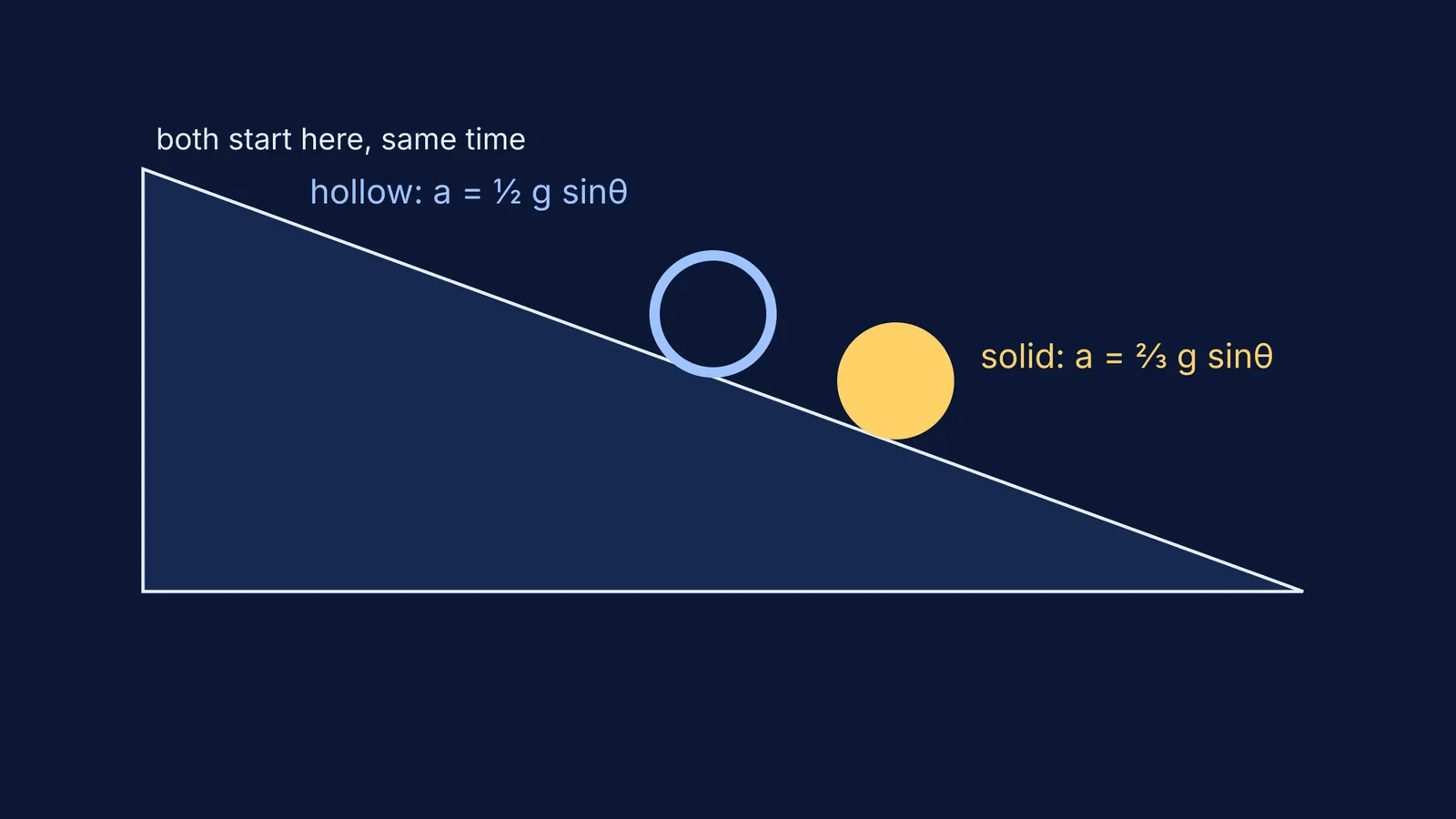
Which rolls down a ramp faster, a solid or a hollow cylinder?
Predict first: a heavy hollow pipe and a light solid rod of different radius roll down the same ramp from rest. Which reaches the bottom first? Does doubling the mass of either one change the answer?
For any object rolling without slipping, the acceleration is a = mg sin θ / (m + I/r²) (OpenStax, section 11.1). A solid cylinder has I = mr²/2 and a thin-walled hollow one has I = mr², per the same section, so m and r cancel out of both.
Worked example: take a 2 m ramp at 30°, with g = 9.8 m/s².
Solid cylinder: a = (2/3)g sin 30° = 3.27 m/s², so t = √(2L/a) = √(4/3.27) ≈ 1.11 s.
Hollow cylinder: a = (1/2)g sin 30° = 2.45 m/s², so t = √(4/2.45) ≈ 1.28 s.
As long as both roll without slipping, the solid one wins every time. In the hollow cylinder all the mass sits at the rim, so more of the falling energy goes into spinning and less into moving down the ramp. Change the mass or radius in the simulation and the times should not budge. For the friction side of this, see our guide to rolling without slipping on inclines.
Why does a skater spin faster when pulling their arms in?
OpenStax uses the spinning figure skater to show conservation of angular momentum (section 11.3). Here is a version with numbers.
Predict first: a skater spinning at 2 revolutions per second pulls their arms in. Does the spin speed up, slow down or stay the same? What happens to the kinetic energy?
The ice exerts almost no torque about the vertical axis, so Iω stays the same. Suppose, as an illustrative example, I drops from 4.0 kg m² with arms out to 1.6 kg m² with arms in. Then ω rises from 2 to 2 × 4.0/1.6 = 5 revolutions per second.
The second half of the prediction is where most students slip. Rotational kinetic energy is L²/2I, so with L fixed it goes up by the factor I/I′, here 2.5 times. OpenStax explains that the extra energy comes from the work the skater does pulling the arms inward. Angular momentum is conserved; kinetic energy is not. More worked cases are in our post on spinning skaters and discs.
How do you balance a seesaw with two different weights?
For balance, the net torque about the pivot must be zero (OpenStax, section 12.1).
Predict first: a 30 kg child sits 2 m from the pivot of a light, centred plank. Where must a 40 kg child sit on the other side?
Taking torques about the pivot: 30g × 2 = 40g × x, so x = 1.5 m. Notice that g cancels. The same seesaw balances on the Moon.
Now push the simulation further: move the pivot off-centre on a plank that has mass of its own. The plank's weight acts at its centre and adds its own torque. Our torque and equilibrium guide for ladders and beams works through it.
How should you use a rotation simulation to study?
Use this loop for each experiment:
Write your prediction and one line of reasoning before you touch anything.
Change one variable only: mass, radius, shape, or distance from the axis.
If the result surprises you, write down which idea you had wrong.
Finish with the formula, and check that it predicts what you saw.
For ideas that are easier to see than to read, the Fermi Simulation Lab has interactive simulations you can change as they run, so you can test a prediction and watch the result straight away.


