On this page
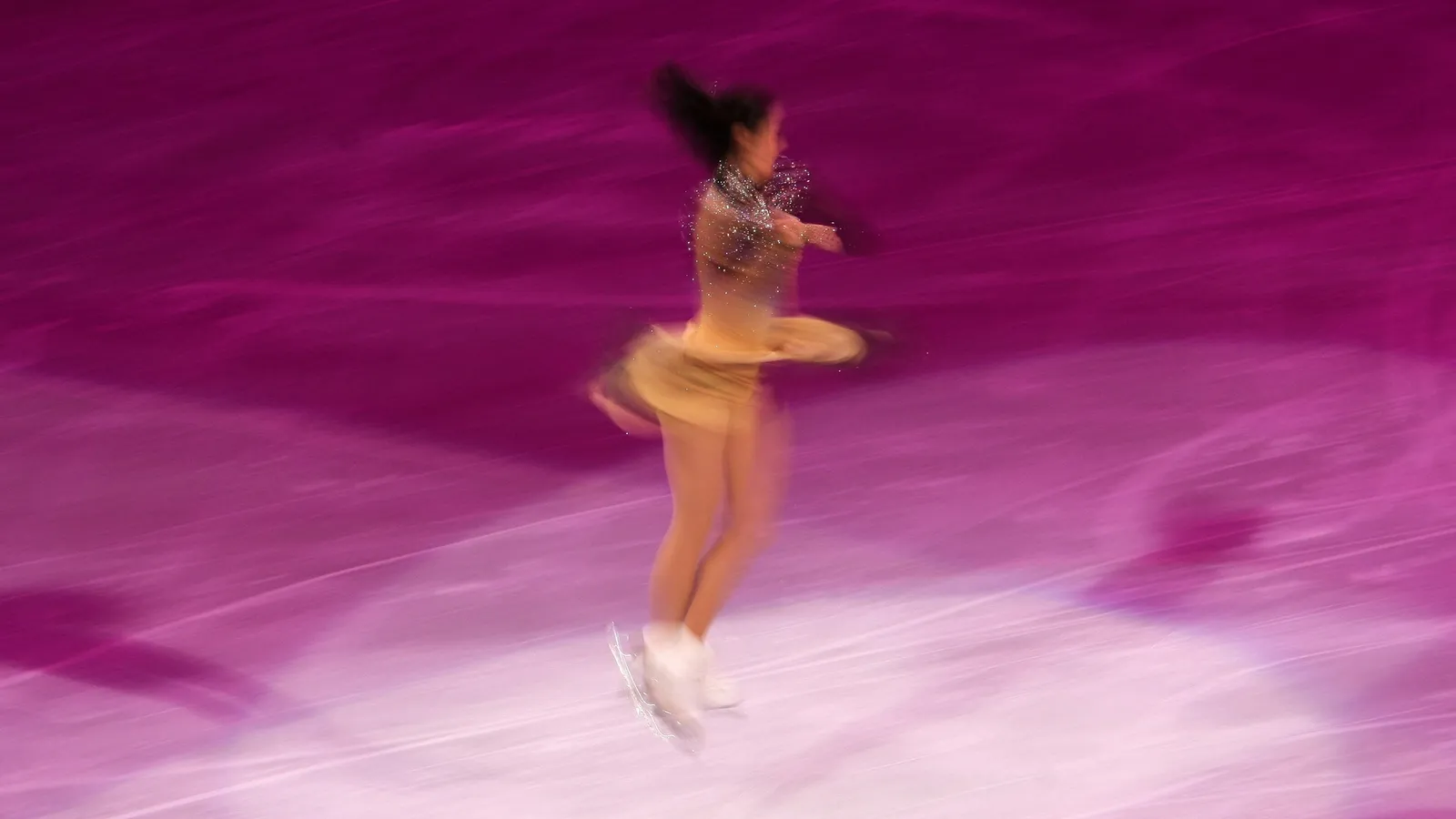
A skater pulls in her arms and spins faster. A child jumps onto a turning merry-go-round and it slows down. A bullet hits a hanging rod and sets it swinging. These are all the same law, and JEE questions on it are usually quick once you know which quantity to conserve and about which axis. This post gives you the rule, four worked examples and the traps.
When is angular momentum conserved?
For rotation about a fixed axis, the angular momentum is L = Iω, and the rate of change of L equals the net external torque about that axis. So if the net external torque about the axis is zero, Iω is constant.
NCERT's rotational motion chapter suggests trying it yourself: sit on a swivel chair with your arms folded and feet off the ground, have a friend spin you, then stretch your arms out. Your angular speed drops; fold them back and it rises. Stretching your arms increases I, so ω must fall to keep Iω the same. NCERT notes that circus acrobats, divers, skaters and dancers performing a pirouette use the same principle.
OpenStax University Physics explains why it works on ice: the friction between skates and ice is small and acts very close to the axis, so the torque is negligible and the skater can spin for a long time.
The JEE (Main) 2026 syllabus lists "conservation of angular momentum and its applications" in Unit 5. The JEE (Advanced) 2026 syllabus also lists collisions of point masses with rigid bodies.
Worked example 1: the skater
A skater spins at 2 revolutions per second with arms out, moment of inertia 4.0 kg m². She pulls her arms in, reducing I to 1.6 kg m². Find her new spin rate.
Conserve angular momentum: 4.0 × 2 = 1.6 × ω₂.
ω₂ = 8 / 1.6 = 5 revolutions per second.
You can keep ω in rev/s here because the units cancel. Now compare kinetic energy, K = ½Iω² = L²/(2I). With L fixed, K is inversely proportional to I, so K rises by a factor of 4.0/1.6 = 2.5. The extra energy comes from the work her muscles do pulling her arms inward.
Worked example 2: two discs joined together
A disc with I = 0.2 kg m² spins at 10 rad/s. A second disc, I = 0.3 kg m², initially at rest, is dropped onto it on the same axle, and they turn together.
Angular momentum before: 0.2 × 10 = 2 kg m²/s.
After: (0.2 + 0.3)ω = 2, so ω = 4 rad/s.
Kinetic energy before: ½ × 0.2 × 10² = 10 J. After: ½ × 0.5 × 4² = 4 J.
So 6 J is lost to friction between the discs as they come to the same speed. This is the rotational version of a perfectly inelastic collision.
Worked example 3: a child jumps onto a merry-go-round
A merry-go-round is a uniform disc of mass 100 kg and radius 2 m, turning at 1 rad/s. A 40 kg child running straight toward the centre (so with no angular momentum about the axis) jumps onto the rim.
Disc: I = ½MR² = ½ × 100 × 2² = 200 kg m².
Child at the rim, treated as a point mass: I = mR² = 40 × 4 = 160 kg m².
Conserve L: 200 × 1 = (200 + 160)ω, so ω = 200/360 ≈ 0.56 rad/s.
If the child had been running along the rim's direction, her angular momentum mvR would have to be added on the left side.
Worked example 4: a bullet hits a hinged rod
A uniform rod of mass 2 kg and length 1 m hangs from a hinge at its top end. A 20 g bullet moving horizontally at 100 m/s hits the bottom end and sticks. Find the rod's angular speed just after.
The hinge exerts a large force during the impact, so linear momentum is not conserved. But that force acts through the hinge, so its torque about the hinge is zero. Conserve angular momentum about the hinge.
Bullet's angular momentum about the hinge: mvL = 0.02 × 100 × 1 = 2 kg m²/s.
Moment of inertia after: rod about its end, ML²/3 = 2/3 ≈ 0.667, plus bullet mL² = 0.02, total ≈ 0.687 kg m².
ω = 2 / 0.687 ≈ 2.9 rad/s.
Choosing the hinge as the axis is the whole trick.
What mistakes do students make?
Conserving kinetic energy in a sticking or arm-pulling problem.
Forgetting that a point mass at distance r adds mr² to the moment of inertia.
Conserving linear momentum when a hinge or axle acts, as in example 4.
Choosing an axis about which an external torque acts, such as the centre of a rod when a hinge is at its end.
Taking the angular momentum of a particle in a straight line as zero. It is mvd about any point at perpendicular distance d from its path.
The parallel with linear momentum in collisions is close, and worth noticing. For the errors that come from moment of inertia itself, see our post on rotational motion mistakes.
A practice routine for angular momentum
For each problem, name the axis and say why the external torque about it is zero.
Solve two changing-shape problems (skaters, swivel chairs), two sticking problems (discs, merry-go-rounds) and two particle-hits-body problems.
In every one, also work out the kinetic energy before and after, and say where any difference went.
Redo example 4 with the bullet hitting the rod's midpoint and compare.
To watch how spin rate changes as mass moves inward, the Fermi Simulation Lab has interactive simulations for ideas that are easier to see than read.
Try the swivel-chair experiment from NCERT today, then calculate roughly how much your spin rate should change.