On this page
You can run this experiment at a desk with a magnifying glass, a ruler and a printed page. Lay the lens flat on the text, lift it slowly, and watch. The letters grow, swell until the view goes blurry, then come back upside down. Each stage is the lens formula at work.
What happens as you lift a magnifying glass off the page?
First find the focal length, f: focus a distant window onto paper and measure the lens-to-paper distance. Never look at the Sun through the lens.
Then run the experiment:
Put the lens flat on the print, eye close to the lens.
Lift it in small steps, measuring u, the lens-to-page distance.
At each step, compare one letter with letters outside the lens, and note upright or inverted.
Carry on past f until the image flips; move your eye back to see it sharply.
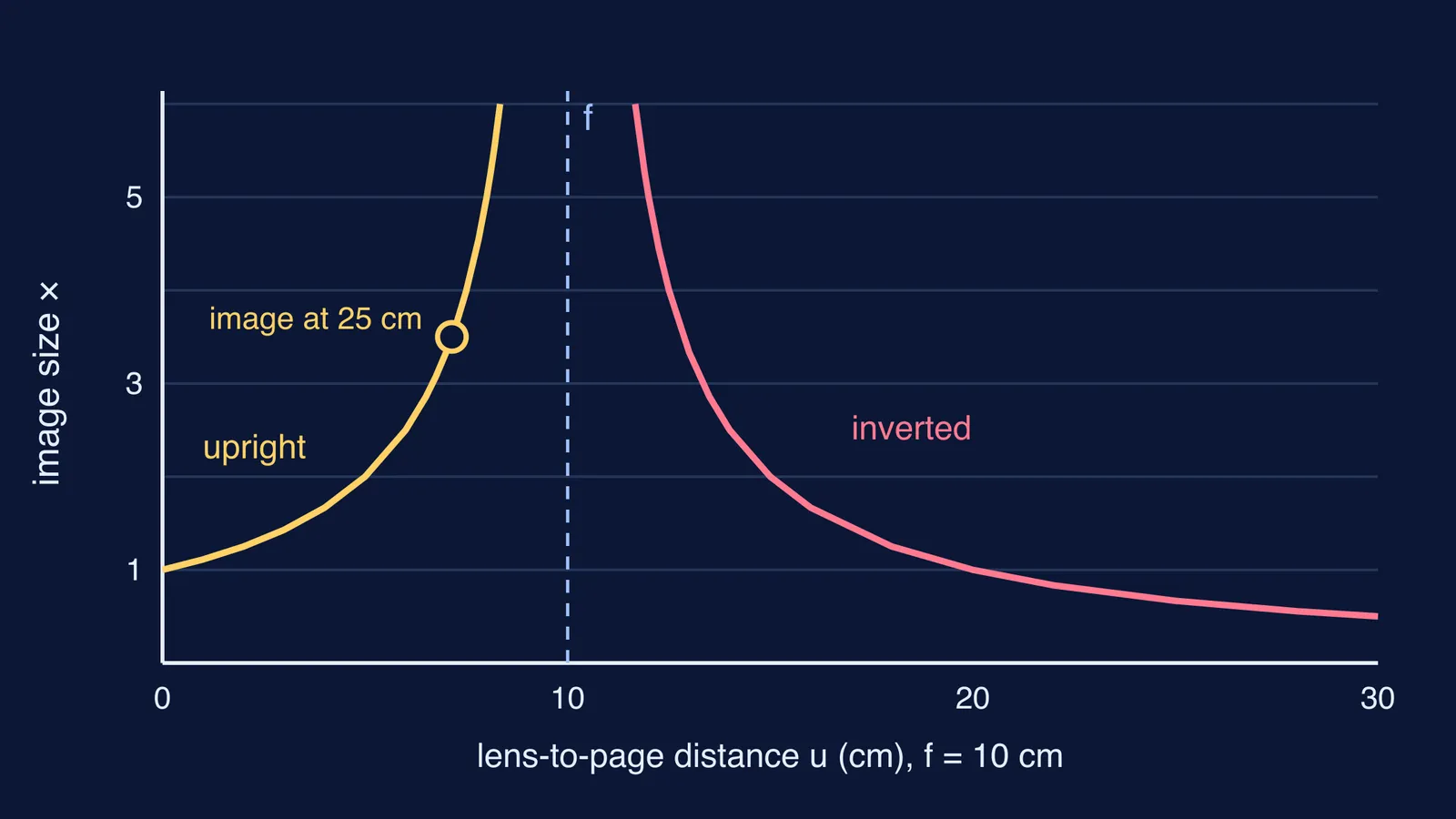
Here are the predicted readings for a lens with f = 10 cm, worked out with the thin-lens equation and m = −di/do from OpenStax University Physics, section 2.4. A negative image distance means a virtual image on the same side as the page.
u = 2 cm: image at −2.5 cm, 1.25 times, upright
u = 6 cm: image at −15 cm, 2.5 times, upright
u = 7.1 cm: image at −25 cm, 3.5 times, upright
u = 8 cm: image at −40 cm, 5 times, upright
u = 9 cm: image at −90 cm, 10 times, upright
u = 10 cm: no image forms; the view is a blur
u = 15 cm: image at +30 cm, 2 times, inverted
u = 20 cm: image at +20 cm, same size, inverted
A real lens has thickness, so your readings will drift a little; the pattern should match.
Why does the image grow, then blur, then flip?
The thin-lens equation is 1/do + 1/di = 1/f, and the magnification is m = −di/do, where a positive m means upright and a negative m means inverted (OpenStax, section 2.4). Your school textbook may write it with a different sign convention; the physics is the same.
The same equations sort the cases. Inside f, the image is virtual, upright and magnified. At f, rays leave parallel and no image forms. Between f and 2f, it is real, inverted and magnified; beyond 2f, real, inverted and smaller. For all six cases drawn out, see convex lens image positions for Class 10.
How far should you hold a magnifying glass for the biggest image?
The list can mislead you. At 9 cm the image is 10 times larger but 90 cm away, so it does not look ten times bigger. Your eye judges the angle the image fills, which is why a magnifier is rated by angular magnification, "the ratio of the angle θimage subtended by the image to the angle θobject subtended by the object" (OpenStax, section 2.7).
The near point is the closest distance at which your unaided eye sees sharply, and OpenStax takes it as 25 cm (OpenStax, section 2.7). The magnifier is compared with the page held there.
With the lens close to your eye, a closer page looks bigger, but the virtual image must stay at least 25 cm away to be sharp. So the biggest clear view comes when the image sits exactly at the near point, at u = 25f/(f + 25). For f = 10 cm that is u ≈ 7.1 cm, the point marked on the graph above.
Image at the near point, lens close to the eye: M = 1 + 25 cm/f (OpenStax, section 2.7).
Image at infinity, page at the focal point, relaxed eye: M = 25 cm/f (same source).
For the 10 cm lens that is 3.5 times at best, or 2.5 times with a relaxed eye. The OpenStax worked example finds that 10 times needs a focal length of about 2.8 cm, so a strong magnifier needs a very short focal length.
The near point is not the same for everyone. It moves farther away with age, which is part of why people need reading glasses after 40.
How do you turn the readings into a lab record?
A short recording sheet makes the link to the formula visible:
Columns: u, predicted size, observed size, upright or inverted, sharp or blurry.
Before each step, predict the size from m = f/(f − u).
Plot observed size against u: you should see two branches either side of f, as in the graph.
Circle the biggest sharp reading and check it against 25f/(f + 25).
If size on the page and size to the eye still feel alike, read linear magnification vs magnifying power.
The Fermi Simulation Lab has interactive simulations for ideas that are easier to see than to read, so try your predictions there first. If one stage still does not make sense, Fermi's AI tutor can draw the figure and work through it with you.
Then pick up the lens and see whether your table agrees.