

On this page
Class 12 ray optics uses the word magnification for two different quantities. One compares sizes, the other compares angles at your eye, and an answer worked out for one does not answer a question about the other.
What is linear magnification?
Linear magnification is the height of the image divided by the height of the object, m = h′/h, which for a lens also equals v/u (NCERT Class 12 Physics, Chapter 9). It is a statement about real sizes. A 2 cm object with a 6 cm image has m = 3, and a minus sign tells you the image is inverted.
What is magnifying power?
How big something looks depends on the angle it makes at your eye, not on its actual size. OpenStax puts it directly: "The apparent size of an object perceived by the eye depends on the angle the object subtends from the eye" (OpenStax University Physics Volume 3, section 2.7). Magnifying power, also called angular magnification, is the angle subtended at the eye by the final image divided by the angle the object subtends without the instrument (same source).
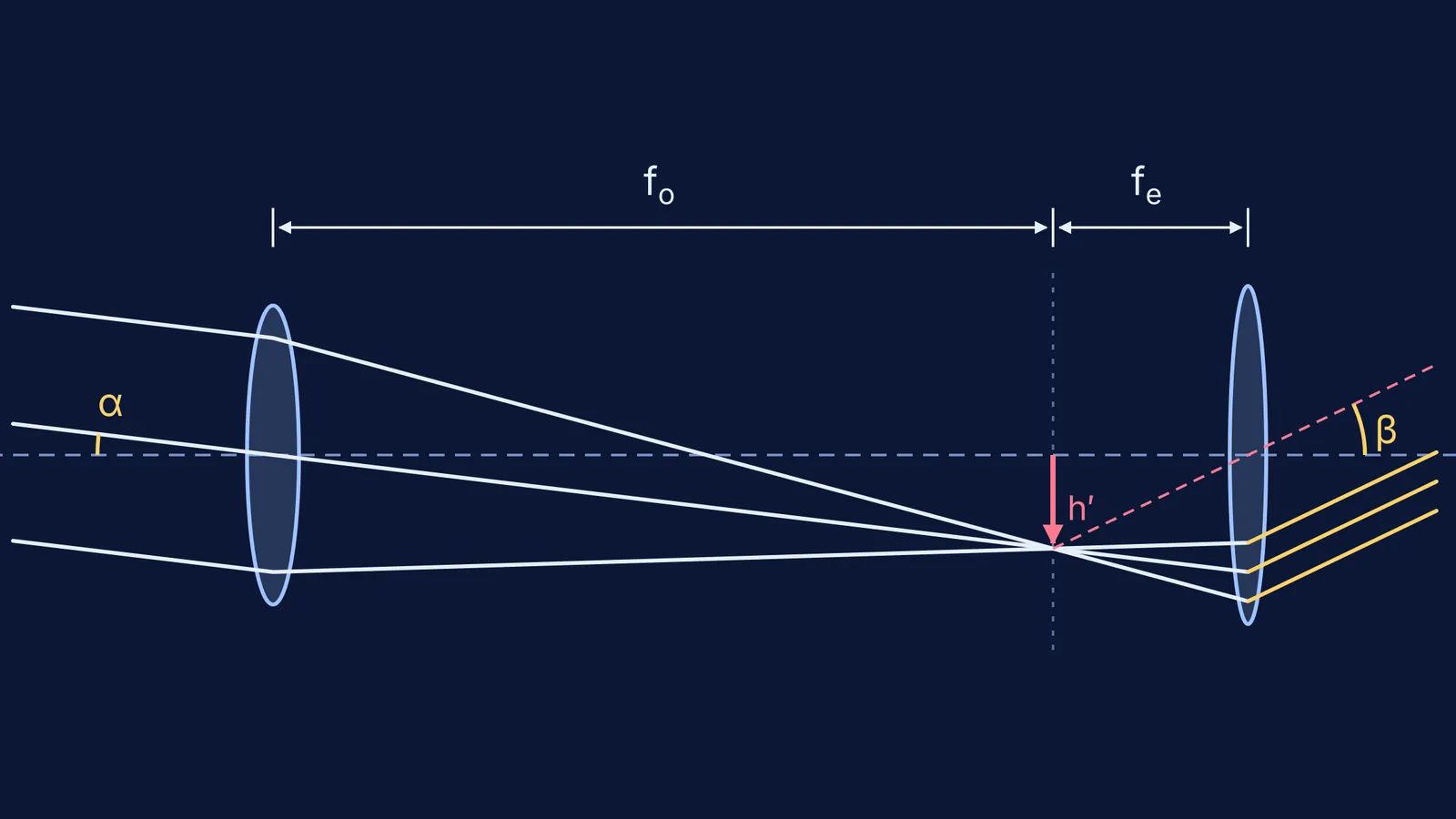
That second angle needs a fixed reference. For a magnifying glass or microscope, the object is imagined at the near point, D ≈ 25 cm, the closest distance the unaided eye sees clearly. This gives NCERT's results for a simple microscope: m = 1 + D/f with the image at the near point, and m = D/f with the image at infinity (NCERT Chapter 9, section 9.7). For a telescope, NCERT defines magnifying power as the angle β subtended at the eye by the final image divided by the angle α the object subtends at the lens or eye, which works out to m ≈ fo/fe.
Why are telescopes rated by angle, not size?
Because a telescope's image is far smaller than the thing you are looking at. Take NCERT's Exercise 9.14: an observatory refractor with an objective of focal length 15 m and an eyepiece of focal length 1.0 cm, pointed at the Moon, whose diameter is 3.48 × 10⁶ m and orbital radius 3.8 × 10⁸ m (NCERT Chapter 9 exercises).
Angle the Moon subtends at your eye: α = 3.48 × 10⁶ ÷ 3.8 × 10⁸ ≈ 9.2 × 10⁻³ rad, about half a degree.
Size of the image the objective forms at its focal plane: h′ = fo × α = 15 m × 0.0092 ≈ 0.14 m, about 14 cm across.
Linear magnification of that image: 0.14 m ÷ 3.48 × 10⁶ m ≈ 4 × 10⁻⁸.
Magnifying power: fo/fe = 1500 cm ÷ 1.0 cm = 1500.
Same telescope, two numbers: a linear magnification far below 1 and a magnifying power of 1500. Only the second describes what you see. In normal adjustment the final image is at infinity, so h′/h for the final image is not even a finite number.
NCERT's own illustration: with fo = 100 cm and fe = 1 cm, m = 100, so two stars 1′ apart appear 100′, about 1.67°, apart. Magnifying power is not the whole story, though: NCERT notes that light-gathering power and resolving power both depend on the objective's diameter. Our explainer on resolving power of microscopes and telescopes covers that side.
Can the two numbers differ for a magnifying glass too?
Yes, and NCERT builds Exercises 9.22 to 9.24 around it, noting they help you "clearly understand the difference between magnification in absolute size and the angular magnification (or magnifying power) of an instrument" (NCERT Chapter 9 exercises). In 9.22, a card ruled into 1 mm² squares sits 9 cm from a lens of focal length 9 cm held close to the eye. The card is at the focus, so the image goes to infinity and h′/h has no finite value. The magnifying power is finite: each square subtends h/9 through the lens against h/25 at the near point, so the ratio is 25/9 ≈ 2.8.
How do you avoid mixing them up in exams?
Before you pick a formula:
Read the noun. Size of the image, height, or magnification produced by a lens or mirror means h′/h or v/u, sign included.
Magnifying power or angular magnification means an angle ratio, β/α.
For a magnifier or microscope, the reference is the object seen at the near point, D = 25 cm, unless the question says otherwise (NCERT Chapter 9).
For a telescope in normal adjustment, m = fo/fe and the tube length is fo + fe.
If the final image is at infinity and you calculated a linear magnification, stop: you used the wrong quantity.
To see the angles change, build a refracting telescope in a simulation, then practise with magnifying power of microscopes and telescopes, worked step by step.
If the idea of a subtended angle is the shaky part, the Fermi Concept Library gives each concept in physics its own lesson and shows where it sits in the map. For practice, the Fermi Problem Library has worked problems with a step-by-step solver that explains the reasoning rather than printing an answer.


