

On this page
A telescope is just two convex lenses in a tube, yet it is often learned as a formula copied from the board. Build one in a ray simulation, with parallel light from a distant star, and you can make a prediction, move a lens and see if you were right. Here is the physics in three short answers, then four predictions to test.
How does a refracting telescope magnify?
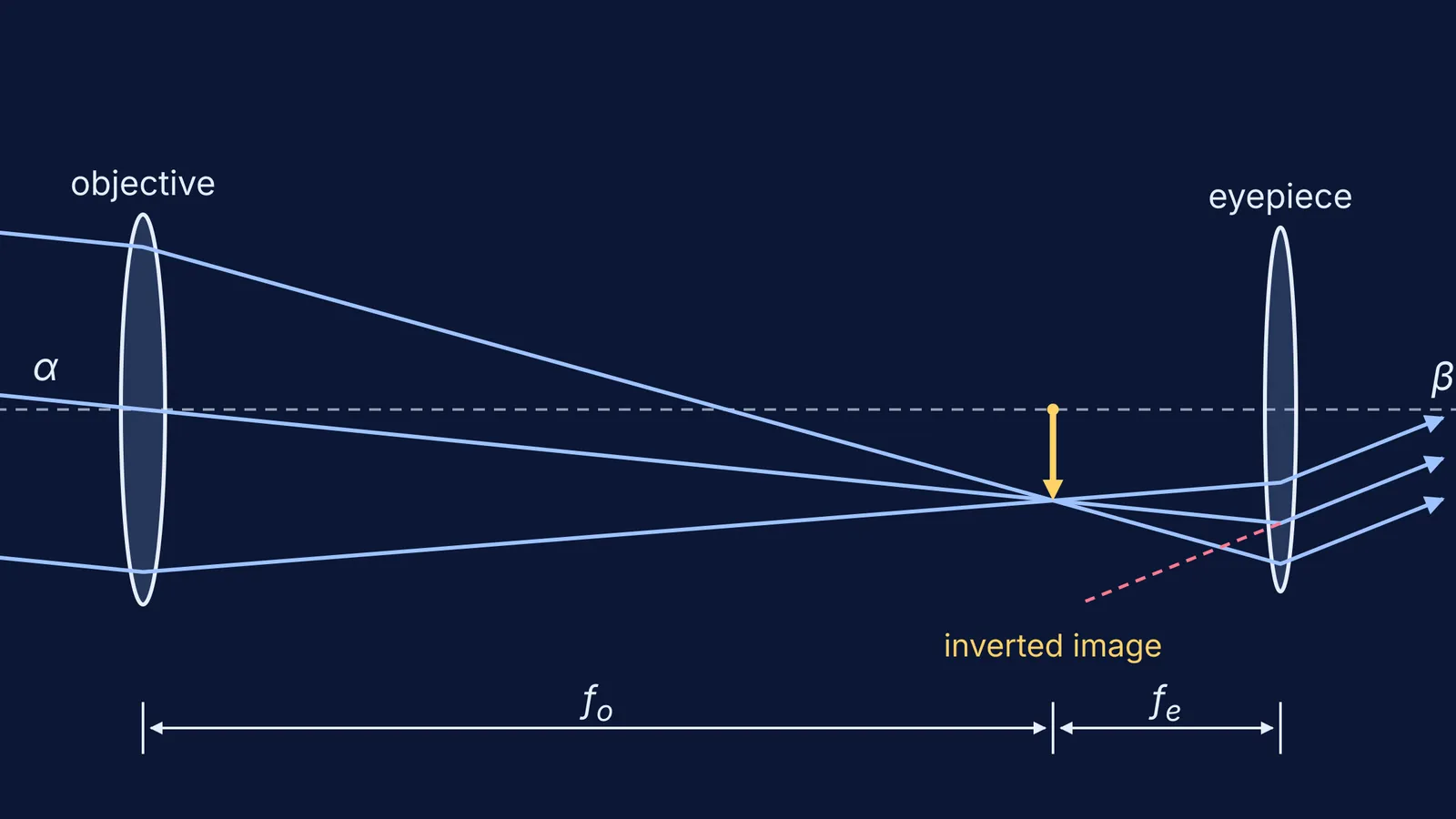
The NCERT Class 12 Physics chapter Ray Optics and Optical Instruments (section 9.7.2) describes it in two steps. Light from a distant object enters the objective, a lens with a long focal length and a much larger aperture than the eyepiece, and forms a real image inside the tube at the objective's second focal point. The eyepiece, a lens with a short focal length, then magnifies that image, much like a magnifying glass.
A telescope cannot make the Moon bigger. What it changes is the angle the image covers at your eye. NCERT defines the magnifying power as the ratio of the angle β that the final image covers at the eye to the angle α that the object covers, and shows that this ratio is m = fo/fe (NCERT, section 9.7.2).
The ray diagram above shows why. Call the height of the first image h. The objective makes it with h ≈ fo × α, and the eyepiece, held one focal length from it, sends the light out at β ≈ h / fe. Divide one by the other and h cancels, leaving fo/fe.
How long should the telescope tube be?
In normal adjustment the final image is at infinity, so you can view it with a relaxed eye. For that, the first image must sit at the focal point of the objective and at the focal point of the eyepiece at the same time. That means the two lenses are fo + fe apart, which NCERT gives as the length of the telescope tube (NCERT).
Why is the image upside down?
Look at where the rays cross. Light from a star above the axis comes in heading slightly downward, passes through the objective and meets below the axis in the focal plane. So the first image is already inverted. The eyepiece magnifies that image but does not flip it back, so the final image is inverted too. HyperPhysics gives the angular magnification as −fo/fe, where the minus sign records the inversion, and notes that viewing stars upside down is no problem.
On the ground it is a nuisance, so NCERT notes that terrestrial telescopes have, in addition, a pair of inverting lenses to make the final image erect (NCERT).
What can you test in a telescope simulation?
Set up two convex lenses on one axis and a beam of parallel rays coming in at a small angle. Using the NCERT results above, write each prediction down before you move anything.
Tube length. Use fo = 50 cm and fe = 5 cm. Predict the spacing at which the rays leave the eyepiece parallel to each other: 55 cm. Then slide the eyepiece 2 cm either way and predict whether the rays leaving it spread out or come together.
Magnification. With the lenses 55 cm apart, predict m = 50/5 = 10, so the rays should leave at about ten times the angle they came in at (for small angles). Swap in a 2.5 cm eyepiece. Predict both the new magnification (20) and the new tube length (52.5 cm).
Swap the lenses. Put the 5 cm lens in front and the 50 cm lens behind. Predict m = 5/50 = 0.1. The telescope now shrinks the view.
Inversion. Tilt the incoming beam so it comes from above the axis. Predict where the first image forms (below the axis) and which way the rays leaving the eyepiece tilt.
If any prediction fails, ask which step of the derivation the simulation broke, not which number to change. For a warm-up, try our guide to common ray diagram mistakes and how to get feedback on them or this single-lens image formation simulation.
You can run experiments like these in the Fermi Simulation Lab, which has interactive simulations for ideas that are easier to see than to read.
A worked example from NCERT
NCERT Exercise 9.13 describes a small telescope with an objective of focal length 144 cm and an eyepiece of focal length 6.0 cm (NCERT exercises).
Magnifying power in normal adjustment: m = fo/fe = 144/6 = 24.
Separation of the lenses: fo + fe = 144 + 6 = 150 cm.
The final image is inverted, because nothing in a two-lens telescope turns it back.
Notice the trade-off: a longer fo raises m but also makes a longer tube. A compound microscope uses the same two-lens idea for small objects close up; see our guide on how to focus a compound microscope.
If you get the formula right but your numericals still come out wrong, the Fermi Problem Library has worked problems with a step-by-step solver that explains the reasoning rather than printing an answer.


