

On this page
Two stars close together in the sky can look like one blob of light, however much you magnify them. Whether you see two points or one depends on the instrument's resolving power, and in optics that comes down to two short formulas.
What limits the resolving power of a microscope or telescope?
Light spreads out as it passes through a lens opening, so even a perfect lens turns a point of light into a bright disc with faint rings, called the Airy pattern. HyperPhysics puts it plainly: when every part of the system is ideal, the resolution of any imaging process is limited by diffraction.
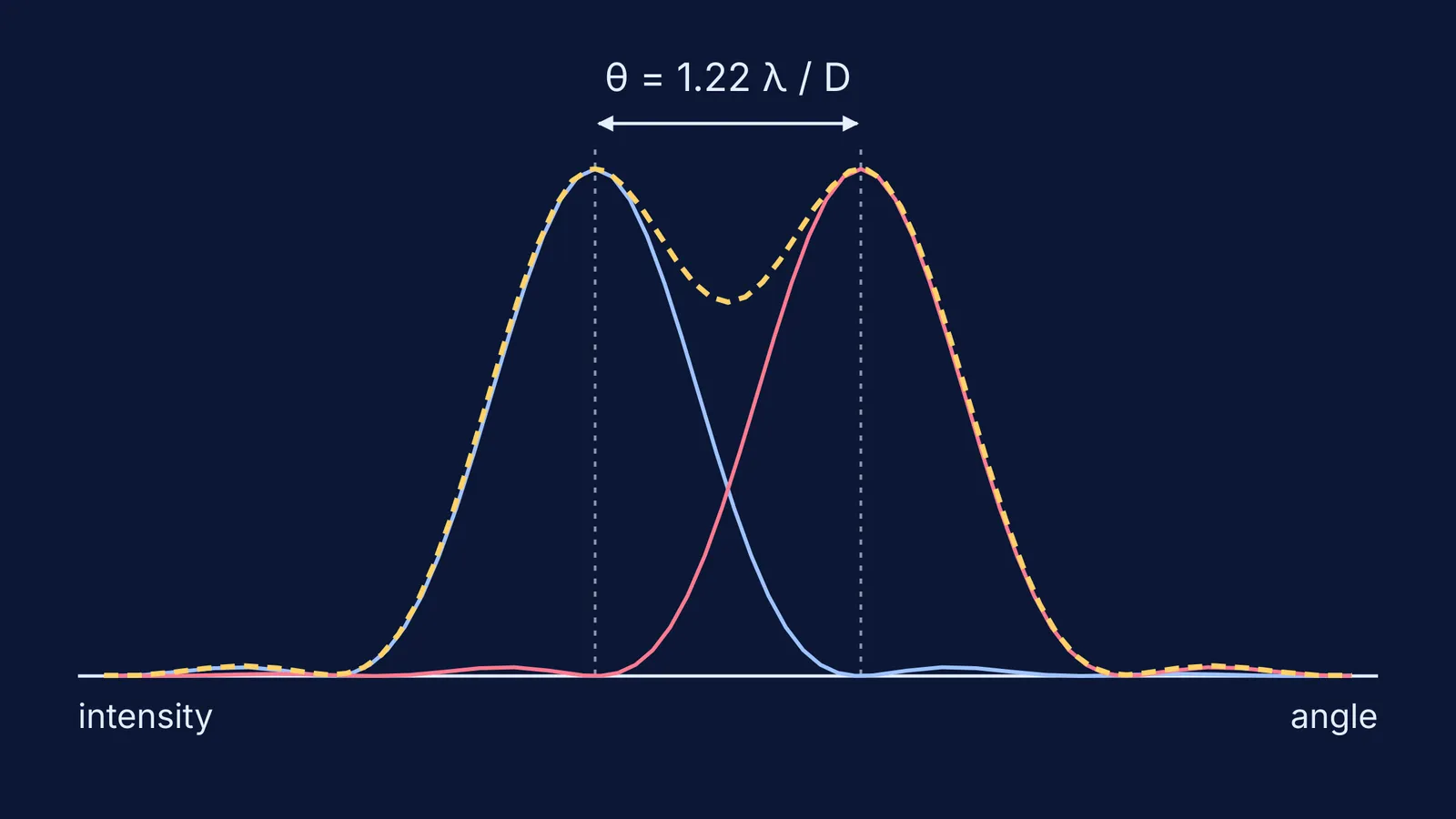
The Rayleigh criterion says two points are just resolved when the central maximum of one diffraction pattern falls on the first minimum of the other (lecture notes, Harish Chandra P.G. College, Varanasi). The same notes define resolving power as the inverse of the smallest distance or angle between two just-resolved objects. So:
Limit of resolution: the smallest angle (telescope) or distance (microscope) you can separate. Smaller is better.
Resolving power: its reciprocal. Bigger is better.
What is the formula for the resolving power of a telescope?
For a circular lens or mirror of diameter D, the smallest angle a telescope can resolve is θ = 1.22λ/D radians, where λ is the wavelength (Angular resolution, Wikipedia). The 1.22 comes from where the first dark ring of the Airy pattern sits. So the resolving power of a telescope is D/(1.22λ).
NASA gives the Hubble Space Telescope's primary mirror as 2.4 metres across and says it can distinguish objects with an angular diameter of 0.05 arcsecond in visible light (NASA).
What is the formula for the resolving power of a microscope?
For a microscope we want the smallest distance d between two points, not an angle. In the Rayleigh form, d = 1.22λ/(2n sin β) = 0.61λ/NA (Nikon MicroscopyU: Resolution).
Numerical aperture is NA = n sin β, where n is the refractive index of the medium between specimen and objective and β is half the angle of the cone of light the objective accepts (Nikon MicroscopyU: Numerical aperture). The resolving power of a microscope is therefore 2n sin β/(1.22λ). MicroscopyU notes that dry objectives struggle to pass an NA of 0.95, while immersion oil, refractive index about 1.51, lets practical objectives reach about 1.4. Some books use d = λ/(2NA); check which one your question expects.
How do wavelength and aperture change resolution?
Halve the wavelength and the limit of resolution halves, for both instruments. Blue light beats red; for electrons, see why an electron microscope resolves more than a light microscope.
Double a telescope's diameter D and θ halves.
Raise a microscope's NA, with a wider cone of light or oil instead of air, and d shrinks.
Magnification appears in neither formula; MicroscopyU says only numerical aperture and wavelength decide resolution.
If the spreading feels abstract, the single-slit diffraction simulation post shows a narrower opening widening the pattern, and the Fermi Concept Library gives diffraction its own lesson and place in the map.
Resolving power numericals, solved
Hubble. D = 2.4 m (NASA), λ = 550 nm. θ = 1.22 × 550 × 10⁻⁹ / 2.4 ≈ 2.8 × 10⁻⁷ rad. Multiply by 206,265 to get about 0.058 arcsecond, close to NASA's 0.05.
Your eye. HyperPhysics uses a 5 mm pupil and 500 nm light. θ = 1.22 × 500 × 10⁻⁹ / (5 × 10⁻³) = 1.22 × 10⁻⁴ rad. Ideally, headlights 1.5 m apart merge beyond 1.5 / θ ≈ 12 km.
Oil-immersion microscope. λ = 550 nm, NA = 1.40 (MicroscopyU). d = 0.61 × 550 / 1.40 ≈ 240 nm, or 0.24 µm. With λ/(2NA) you get 0.20 µm, MicroscopyU's table value. Resolving power = 1/d ≈ 4.2 × 10⁶ m⁻¹.
Use blue light. Same objective, λ = 400 nm: d = 0.61 × 400 / 1.40 ≈ 174 nm.
Remove the oil. A dry objective at NA 0.95 with 550 nm light: d = 0.61 × 550 / 0.95 ≈ 353 nm. Oil improves resolution by 1.40/0.95, about 1.5 times.
Before calculating, check:
Telescope gives an angle; microscope gives a distance.
Convert nm to m (× 10⁻⁹) and mm to m (× 10⁻³).
Use the diameter D, not the radius, and keep n inside NA.
Read whether the question wants the limit or the power.
Sanity check: a shorter λ or larger aperture must give a smaller limit.
If your answer is off by a factor of 1,000, the Fermi Problem Library has worked problems with a step-by-step solver that explains the reasoning rather than printing an answer.
Is resolving power still in the NCERT syllabus?
The Wave Optics chapter of the current NCERT Class 12 Physics reprint (2026-27) has no separate section on it: it goes from 10.6.2, on the single-slit pattern, straight to 10.7, polarisation (NCERT Wave Optics PDF). Syllabi change, so check your board's or exam's official syllabus before deciding how much time to give it. For the instrument itself, read how to focus a compound microscope.


