

On this page
Drop equal strips of magnesium ribbon into hydrochloric acid and acetic (ethanoic) acid of the same concentration. The HCl tube fizzes hard; the acetic acid tube bubbles gently for much longer. Yet both give the same volume of hydrogen in the end.
What changes when you swap HCl for acetic acid?
The Royal Society of Chemistry's class practical The acidic reactions of ethanoic acid uses 0.05 M solutions of both acids and asks students to add magnesium ribbon to each and compare the rate. Its notes record that hydrogen is given off more slowly with ethanoic acid.
The RSC page explains why: hydrochloric acid is a strong acid and dissociates fully (HCl → H⁺ + Cl⁻), while ethanoic acid is a weak acid that does not fully dissociate (CH₃COOH ⇌ H⁺ + CH₃COO⁻).
The reaction is the same in both tubes: Mg + 2H⁺ → Mg²⁺ + H₂. Magnesium reacts with H⁺ ions, so speed depends on how many H⁺ ions are free right now.
Why does magnesium react faster with HCl than acetic acid?
Because the strong acid puts far more H⁺ ions in the solution at the same concentration. More H⁺ ions near the metal surface means more collisions each second, so more hydrogen forms each second.
Acetic acid's acid ionisation constant is Ka = 1.8 × 10⁻⁵ at 25 °C, according to this table of acid ionisation constants. For 1 M acetic acid, write x for [H⁺]:
Ka = x² / (1 − x) = 1.8 × 10⁻⁵
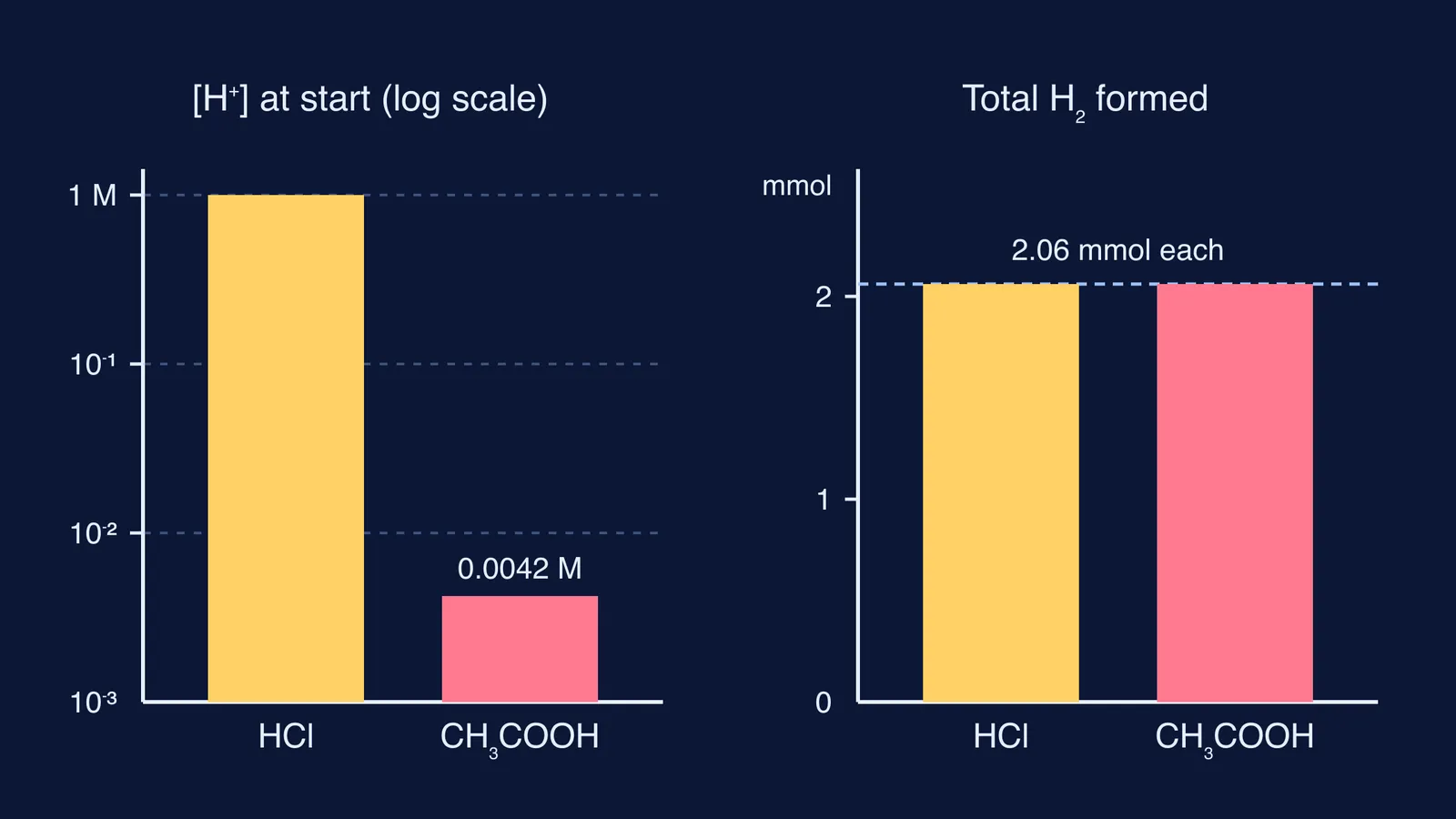
Because x is tiny, 1 − x ≈ 1, so x ≈ √(1.8 × 10⁻⁵) ≈ 4.2 × 10⁻³ M
Degree of ionisation = 0.0042 / 1 ≈ 0.42%, and pH ≈ 2.4
In 1 M HCl, [H⁺] is about 1 M. So at the start, the HCl tube has roughly 240 times more free H⁺ than the acetic acid tube (1 ÷ 0.0042 ≈ 238). That is not "240 times faster": the ratio explains why the gap is large, not its exact size.
Weak-acid ionisation also changes with concentration; our explainer on why percent ionisation of a weak acid rises on dilution shows the working.
Why is the total volume of hydrogen the same?
The amount of hydrogen depends on how much of each reactant there is, not on how fast it reacts. Doc Brown's chemistry notes put it plainly: the ionisation of the weak acid continues as hydrogen ions are used up, so both reactions give the same final volume of gas and the strong acid just finishes sooner.
Both acids are monoprotic, so 50 mL of 1 M acid can supply the same 50 mmol of H⁺ in either case, enough for up to 25 mmol of hydrogen gas.
This is a known trap. In a 2010 study in Chemistry Education Research and Practice, Tan, Treagust, Chandrasegaran and Mocerino gave 217 pre-service science teachers in Singapore a question comparing powdered marble with excess 1 M HCl and excess 1 M acetic acid. 79% picked the correct graph (same final volume, slower start for acetic acid), but only 68% gave an acceptable reason. Another 5% chose a graph where acetic acid made less gas; most of them (3% of all participants) reasoned that a weak acid releases fewer hydrogen ions.
Worked example: sketch both graphs before you test
Take 0.050 g of magnesium ribbon and 50 mL of 1 M acid in each flask, collecting hydrogen in a gas syringe.
Moles of Mg: magnesium's standard atomic weight is about 24.3, per the IUPAC atomic weights commission (CIAAW), so 0.050 ÷ 24.3 ≈ 2.06 mmol.
Acid needed: Mg + 2H⁺ needs 2 × 2.06 ≈ 4.1 mmol of H⁺. Each flask has 50 mmol of acid, so the acid is in excess and magnesium is the limiting reactant.
Hydrogen formed: 1 mol H₂ per mol Mg, so 2.06 mmol H₂ in both flasks.
Sketch: the HCl curve rises steeply and flattens early; the acetic acid curve starts with a gentler slope and flattens later, at the same height.
How do you write this in a board or JEE Main answer?
A full-mark answer usually has four parts:
Name the acid types: HCl is strong and ionises fully; acetic acid is weak and ionises only slightly.
Link to [H⁺]: at equal concentration, HCl has a much higher H⁺ concentration.
Link to rate: more H⁺ means more frequent collisions with the magnesium surface, so faster reaction.
Explain equal volume: same moles of monoprotic acid and magnesium; acetic acid keeps ionising as H⁺ is used, so the same hydrogen forms, more slowly.
For more acid practice, try working out the pH of 2 M HCl and checking how much acetic acid is in vinegar.
If rate and stoichiometry questions trip you up, the Fermi Problem Library has worked problems with a step-by-step solver that explains the reasoning rather than printing an answer. To revisit Ka and degree of ionisation from the start, each idea has its own lesson in the Fermi Concept Library.


