On this page
Most of us met the pH scale as a strip of colours from 0 to 14. So when your calculator gives a negative pH for a strong acid, it looks like a mistake. It isn't. The scale has no wall at 0 or 14; those numbers mark where everyday solutions sit.
Can pH be negative or greater than 14?
Yes, and your own textbook says so. Table 6.5 in the NCERT Class 11 chemistry chapter on equilibrium lists 1 M HCl at about 0, concentrated HCl at about −1.0 and a saturated NaOH solution at about 15.
Real waters go far lower. D. Kirk Nordstrom and colleagues found mine waters underground in the Richmond Mine at Iron Mountain, California, with pH values as low as −3.6, which their paper in Environmental Science & Technology calls the most acidic waters known. Below pH 0.5, they report, glass-electrode calibration becomes strongly nonlinear, so they calibrated using the Pitzer method, a thermodynamic model of concentrated solutions. Our explainer on how a glass electrode pH meter works covers the normal range.
Why is the pH scale 0 to 14 in the first place?
The NCERT equilibrium chapter gives the ion product of water at 298 K as Kw = [H₃O⁺][OH⁻] = 10⁻¹⁴, so pH + pOH = 14. A solution with 1 M hydrogen ions has pH 0, and one with 1 M hydroxide ions has pH 14.
Most acids and bases you handle are more dilute than 1 M, so they land inside that window. That is why a pH chart of common substances can run from stomach acid to bleach without leaving 0 to 14. Nothing in the definition stops a more concentrated solution from going past either end.
What is the pH of 2 M HCl?
The definition decides it. The NCERT chapter writes pH = −log a(H⁺), where a is the activity of hydrogen ions, and adds that activity equals molarity in magnitude only in dilute solutions, below about 0.01 M.
Activity is the effective concentration: in a crowded solution, ions interact and behave as if there were slightly fewer, or more, of them. Activity = γ × concentration, where γ is the activity coefficient.
Concentration only: pH = −log 2 = −0.30.
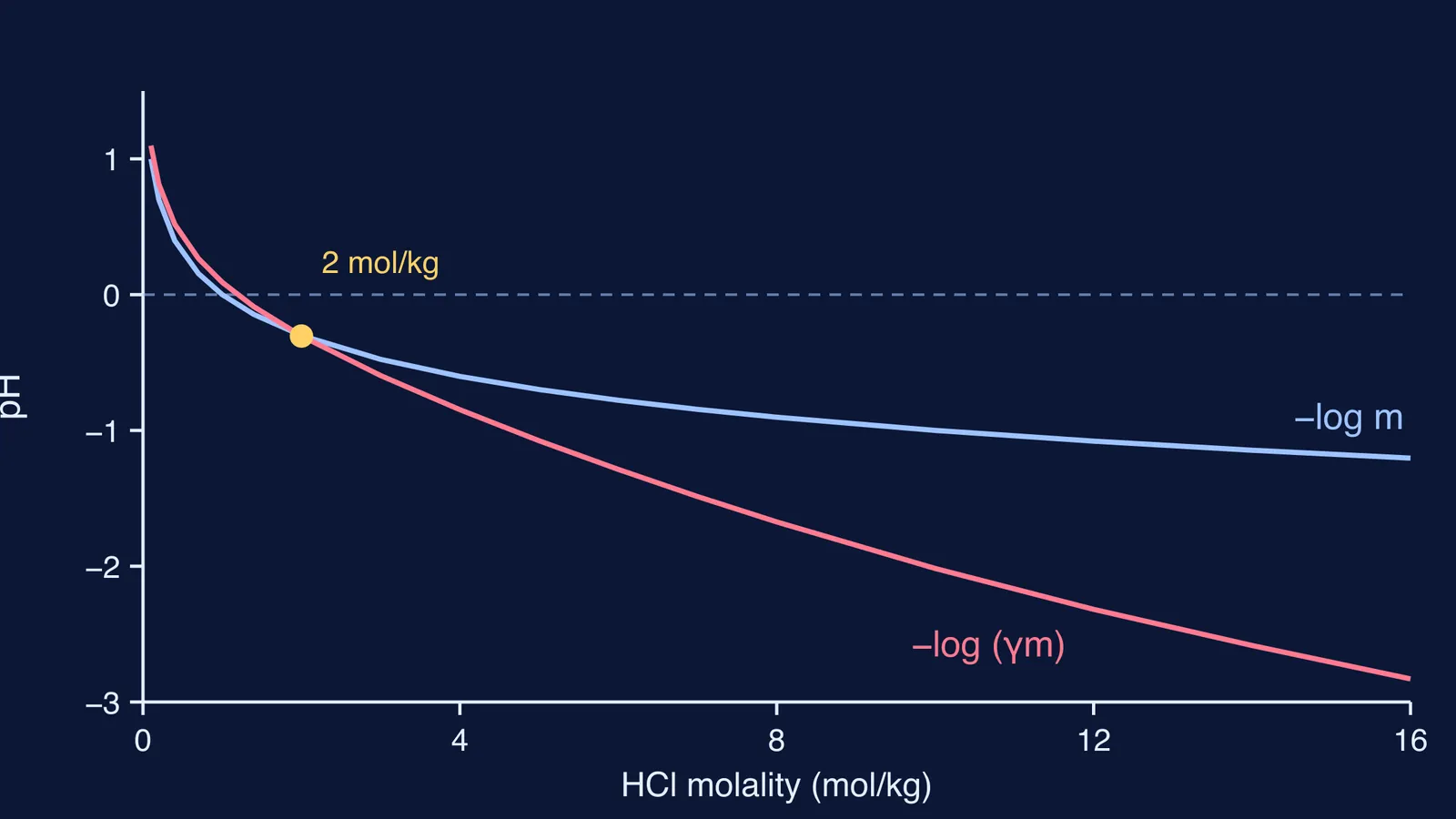
Look up γ for HCl. The critically evaluated tables by Hamer and Wu (1972), from the US National Bureau of Standards (now NIST), give a mean activity coefficient of 1.009 at 2 mol per kg of water and 25 °C. These are molality values; at this strength molality is close to, though slightly above, molarity.
Activity at 2 mol/kg: a ≈ 1.009 × 2 = 2.018.
pH ≈ −log 2.018 = −0.305, which rounds to −0.30.
So 2 M HCl has a pH of about −0.3 either way: a coincidence of this strength, not a rule.
Where does activity take over from concentration?
Using the same Hamer and Wu table for HCl, here is how far the simple formula drifts:
0.1 mol/kg: γ = 0.797, so pH ≈ 1.10 instead of 1.00.
1 mol/kg: γ = 0.811, so pH ≈ 0.09 instead of 0.
2 mol/kg: γ = 1.009, so pH ≈ −0.30 either way.
6 mol/kg: γ = 3.23, so pH ≈ −1.29 instead of −0.78.
10 mol/kg: γ = 10.40, so pH ≈ −2.02 instead of −1.00.
The first line matches experiment: a measured pH of 1.10 for 0.100 M HCl appears in this LibreTexts data exercise.
Up to about 2 mol/kg, γ sits below 1 and HCl acts slightly weaker than its concentration. Beyond that, γ climbs past 1 and keeps rising, so the real pH falls well below −log c.
Standard practice stays in the dilute zone: the IUPAC 2002 recommendations on measuring pH cover definitions and procedures for dilute aqueous solutions between 5 and 50 °C. Our post on how pH changes when a strong acid is diluted ten times works in that comfortable range.
How should you answer this in an exam?
Use this three-step check, based on the NCERT treatment of pH:
If the question gives a concentration and says nothing about activity, use pH = −log[H⁺]. A negative answer is allowed; do not round it up to 0.
If it asks whether pH can leave 0 to 14, say yes and give the reason: pH is defined by activity, and 0 and 14 only mark 1 M hydrogen ions and 1 M hydroxide ions at 298 K.
If it gives an activity coefficient, multiply it by the concentration first, then take the log.
If activity is a new idea for you, the Fermi Concept Library has a lesson for every chemistry concept, with its place in the map. To practise, the Fermi Problem Library has worked problems with a step-by-step solver that explains the reasoning rather than printing an answer.
Next time your calculator gives a negative pH for a concentrated strong acid, trust it, and know why.