On this page
If you are revising acids, bases and salts, you need the pH values of a few everyday substances, and questions often ask which side of 7 each one falls on. Below are approximate values for nine of them, each with its source. After that comes the one idea that makes the scale make sense: every step of 1 on the pH scale is a tenfold change.
What is the pH of common substances?
These are typical values. The real number depends on the brand, how dilute the sample is and its temperature, so treat them as landmarks rather than constants.
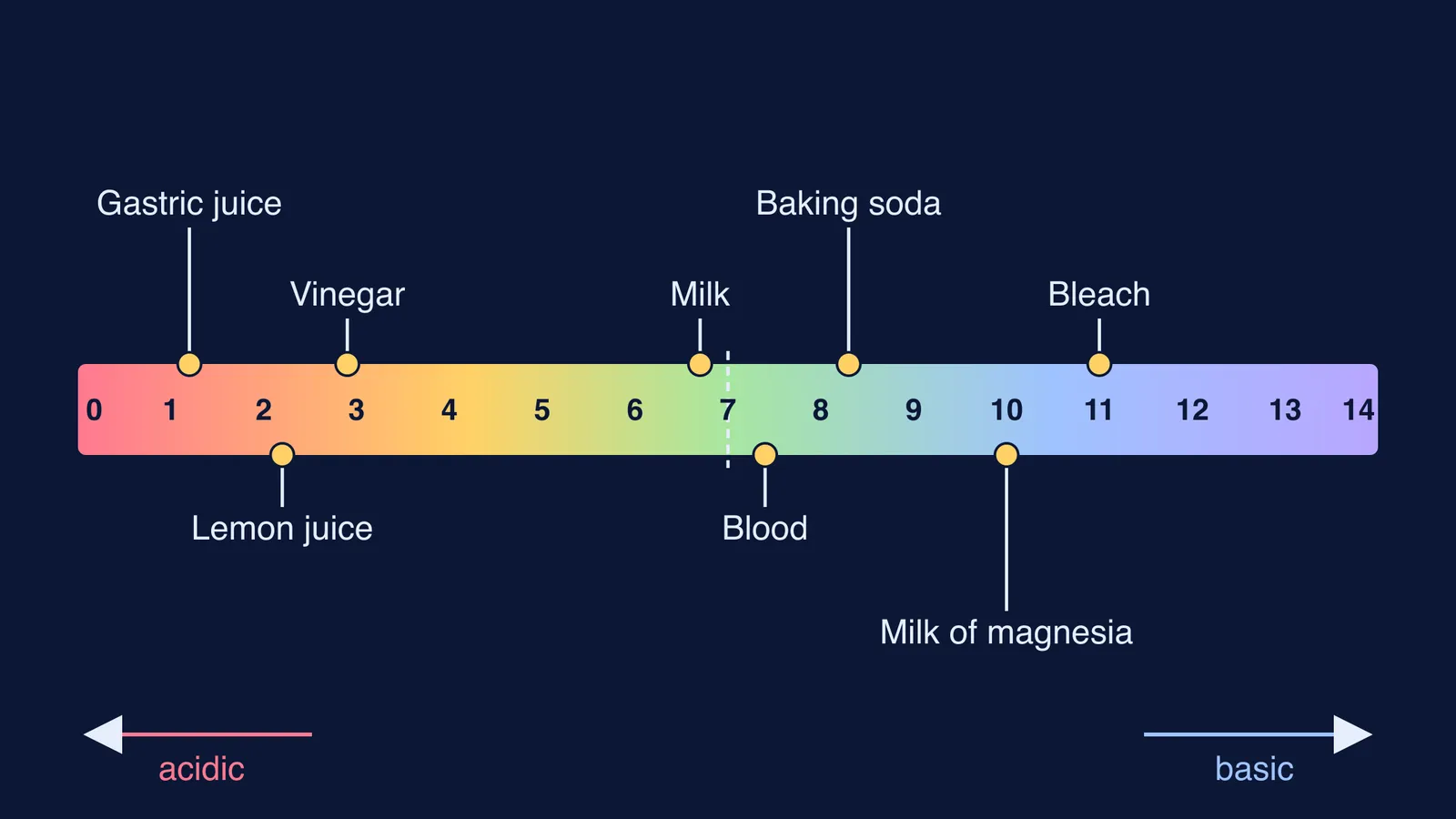
Gastric juice: about 1.2, according to Figure 2.7 of NCERT Class 10 Science, Chapter 2.
Lemon juice: about 2.2 in the same NCERT figure; 2.00 to 2.60 in a Clemson University table of food pH values.
Vinegar: 2.40 to 3.40, from the same Clemson table.
Milk: 6.6 to 6.8, with 6.7 the most common value, says the Tetra Pak Dairy Processing Handbook.
Pure water: 7, which is neutral (NCERT).
Blood: about 7.35 to 7.45, so slightly basic, says the MSD Manual. NCERT rounds this to 7.4.
Baking soda (sodium bicarbonate): 8.3 for a freshly made 0.1 molar solution at 25 °C, according to PubChem.
Milk of magnesia (magnesium hydroxide): about 10 (NCERT).
Household bleach: around 11 at 5% sodium hypochlorite, and about 13 for concentrated 10 to 15% bleach, according to a University of Bristol chemistry page.
In order from most acidic to most basic: gastric juice, lemon juice, vinegar, milk, water, blood, baking soda, milk of magnesia, bleach.
How do you read the pH scale?
The pH scale usually runs from 0 (very acidic) to 14 (very alkaline), and a neutral solution has a pH of 7, as NCERT's chapter on acids, bases and salts explains. The same chapter notes that the higher the hydronium ion concentration, the lower the pH. The "p" comes from the German word *potenz*, meaning power.
Each whole number on the scale is a 10-fold change, so water at pH 5 is ten times more acidic than water at pH 6, says the US Geological Survey.
How many times more acidic is lemon juice than milk?
Lemon juice is about pH 2.2 (NCERT) and milk is about pH 6.7 (Tetra Pak handbook).
Difference: 6.7 − 2.2 = 4.5 pH units.
Ratio of hydrogen ion concentrations: 10^4.5 = 10^4 × 10^0.5 ≈ 10,000 × 3.16 ≈ 31,600.
So lemon juice has roughly 30,000 times the hydrogen ion concentration of milk, even though the two numbers look only 4.5 apart.
Now try it yourself. How does gastric juice (1.2) compare with blood (7.4), both NCERT values? The difference is 6.2 units, so the ratio is 10^6.2 ≈ 1.6 million. Gastric juice has more than a million times the hydrogen ion concentration of blood.
If the logarithm step is what trips you up, the Fermi Concept Library covers every concept in chemistry and mathematics, each with its own lesson, so you can fill that gap before moving on.
Why does pH matter in the stomach and the blood?
NCERT explains that the stomach makes hydrochloric acid, which helps digest food. When the stomach makes too much, people use antacids, which are mild bases such as milk of magnesia, to neutralise the excess. For the numbers behind that, read our post on how much stomach acid one antacid tablet can neutralise. Frequent acidity is something to discuss with a doctor; this post is for exam revision, not treatment.
Blood is different: the MSD Manual describes acidosis as a fall in blood pH and alkalosis as a rise, which is why the body keeps it in such a narrow band. Our explainer on how the bicarbonate buffer keeps blood pH at 7.4 shows the chemistry.
Which pH mistakes do students make in exams?
Run through this checklist before a test (values from NCERT, the Tetra Pak handbook and PubChem):
Blood at 7.4 is slightly basic, not neutral.
Milk at about 6.7 is slightly acidic, not neutral.
Lower pH means more hydrogen ions, not fewer.
One unit is a tenfold change, never "one more".
The pH of a solution you make up depends on its concentration: PubChem's 8.3 for baking soda is for a 0.1 molar solution.
Learn the three textbook landmarks: gastric juice about 1.2, blood 7.4 and milk of magnesia 10.
To see these values change colour on indicator paper, follow our guide to the Class 10 universal indicator practical.
NCERT warns never to taste or touch alkalis, and the CDC's bleach guidance asks for good ventilation when you use bleach indoors, so open a window.
For more practice, the Fermi Problem Library has worked problems with a step-by-step solver that explains the reasoning rather than printing an answer, which helps when you are working through pH and dilution questions.