On this page
The normal range of blood pH is 7.35 to 7.45, according to a 2022 review of acid–base physiology by Shaw and Gregory in BJA Education. The same review estimates that the body makes about 13 mol of acid a day, almost all of it as carbon dioxide. The main thing that absorbs that load without letting pH swing is one conjugate pair: carbonic acid and bicarbonate.
What is the carbonic acid–bicarbonate buffer?
A buffer is a weak acid and its conjugate base present together. In blood the pair is H2CO3 and HCO3-, tied to carbon dioxide:
CO2 + H2O ⇌ H2CO3 ⇌ H+ + HCO3-
The first step on its own takes several minutes, but the enzyme carbonic anhydrase cuts it to a fraction of a second (Shaw and Gregory, 2022).
The OpenStax Anatomy and Physiology textbook gives the two reactions that do the buffering:
Added strong acid: NaHCO3 + HCl → H2CO3 + NaCl, a weak acid in place of a strong one.
Added strong base: H2CO3 + NaOH → NaHCO3 + H2O.
How does the bicarbonate buffer keep blood pH at 7.4?
Use the Henderson–Hasselbalch equation. For this buffer the pKa is 6.1 (Shaw and Gregory). The acid term is written as dissolved CO2: PCO2 in mmHg multiplied by the solubility of CO2, 0.03 mmol/L per mmHg (LibreTexts Pulmonary Physiology):
pH = 6.1 + log ( [HCO3-] / (0.03 × PCO2) )
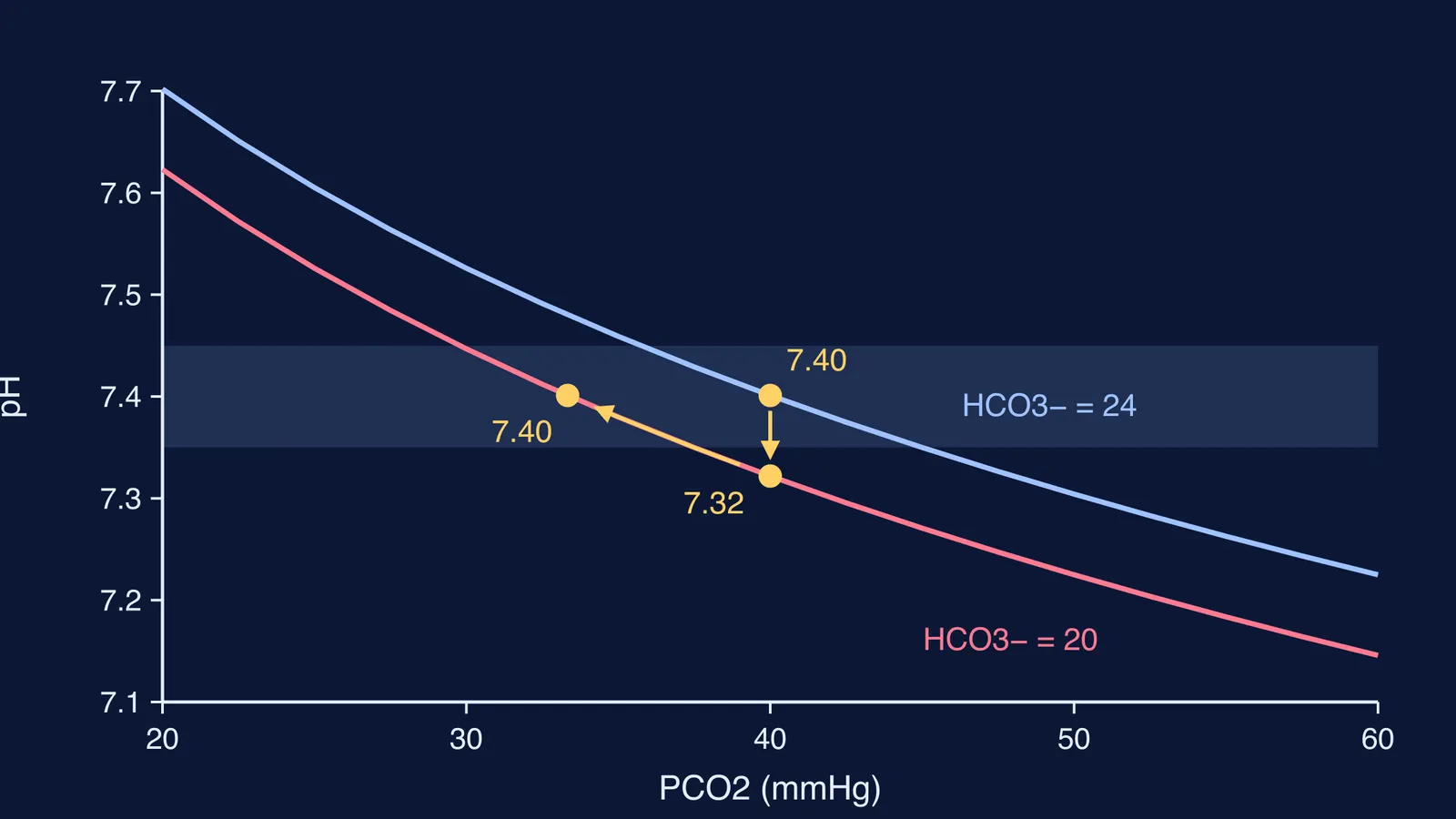
The review uses normal values of 24 mmol/L bicarbonate and 1.2 mmol/L dissolved CO2; with the 0.03 factor, 1.2 mmol/L matches a PCO2 of 40 mmHg. The ratio is 24 / 1.2 = 20, and log 20 = 1.30, so pH = 6.1 + 1.30 = 7.4.
That 20 is the textbook ratio: OpenStax states that bicarbonate ions and carbonic acid are present in blood in a 20:1 ratio when blood pH is in the normal range (OpenStax).
Why does a buffer with a pKa of 6.1 work at pH 7.4?
A buffer resists change best near its pKa, and 7.4 is 1.3 units away. Shaw and Gregory give two reasons the bicarbonate system still matters most: it is the most plentiful buffer in the body, and it is an open system, because the lungs can remove CO2 (BJA Education).
Worked example: adding acid
These are teaching numbers built on the review's normal values, not clinical advice. Suppose 4 mmol/L of strong acid enters the blood. Bicarbonate neutralises it, so HCO3- falls from 24 to 20 mmol/L and the same amount of carbonic acid forms.
Closed flask, CO2 trapped: dissolved CO2 rises from 1.2 to 5.2 mmol/L. pH = 6.1 + log (20 / 5.2) = 6.69. A large drop.
Open system, lungs breathe off the extra CO2 and PCO2 stays at 40 mmHg: pH = 6.1 + log (20 / 1.2) = 7.32. A small drop.
Breathing a little harder lowers PCO2 to about 33 mmHg (1.0 mmol/L): pH = 6.1 + log (20 / 1.0) = 7.40. The ratio is back to 20.
Over hours to days, the kidneys secrete H+ and return bicarbonate to the blood, rebuilding HCO3- towards 24 mmol/L.
The lesson: pH depends on the ratio, not on either amount alone, so the body can correct pH by moving either half.
How do the lungs and kidneys share the work?
OpenStax puts the three defences on a clock (OpenStax):
Chemical buffers adjust pH in seconds.
The lungs can raise pH within minutes by breathing out CO2; acidosis stimulates receptors in the brain and arteries, which speeds up breathing.
The kidneys excrete H+ and conserve bicarbonate, but this takes hours to days.
Shaw and Gregory add that alveolar ventilation rises by 1 to 2 L/min for each 0.1 kPa rise in PCO2, and the kidneys reabsorb 80 to 90% of filtered bicarbonate in the proximal convoluted tubule (BJA Education). A simple way to remember the split: the lungs control the bottom of the ratio (CO2), and the kidneys control the top (HCO3-).
How to answer a blood buffer question in an exam
Use this checklist for a 3 or 5 mark answer:
Write the full equilibrium.
Say which species meets added H+ (HCO3-) and which meets added OH- (H2CO3), with an equation for each.
For a pH value, use Henderson–Hasselbalch and log 20 = 1.3.
Say "open system": lungs for CO2, kidneys for HCO3-.
Give the time scale: seconds, minutes, hours to days.
For practice, see buffer pH using moles instead of concentration, why buffer pH stays the same on dilution and the buffer solution simulation where you add acid and base. If your method goes wrong, the Fermi Problem Library has worked problems with a step-by-step solver that explains the reasoning. If the gap is the idea itself, such as conjugate pairs or pKa, the Fermi Concept Library gives each concept its own lesson.
This post explains textbook physiology for students. Questions about a real blood test or symptoms belong with a doctor.