

On this page
In short The Henderson-Hasselbalch equation traditionally uses the molar concentrations of a weak acid and its conjugate base. However, because both components are dissolved in the same total volume, this volume cancels out in the ratio, meaning you can safely calculate a buffer's pH using moles instead of concentration to save time.
If you have ever calculated the pH of a buffer solution, you know the standard drill: find the moles of your acid, find the moles of your conjugate base, divide both by the total volume of the solution to get molar concentrations, and then plug those concentrations into the Henderson-Hasselbalch equation.
But finding the concentration first is often an unnecessary step. By using the ratio of moles directly, you can save time, avoid calculation errors, and simplify complex titration problems.
Why can you use moles instead of concentration?
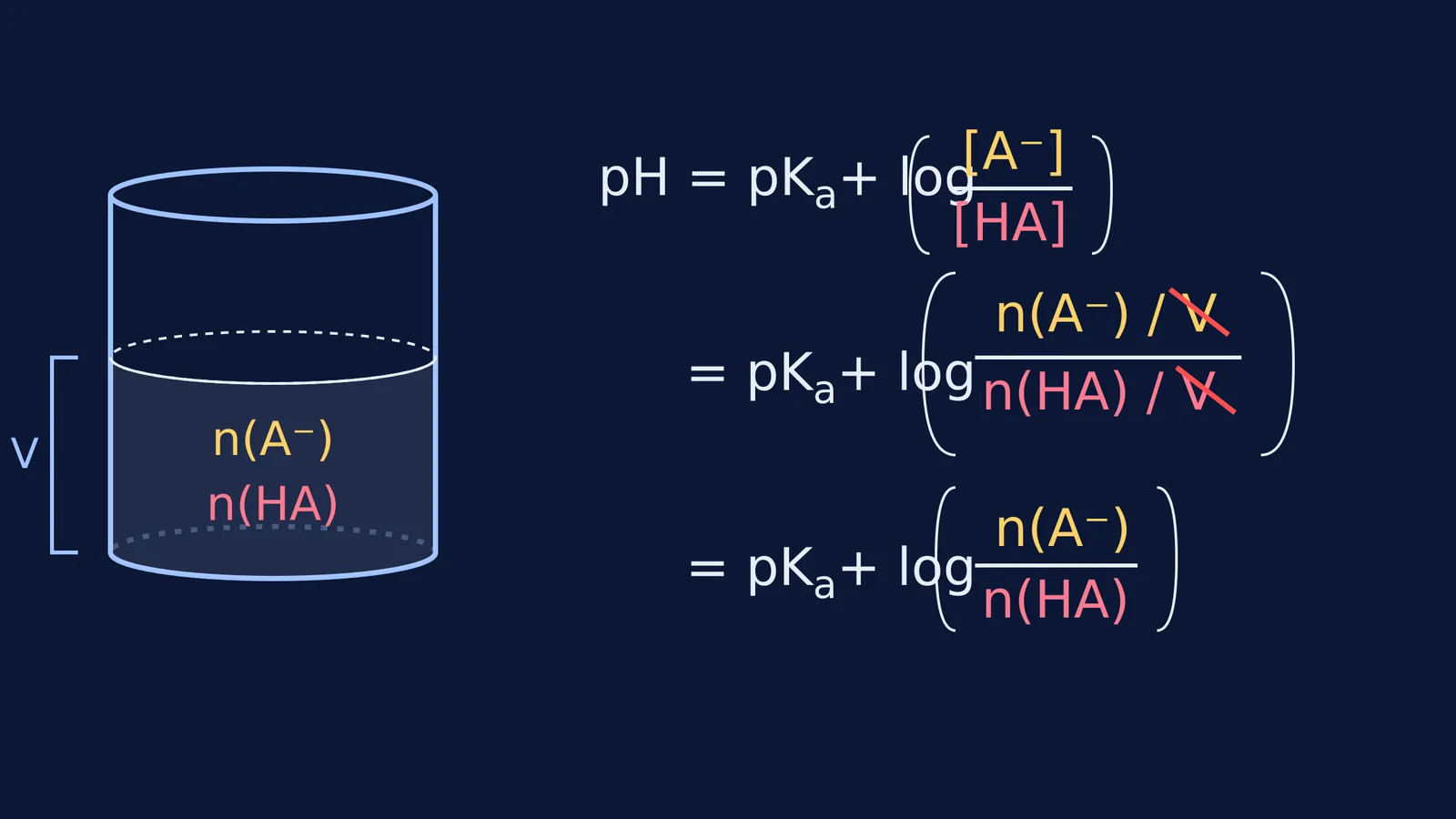
The standard Henderson-Hasselbalch equation is written as:
pH = pKₐ + log([Base] / [Acid])
Here, the square brackets denote molar concentration (moles per litre). However, the concentration of any solute is simply its number of moles (n) divided by the total volume (V) of the solution.
Because the weak acid and its conjugate base are dissolved in the exact same container, they share the same total volume (LibreTexts/Acids_and_Bases/Buffers/Introduction_to_Buffers)). When you substitute concentration for moles over volume, the equation looks like this:
pH = pKₐ + log((n_base / V) / (n_acid / V))
Since the volume (V) is identical for both species, it cancels out mathematically. This leaves you with the simplified "moles" version of the formula:
pH = pKₐ + log(n_base / n_acid)
This property of buffers also explains why diluting a buffer with pure water does not significantly change its pH: the total volume changes, but the ratio of moles between the acid and base remains completely untouched. (Keep in mind that neutral pH is not always 7: how Kw changes with temperature can affect exact readings in extreme real-life conditions, but the fundamental mole ratio principle holds firm).
When is the mole ratio most useful?
Using moles instead of concentration is especially helpful in two common chemistry scenarios:
Titration calculations: During a titration, adding a titrant constantly changes the total volume of the solution. If you use concentrations, you must recalculate the new total volume at every single step. If you use moles, you only need to track the moles of acid and base remaining after the neutralisation reaction.
Buffer preparation: When you prepare a buffer by adding a solid salt (like sodium acetate) to a liquid acid, finding the final volume can be tedious. Using the mole ratio allows you to determine the required mass of the salt without worrying about the final solution volume.
If you are dealing with complex mixtures where you need to verify purity through indirect methods, mastering these mole shortcuts is just as important as understanding back titration: finding purity when direct titration fails.
A worked example: calculating buffer pH
Consider a buffer solution containing 0.50 moles of acetic acid (pKₐ = 4.76) and 0.20 moles of sodium acetate, all dissolved in a total volume of 2.0 litres.
The standard method (using concentration):
[Acid] = 0.50 moles / 2.0 L = 0.25 M
[Base] = 0.20 moles / 2.0 L = 0.10 M
pH = 4.76 + log(0.10 / 0.25)
pH = 4.76 + log(0.4)
pH = 4.76 - 0.398 = 4.36
The shortcut method (using moles):
n_acid = 0.50 moles
n_base = 0.20 moles
pH = 4.76 + log(0.20 / 0.50)
pH = 4.76 + log(0.4)
pH = 4.76 - 0.398 = 4.36
Both methods yield the exact same pH of 4.36, but the mole method skips the volume division entirely. Notice how the concentration-based approach requires two extra division steps. While these divisions might seem trivial with round numbers like 2.0 litres, they become a major source of arithmetic errors during exams when dealing with irregular volumes like 37.5 mL.
Building your intuition for chemistry math
Formulas in chemistry are rarely arbitrary. When you understand how equations are derived, you can spot mathematical shortcuts like the mole ratio naturally.
If you are unsure when a mathematical shortcut applies to your homework, the Fermi Problem Library has worked problems with a step-by-step solver that explains the reasoning rather than printing an answer. And if you need to revisit the fundamentals of equilibrium or acid-base reactions, the Fermi Concept Library contains every concept in physics, chemistry, biology, mathematics and computing, each with its own lesson and its place in the map.


