

On this page
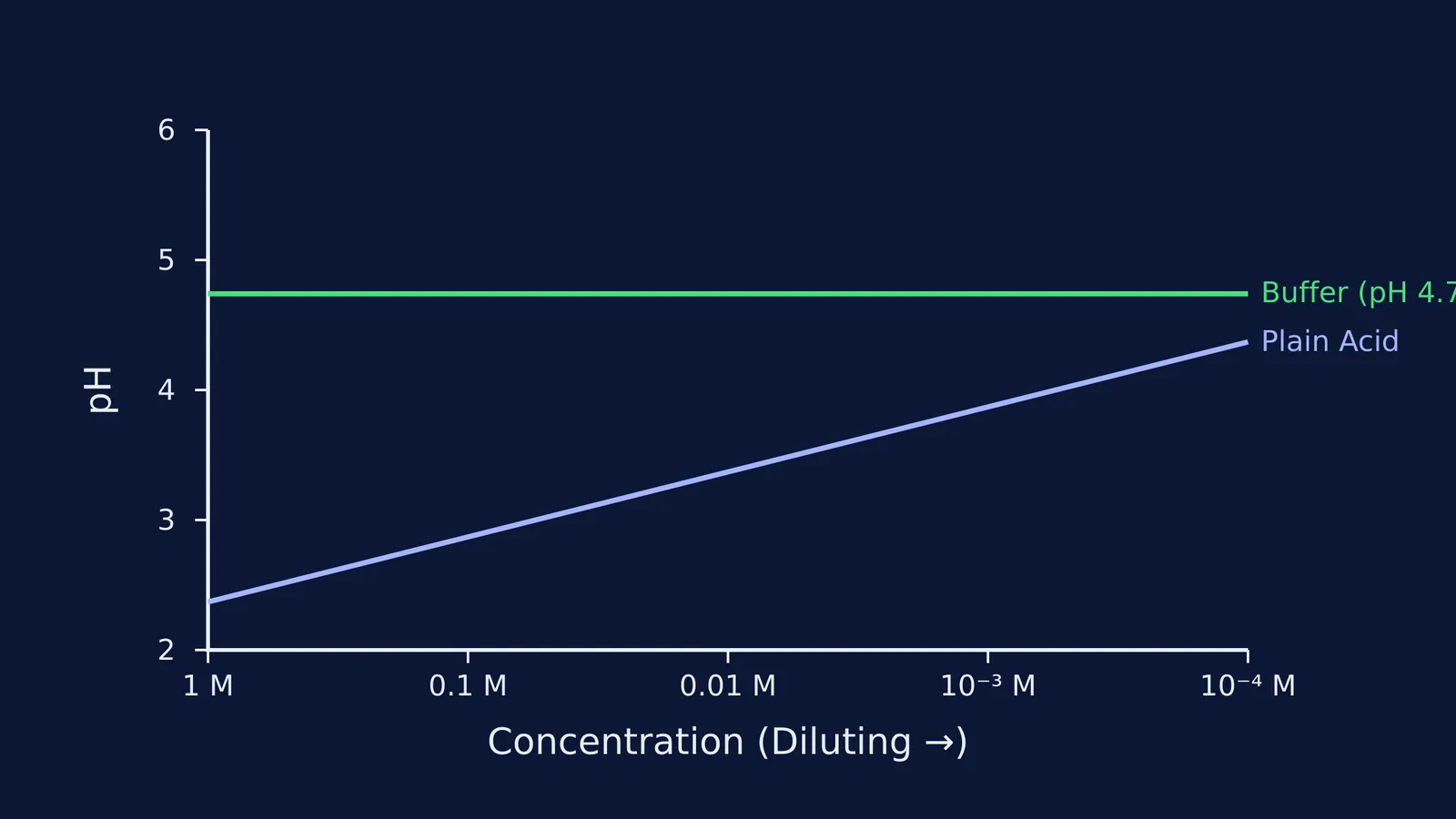
When you prepare a stock buffer solution in the chemistry lab and dilute it for an experiment, you might expect the pH to change. After all, if you add water to a simple acid like hydrochloric acid, the hydrogen ion concentration drops and the pH rises. Yet, a buffer solution stubbornly holds its pH.
Why does a buffer behave so differently from a plain acid? For students preparing for JEE or NEET, understanding the mechanism behind this—and its limits—is a standard part of ionic equilibrium.
Why does the pH stay constant?
The pH of a buffer solution depends on a dynamic equilibrium between a weak acid (HA) and its conjugate base (A⁻). The relationship is described by the Henderson-Hasselbalch equation:
pH = pKa + log([A⁻] / [HA])
When you dilute a buffer by adding water, the volume of the entire solution increases. This decreases the molar concentration of the acid ([HA]) and the base ([A⁻]) by the exact same factor. Because both terms in the logarithmic fraction are divided by the same new volume, the ratio of [A⁻] to [HA] remains completely unchanged. With a constant ratio and a fixed pKa for the acid, the pH value stays constant.
According to a review of buffer principles by Chemistry LibreTexts/Acids_and_Bases/Buffers/Introduction_to_Buffers), this mathematical stability holds because the system relies on the relative proportions of the conjugate pair, not their absolute amounts.
How does Le Chatelier's principle explain this?
Beyond the maths of the Henderson-Hasselbalch equation, we can also look at dilution through the lens of Le Chatelier's principle. A buffer is a system at equilibrium:
HA ⇌ H⁺ + A⁻
When you dilute the solution by adding water, the concentration of all aqueous species drops. According to Le Chatelier's principle, an equilibrium system will shift to counteract this change. To replace the "lost" concentration, the equilibrium shifts slightly to the right, towards the side with more dissolved particles.
A small fraction of the weak acid (HA) dissociates to produce more H⁺ and A⁻ ions. This slight shift replaces the H⁺ ions that were spread out by the added water, effectively replenishing the H⁺ concentration and maintaining the original pH level. Because the buffer holds a large reservoir of undissociated HA, it can easily afford this minor adjustment without noticeably changing the overall [A⁻]/[HA] ratio.
What happens to buffer capacity on dilution?
Even though the pH stays the same, the buffer does not behave exactly as it did before. What changes upon dilution is the buffer capacity—its ability to resist pH changes when *new* amounts of strong acid or strong base are introduced.
Buffer capacity is directly tied to the absolute concentrations of the acid and base components. A highly concentrated buffer and a dilute buffer made of the same components will have the exact same pH, but the concentrated one has a much larger reserve of active particles ready to neutralise intruders.
If you add a few drops of a strong acid to the diluted buffer, it will exhaust its smaller reserve of conjugate base much faster, causing a rapid and noticeable shift in pH. If you have concept gaps around molarity and equilibrium equations, the Fermi Concept Library offers a lesson for each idea and shows its place in the wider chemistry map.
What is the limit of extreme dilution?
Can you dilute a buffer indefinitely and expect the pH to stay locked? No.
The Henderson-Hasselbalch equation makes a fundamental simplifying assumption: it ignores the hydrogen (H⁺) and hydroxide (OH⁻) ions produced by the natural autoionization of water.
When a buffer becomes extremely dilute, the number of H⁺ ions coming from the buffer components themselves becomes comparable to the H⁺ ions naturally present in pure water. As Chemistry LibreTexts/Acids_and_Bases/Buffers/Introduction_to_Buffers) explains, at this point of extreme dilution, the buffer effectively breaks. The water's own chemistry becomes the dominant factor, and the pH will inevitably drift towards the pH of neutral water.
For further exam practice on these limits, see our guide on Henderson-Hasselbalch buffer problems: design, capacity and limits and our step-by-step breakdown of ionic equilibrium: pH, buffers and salt hydrolysis, worked out.
A practical framework: The dilution check
If you are working with buffers in a practical exam or setting up a titration, use this mental checklist before diluting a stock solution:
Target pH: Diluting the stock will keep the pH at your target value. You do not need to recalculate the pH for a simple dilution step.
Required capacity: Ensure the final diluted concentration is still high enough to handle any expected acid or base byproducts in your reaction.
Volume change: Measure the final volume precisely if the buffer forms part of a quantitative reaction, but know that accidentally adding a little extra water will not ruin the initial pH reading.


