

On this page
You can read that buffers "resist pH change" a dozen times and still not see why. A simulation lets you test it: add the same acid to water and to a buffer, and watch one pH crash while the other barely moves. On whether simulations help at all, our summary of what PhET research says interactive simulations are good for covers the evidence.
What is a buffer solution, and why does its pH hold steady?
Buffers are solutions that keep a relatively constant pH when an acid or a base is added (LibreTexts, Buffered Solutions/17%3A_Additional_Aspects_of_Aqueous_Equilibria/17.02%3A_Buffered_Solutions)). The standard school example is acetic acid (CH₃COOH) mixed with sodium acetate.
Each partner neutralises one kind of intruder:
Added H⁺ meets acetate: CH₃COO⁻ + H⁺ → CH₃COOH
Added OH⁻ meets acetic acid: CH₃COOH + OH⁻ → CH₃COO⁻ + H₂O
The strong acid or base becomes a weak one, so only the acid-to-base ratio shifts. The pH follows that ratio through the Henderson-Hasselbalch equation, pH = pKa + log([A⁻]/[HA]) (same LibreTexts page). Acetic acid has a pKa of 4.76 at 25 °C (PubChem: acetic acid).
How much does pH change when you add acid to a buffer vs water?
Use any acid-base simulation, such as the free "Creating a Buffer Solution" lab from ChemCollective, or work on paper with acetic acid's pKa of 4.76 (PubChem).
Beaker A: 100 mL of pure water, pH 7.00.
Beaker B: 100 mL of buffer that is 0.10 M acetic acid and 0.10 M sodium acetate, so 10 mmol of each. The amounts are equal, so pH = pKa = 4.76.
Add 1.0 mL of 1.0 M HCl (1 mmol of H⁺) to each. Predict, then work it out in moles:
Water: 1 mmol of H⁺ in 101 mL gives [H⁺] ≈ 0.0099 M, so the pH is about 2.00. It drops by five units.
Buffer: 1 mmol of acetate turns into acetic acid, leaving 9 mmol of A⁻ and 11 mmol of HA. pH = 4.76 + log(9/11) = 4.67. It drops by 0.09.
With 1.0 mL of 1.0 M NaOH instead, water jumps to pH 12.00 and the buffer only rises to 4.76 + log(11/9) = 4.85. Volume cancels in the ratio, so work in mmol, as in our guide to pH after mixing acids and bases.
When is a buffer used up?
Keep adding HCl to beaker B, 1 mmol at a time. While some acetate is left, Henderson-Hasselbalch (LibreTexts/17%3A_Additional_Aspects_of_Aqueous_Equilibria/17.02%3A_Buffered_Solutions)) gives pH = 4.76 + log((10 − n)/(10 + n)) after n mmol:
5 mmol: pH 4.28
8 mmol: pH 3.81
10 mmol: pH 2.75 (no acetate left, only about 0.18 M acetic acid)
11 mmol: about pH 2.03 (mostly free H⁺)
The first 8 mmol move the pH by less than one unit; the next 3 move it by nearly two. That cliff is the buffer running out: with no acetate left, H⁺ stays free, as in water.
This limit is called buffer capacity: the amount of strong acid or base a buffer can absorb before its pH changes significantly (same LibreTexts page). The same source says a buffer is useful within about pH = pKa ± 1, which is 3.76 to 5.76 for acetate. Outside it, one partner is over ten times scarcer than the other. For more problems, see our guide to Henderson-Hasselbalch buffer design and capacity.
Why does pH equal pKa at the half-way point?
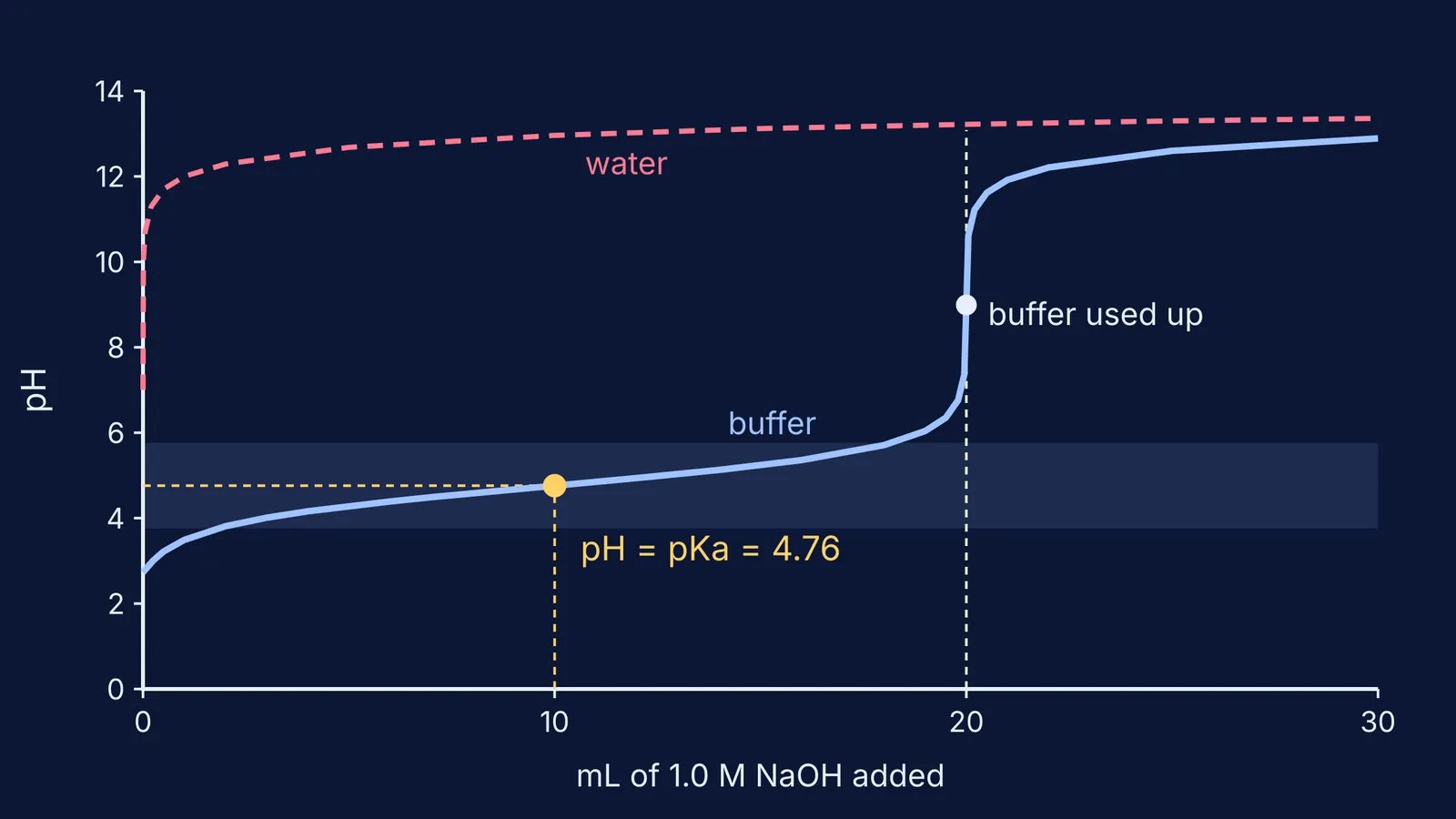
Now titrate 100 mL of 0.20 M acetic acid (20 mmol) with 1.0 M NaOH, as in the diagram at the top.
Each mL of NaOH turns 1 mmol of acid into acetate. At 10 mL, half-way to equivalence, you have 10 mmol of HA and 10 mmol of A⁻. The ratio is 1 and log 1 = 0, so pH = pKa = 4.76, whatever the concentrations (LibreTexts/17%3A_Additional_Aspects_of_Aqueous_Equilibria/17.02%3A_Buffered_Solutions)). The curve is flattest here, with equal reserves against acid and base, so chemists pick a buffer whose pKa is close to the pH they need.
On the curve, the pH starts at 2.73 and stays in the shaded pKa ± 1 band from about 2 to 18 mL. At 20 mL the acid is used up: the pH passes about 9 (acetate is a weak base), then tops 11 within half a millilitre. Water, dashed, passes pH 10 with the first drop.
A five-step plan for your simulation session
Predict each beaker's pH and name the species that will react with the added H⁺ or OH⁻.
Add acid in equal steps and plot pH against amount added.
Mark where the pH starts falling fast and check it against the moles of conjugate base you started with.
Repeat with base, and read the pKa off the half-way point.
Double both buffer concentrations. The starting pH should stay the same, but the buffer should last twice as long.
If a result surprises you, the Fermi Concept Library has a lesson for each chemistry concept; read the one behind it and run the simulation again. For physics ideas that are easier to see than to read, the Fermi Simulation Lab has interactive simulations.


