On this page
In February 1964, Charles Yanofsky and four colleagues at Stanford University published a paper titled On the colinearity of gene structure and protein structure. Working with the bacterium *E. coli*, they showed that when you line up the mutations along a gene, and then line up the amino acid changes those mutations cause in the protein, the two lists fall in the same order. Your textbook states this in one line. Yanofsky turned it from an assumption into evidence.
What is gene–protein colinearity?
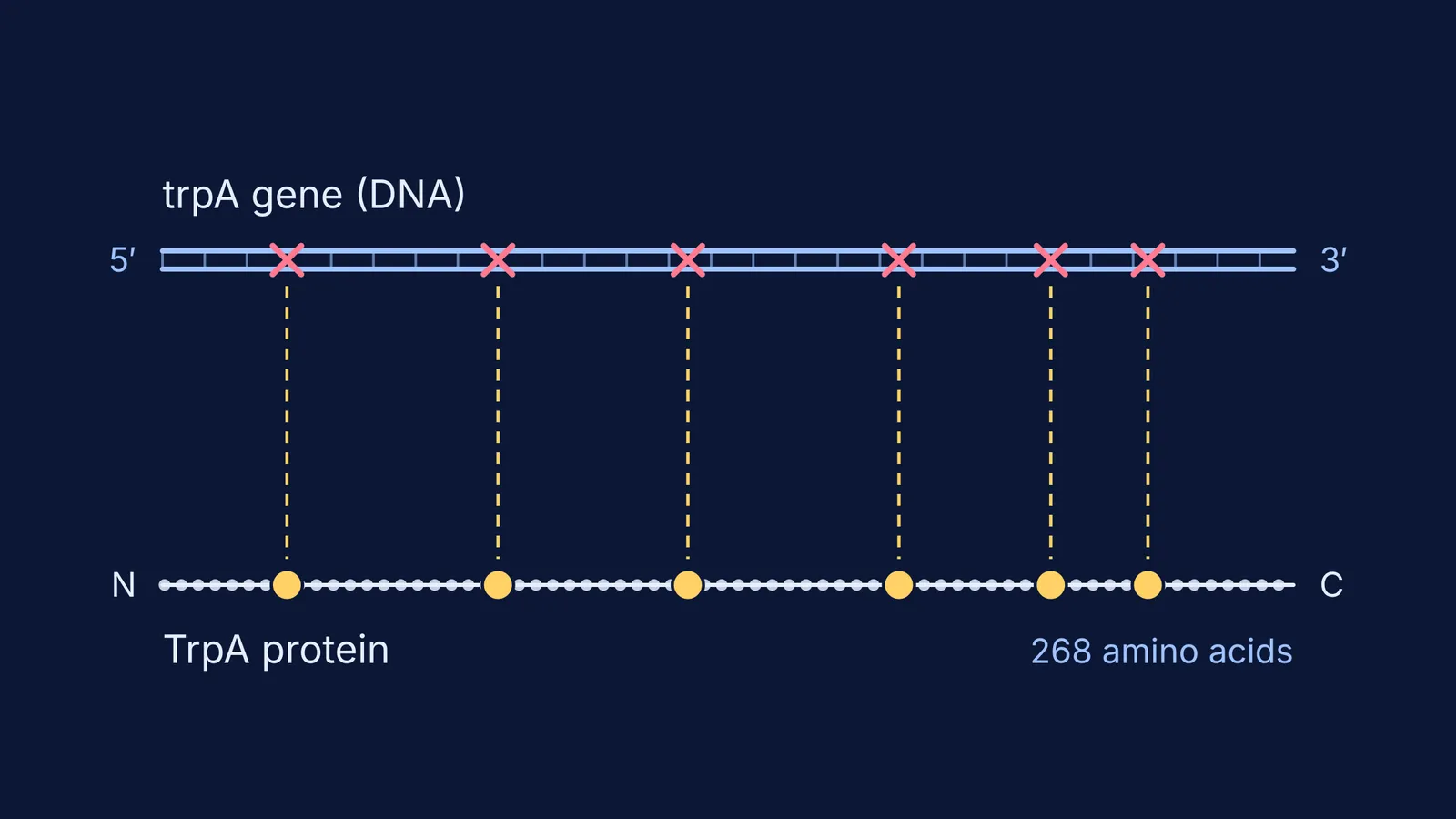
Colinearity means that a position along a gene corresponds to a position along its protein: a mutation near one end of the gene changes an amino acid near the matching end of the protein.
The National Academy of Sciences memoir of Yanofsky explains why this was hard to prove: “Even after it was clear that DNA was the genetic material, it was not trivial to show that DNA and proteins are co-linear. After all, sequencing technologies had not been developed.” A decade after the 1953 double helix model, nobody could yet read a gene letter by letter. Yanofsky later called colinearity “the most challenging problem I initially attacked” (Annual Review of Biochemistry, 2001).
How did Yanofsky prove colinearity?
He made two maps of the same gene with completely different tools, then checked whether they agreed. His gene was *trpA*, which codes for the A protein of tryptophan synthetase. In Yanofsky's own account in the journal Genetics (2005), the work had three steps:
Map the mutations. His research assistant, Ginny Horn, isolated many *trpA* mutants and crossed them in pairs using a phage called P1kc. How often two mutants recombined gave the map distance between their sites.
Find each amino acid change. Each mutant protein was cut with trypsin or chymotrypsin, and the pieces were spread into a two-dimensional “fingerprint”. This was the method Vernon Ingram used on sickle-cell haemoglobin. In about half the mutant proteins first examined, one peptide moved differently, and sequencing that peptide revealed the change.
Compare the two orders. By 1962, the group saw that mutants close together on the gene map had changes in the same peptide. In 1967, they published the complete amino acid sequence of the protein and its colinear relationship with the genetic map. Yanofsky described it as the longest polypeptide sequenced up to that time.
The *E. coli* TrpA protein is 268 amino acids long (UniProt entry P0A877).
Why was tryptophan synthetase the right protein?
Yanofsky's Genetics essay points to two features that helped. First, a broken TrpA protein could still be detected with antibodies as “cross-reacting material”, so inactive mutant proteins could be collected and studied. Second, TrpA and its partner TrpB raise each other's activity 30- to 100-fold when mixed, which let the team test mutant proteins indirectly.
Who else showed colinearity in 1964?
In January 1964, A. S. Sarabhai, A. O. W. Stretton, Sydney Brenner and A. Bolle reported co-linearity of the gene with the polypeptide chain in a head protein of phage T4. The memoir notes that Yanofsky used missense mutants, which swap one amino acid for another. Brenner's group used nonsense mutants, which cut the protein short. Seymour Benzer, Brenner and Yanofsky shared the 1971 Albert Lasker Award in Basic Medical Research for their individual contributions to molecular genetics.
How do you explain colinearity in an exam answer?
Try this worked example. The data are made up, but the reasoning is Yanofsky's. Mutants P, Q, R and S map in the order P–Q–R–S along a gene. Their amino acid changes are at residues 175 (R), 30 (P), 234 (S) and 80 (Q).
Sort the residues: 30, 80, 175, 234.
Read off the mutants in that order: P, Q, R, S.
That matches the map order, so the data are colinear.
If Q had changed residue 200 instead, it would come after R in the protein but before R on the map. You would recheck the map before concluding anything.
Compare the order, not the exact distances, because distances from recombination are estimates. And keep mutation and recombination apart: mutation creates the changed sites, and recombination between them is what lets you map them.
For a four-line answer:
Define colinearity.
Name Yanofsky, 1964, *E. coli* and the *trpA* gene.
Give the two methods: a recombination map and protein fingerprinting.
Conclude that the order of codons in the gene matches the order of amino acids in the protein.
If the jump from gene map to protein is hard to picture, the Fermi Concept Library gives every biology concept its own lesson and its place in the map. Fermi's AI tutor can work out what you already know and build a plan for the session.
Yanofsky died in 2018, aged 92. In a 1991 editorial quoted in his memoir, he wrote that “the proper practice of science demands intellectual and experimental commitment until the process under scrutiny is thoroughly understood.” Colinearity is what that kind of patience produced.