On this page
Charles Messier hunted comets, and he kept running into faint, fuzzy patches that looked like comets but never moved. So he wrote them down as things to ignore. That list of distractions still holds some of the best-known galaxies and nebulae you can see from a backyard.
What is the Messier catalogue?
The Messier catalogue, which Messier called the Catalog of Nebulae and Star Clusters, is a list of deep-sky objects visible from northern latitudes, numbered M1 to M110 (SEDS Messier Database).
Messier published it in three steps, according to the same SEDS history. The first edition, printed in 1774, covered M1 to M45. A supplement in 1780 took it to M68. The final version, published in 1781 in the French almanac Connoissance des Temps, ran to M103.
The last seven numbers were added long after his death, largely from notes left by Messier and his colleague Pierre Méchain. Camille Flammarion added M104 in 1921, Helen Sawyer Hogg added M105 to M107 in 1947, Owen Gingerich added M108 and M109 in 1960, and Kenneth Glyn Jones added M110 in 1967 (Messier object, Wikipedia).
The objects fall into six kinds: open clusters, globular clusters, diffuse nebulae, planetary nebulae, supernova remnants and galaxies.
Why did Charles Messier list things that were not comets?
Messier was born on 26 June 1730 in Badonviller, France, and died in Paris on 12 April 1817 (Charles Messier, Wikipedia). In 1751 he joined Joseph Nicolas Delisle, astronomer of the French Navy, and learned to keep careful records of his observations. He went on to discover 13 comets, and King Louis XV nicknamed him the "Ferret of Comets".
The catalogue began with a mistake. While following a comet in 1758, Messier found a comet-like patch in Taurus on 28 August 1758 (SEDS biography of Messier). The patch was not moving against the stars, so it could not be a comet. He measured its position on 12 September 1758, and it became M1.
Later in life he explained his purpose in his own words, quoted in the SEDS biography: "This nebula had such a resemblance to a comet in its form and brightness that I endeavored to find others, so that astronomers would no more confuse these same nebulae with comets just beginning to appear."
Which famous objects are in the Messier catalogue?
The "nebula" that started it all, M1, is now known as the Crab Nebula, the remains of a star that exploded as a supernova, which Chinese astronomers recorded as a "guest star" in 1054 (NASA Hubble: Messier 1). NASA puts it about 6,500 light-years away.
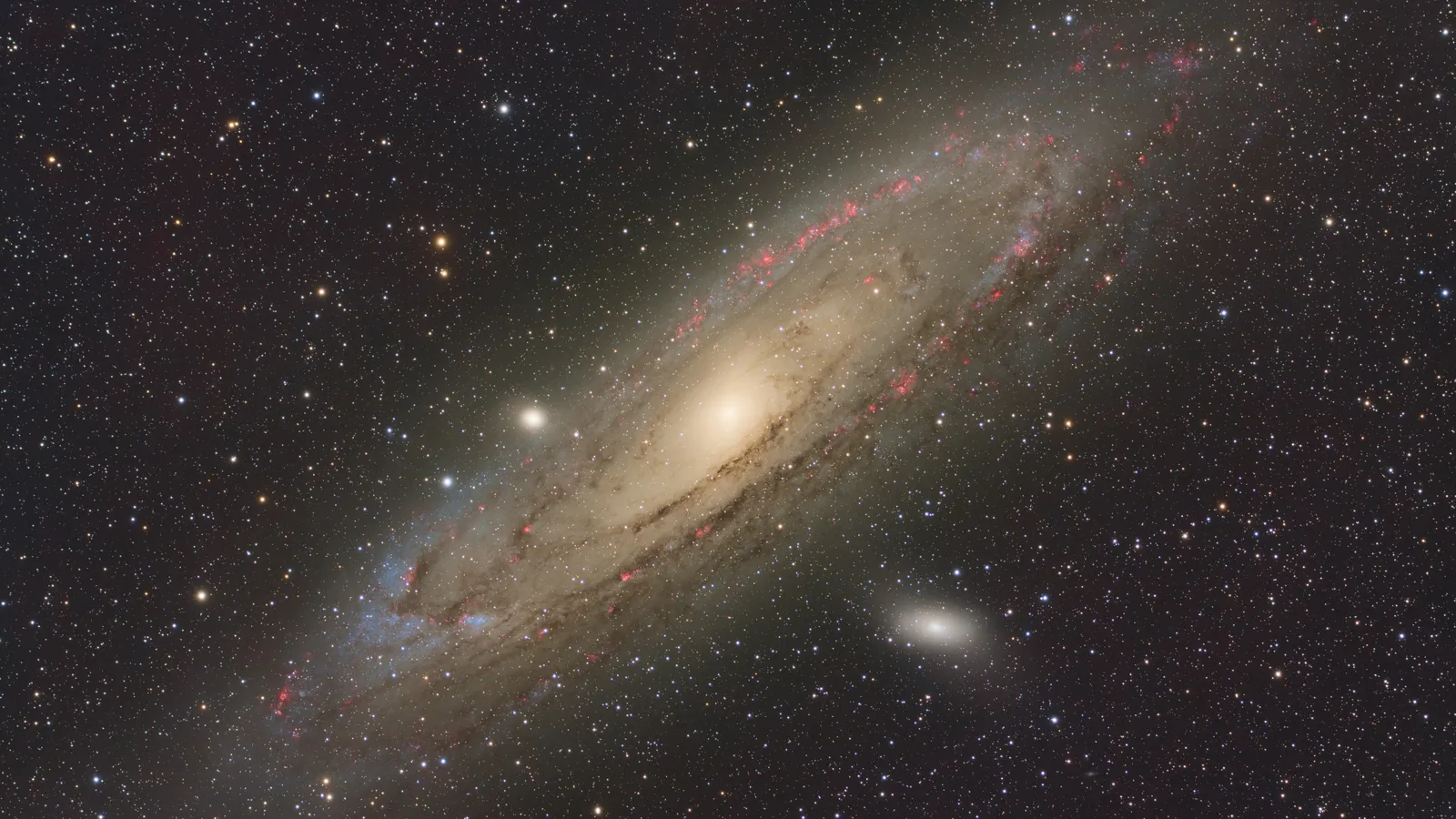
M31 is the Andromeda Galaxy, a spiral galaxy about 2.5 million light-years away that can be seen with the naked eye even under moderate light pollution (NASA Hubble: Messier 31). Messier had no way to know it was a separate galaxy; to him it was another fuzzy patch. Sorting such patches into types came much later, as our post on Hubble's tuning fork diagram of galaxy types explains.
Other well-known entries, listed by type in the SEDS Messier object index, include:
M42, the Orion Nebula, a star-forming nebula
M45, the Pleiades, an open star cluster
M44, the Beehive Cluster (Praesepe), another open cluster
M57, the Ring Nebula, a planetary nebula
The Hubble Space Telescope has observed 96 of the 110 objects, and NASA calls them good targets for backyard astronomers with binoculars or a small telescope and a fairly dark sky (NASA Hubble Messier Catalog).
How can you tell a comet from a Messier object?
Messier's test still works with binoculars and a notebook.
On night one, sketch the fuzzy patch and the three or four brightest stars around it. Note the date and time.
On night two, at about the same time, sketch the same field again.
Compare. If the patch sits in the same place relative to those stars, it is a fixed object such as a nebula, cluster or galaxy.
If it has shifted, check a third night. A steady drift in one direction is what a comet does as it travels around the Sun.
Check your fixed patch against a Messier list. If it matches, you have found what Messier found.
A worked example: you see a faint smudge near the bright stars of Taurus. Two nights later it has not moved against its neighbours. That is the same kind of result Messier got in 1758, and the smudge is M1, the Crab Nebula.
If your school wants to try this as a group, our guide to starting an astronomy club at school on a small budget covers the basics. To make sense of Andromeda's distance, see our post on light years, parsecs and astronomical units, and if a related idea such as parallax is still shaky, the Fermi Concept Library gives every physics concept its own lesson.
On your next clear night, find one Messier object and check it on two nights, as Messier did.