On this page
Your teenager offers to show Dadi how to make a WhatsApp video call. That small favour does two jobs: your child practises explaining clearly and patiently, and your parents become safer online, because their teacher can also show them which calls to hang up on.
Why should a child teach grandparents to use a smartphone?
Teaching helps the teacher. In a 2014 study in Memory & Cognition, Nestojko, Bui, Kornell and Bjork had people study a passage either for a test or to teach it to another student. In the end everyone took the test and nobody actually taught. Those who expected to teach recalled the passage more completely and in a more organised way, and generally answered more questions correctly, especially about the main points.
When a teenager has to explain how a fake bank message differs from a real one, they have to sort out what they know first.
How do you teach a grandparent to use a smartphone without losing patience?
Frustration usually comes from rushing and taking over. Agree on five rules first:
They choose the task. Calling a grandchild or reading the news in a bigger font. One task per sitting.
Their hands, your words. The grandparent holds the phone and taps. The teacher only points and talks.
Same name every time. Say “the green phone button” every time, never “dial”, then “call icon”, then “that one”.
Write it down in their language. Keep a small notebook with numbered steps in Hindi, Tamil or whatever they read most easily.
Teach-back the next day. Ask, “Can you show me how you did it?” If they get stuck, add the missing step to the notebook.
What does a first smartphone lesson look like?
The goal: Nani video-calls her grandson in Pune by herself. Her notebook page might read:
Open WhatsApp (the green speech bubble).
Tap the search bar at the top and type “Arjun”.
Tap his name, then the camera icon at the top right.
To end the call, tap the red button.
On day two, she calls Arjun alone while the teacher watches. For rules about little children using a grandparent's phone, see our guide on setting phone rules with grandparents.
Which scams should grandparents learn to spot first?
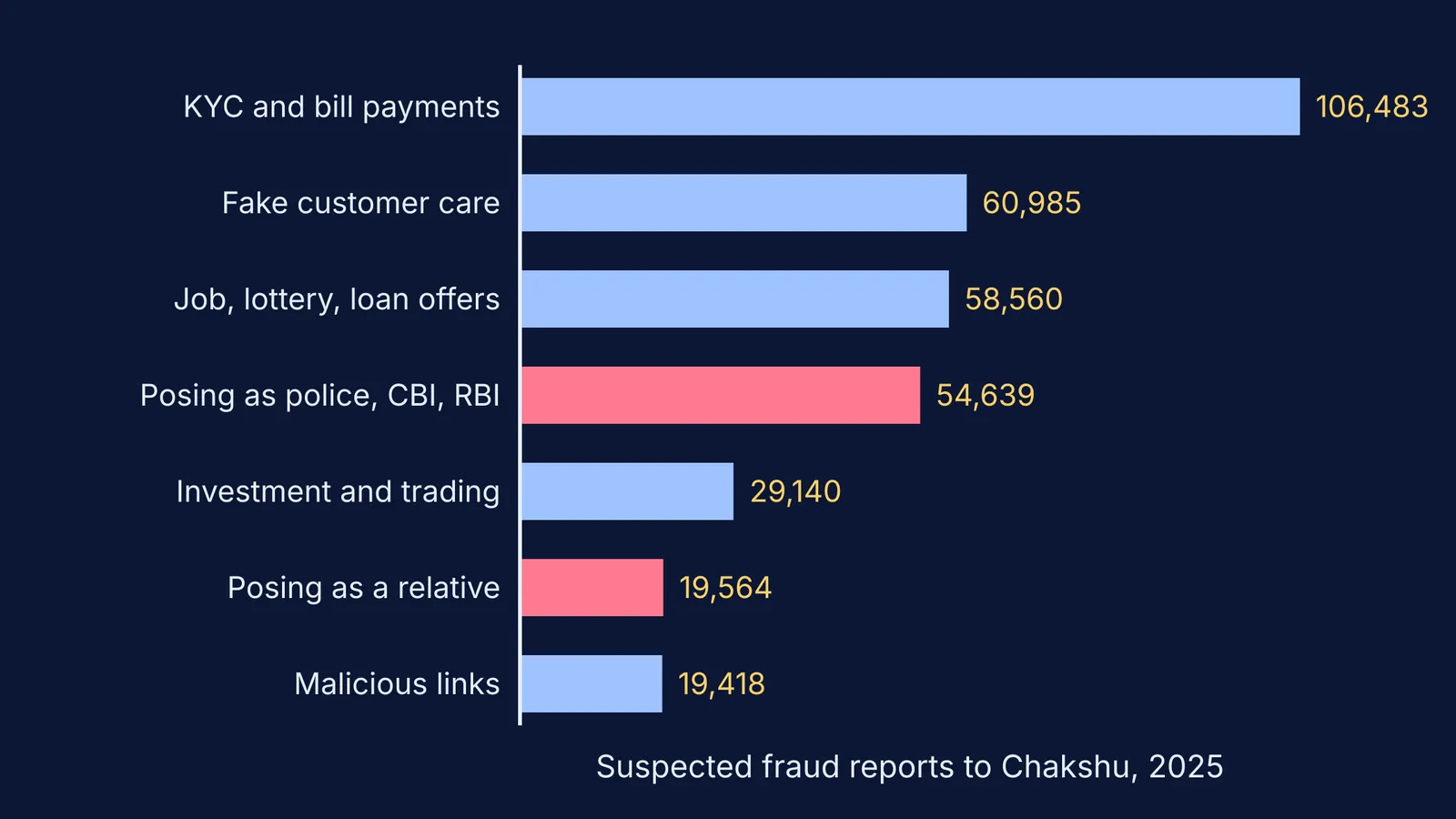
Start with what people actually report. In 2025, citizens reported 519,662 suspected fraud communications through the Chakshu facility on Sanchar Saathi, according to a Department of Telecommunications reply in the Rajya Sabha (PIB, 5 February 2026). The largest named category was KYC and payment messages about banks, electricity, gas or insurance, with 106,483 reports. Callers posing as police, CBI, customs, Aadhaar or RBI officials accounted for 54,639 reports, and callers posing as a relative or friend for 19,564. These are reports of attempts, not confirmed losses.
The “digital arrest” scam relies on fear of authority. In an October 2024 advisory, the Indian Cyber Crime Coordination Centre (I4C) stated that CBI, police, customs, ED officers and judges do not arrest people on video calls. TRAI's August 2025 advisory adds that no regulatory body conducts investigations or collects payments through calls, messaging apps or video platforms.
Then role-play it. Your teen plays a “bank officer” asking for an OTP, and the grandparent practises saying “I will call my bank myself” and hanging up. For the teen's own skills, see our guide to spotting fake news and AI images.
What should grandparents do if a call feels wrong?
In the October 2024 Mann Ki Baat, the Prime Minister invoked the mantra “Ruko, Socho Aur Action Lo” (stop, think, take action), and urged people to report to the 1930 helpline. Turn it into a card for the fridge, written by your teen:
Ruko (stop): Hang up. Never share your OTP, PIN, Aadhaar or bank details on a call or video chat. TRAI advises against sharing personal, banking or identification details on calls or video chats.
Socho (think): Real officials do not threaten or ask for money over video. Call your bank or family member yourself, on a number already saved in your phone.
Action lo (act): If money has gone, call 1930 or go to cybercrime.gov.in, then call your bank. If it was only an attempt, report the number on Chakshu through Sanchar Saathi.
Add one family rule: a caller claiming to be a grandchild in trouble gets a call back on the saved number before any money moves. For a younger child, the same ideas work as a gentler online safety talk with a 10-year-old.
If your teen enjoys explaining, they can use the habit for school too: Fermi's AI tutor checks understanding as it goes and decides whether to explain, ask or show. For this week, pick one task and one scam, and book the first lesson.