

On this page
A forward lands in the family WhatsApp group: a dramatic photo, a caption in capitals, "share before it gets deleted". "Don't believe everything online" does not help much. A short routine your teen can run on any post, practised with you on real examples, does.
Why do smart teenagers fall for fake posts?
Being good at studies does not make someone good at checking sources. In a Stanford-led assessment of 3,446 US high school students with live internet access, more than half believed an anonymous Facebook video was "strong evidence" of voter fraud, and two thirds could not tell news stories from adverts on a website's home page (Breakstone et al., Educational Researcher, 2021). Students were swayed by weak signals such as a site's look, its top-level domain and its About page.
The fix can be taught. Lateral reading means leaving an unfamiliar website to search the open web before investing attention in the site itself (Wineburg et al., Journal of Educational Psychology, 2022). In that district-wide field study, 271 high school students taught strategies drawn from professional fact checkers grew significantly in judging the credibility of online content, compared with 228 peers in regular classes.
What should my teenager check before sharing a viral post?
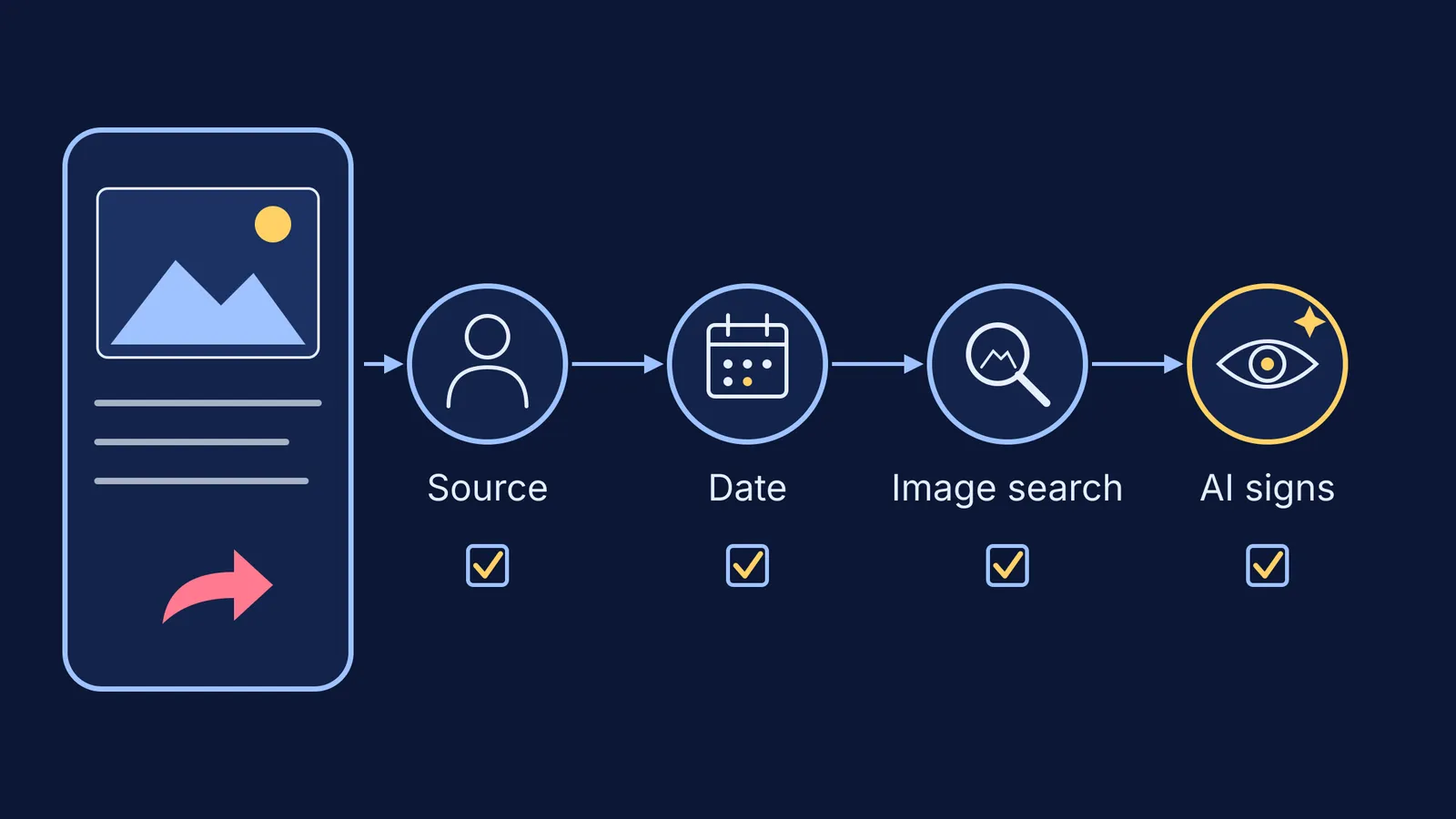
Four questions, in this order. Only the last depends on how convincing the post looks.
Who is behind it? Not who forwarded it, but who posted it first. Open a new tab and search the account or website name.
When is it from? Old photos come back during floods and exam seasons. Find a date, then check whether news sites reported it then.
Where else does the picture appear? Run a reverse image search. On a computer, go to google.com, click Search by image and upload the file; in Chrome you can right-click an image and choose "Search with Google Lens" (Google Search Help). A "today" photo on a page from years ago is your answer.
Are there signs it was made by AI? Look at hands, ears and teeth, writing on signs or clothes, reflections and shadows, and backgrounds that blur into each other. Treat a glitch as a strong clue. Treat no glitch as no clue at all.
Can you tell an AI-made picture just by looking?
Not reliably, which is why AI signs come last. In a 2022 study, people judging whether faces were real or made by AI were right 48.2% of the time, close to the 50% you would get by guessing (Nightingale and Farid, PNAS, 2022). After a short tutorial on rendering artefacts and feedback on every answer, accuracy rose only to 59.0%. The authors' explanation: "some synthetic faces simply do not contain perceptually detectable artifacts." They also found AI-made faces were rated as more trustworthy than real ones.
So "I can't tell" is a fine answer; then go back to source, date and reverse search. Labels are not proof either. Google's "About this image" can show when Google may have first seen the image or similar ones and pages where it appeared much earlier, but Google itself notes that credit and source metadata can be changed with image generation and editing tools, and the feature is only available in some regions (Google Search Help).
How do you practise this together at home?
Once a week, check one real forward together: your teen holds the phone, you ask the questions.
A made-up but typical example: a screenshot saying an exam has been postponed, with an official-looking logo.
Source: it names no website. Your teen opens the exam body's official notices page. Nothing there.
Date: none at all, a warning in itself.
Image search: if Google Lens finds the same screenshot from an earlier year, the case is closed.
Verdict: fake, without ever judging the logo.
More on this in what to do when JEE Main and NEET-UG Telegram rumours cause panic.
What to say:
"I'm not sure about this one. Want to check it with me?"
"Who posted this first? Let's find out before we decide."
For claims about government announcements, the Press Information Bureau runs PIB Fact Check, which accepts posts on WhatsApp at +91-8799711259 (PIB Fact Check). When a viral post makes a science claim, look up the idea itself in the Fermi Concept Library, which covers every concept in physics, chemistry, biology, mathematics and computing, so your teen checks the claim against the science rather than another forward. For the wider habit of questioning claims, see how to improve critical thinking skills.
What if the fake image is of your teen or a friend?
Then it is not practice. Save screenshots and links, do not reshare, and report it on the National Cyber Crime Reporting Portal, cybercrime.gov.in, which has a special focus on cyber crimes against women and children; the toll-free National Cyber Crime Helpline is 1930 (PIB). Our guide to talking with your teen about deepfakes and photo sharing covers that conversation. If your teen is very upset, the free Tele MANAS helpline, 14416, connects callers with mental health professionals (PIB).
Start this week: one forward, four questions, fifteen minutes together.


