

On this page
Critical thinking is often treated as a vague, innate talent, but research shows it is a concrete set of skills that must be explicitly taught. Rather than simply absorbing facts, students need to learn how to interpret, evaluate and draw inferences from the information they consume daily.
A landmark 2015 meta-analysis of 341 effect sizes by Abrami et al. found that critical thinking does not develop automatically as a byproduct of standard education. The study showed that immersion alone—where students are expected to pick up analytical skills simply by being in an academic environment—is the least effective method. Instead, critical thinking requires explicit instruction, yielding a weighted mean effect size of 0.30 when taught deliberately across all educational levels.
So, how can educators and parents bridge the gap between rote memorisation and genuine analysis?
How to improve critical thinking skills for students?
The 2015 meta-analysis identified three pedagogical strategies that have positive effects on critical thinking skills:
Dialogue: Engaging in structured class discussions, debates and collaborative inquiry allows students to hear opposing views and defend their own reasoning.
Authentic problems: Exposing students to real-world issues, news and case studies rather than abstract textbook scenarios forces them to apply logic to messy, incomplete data.
Mentoring: One-on-one interaction between an expert and a student helps to model thinking processes and catch errors in reasoning early.
When students encounter an authentic problem but do not know how to approach it, Fermi's AI tutor can step in. It works out what the student already knows, builds a plan for the session, and teaches through it—writing on a board, drawing the figure, running the simulation, and checking understanding as it goes.
How do you question claims in the news?
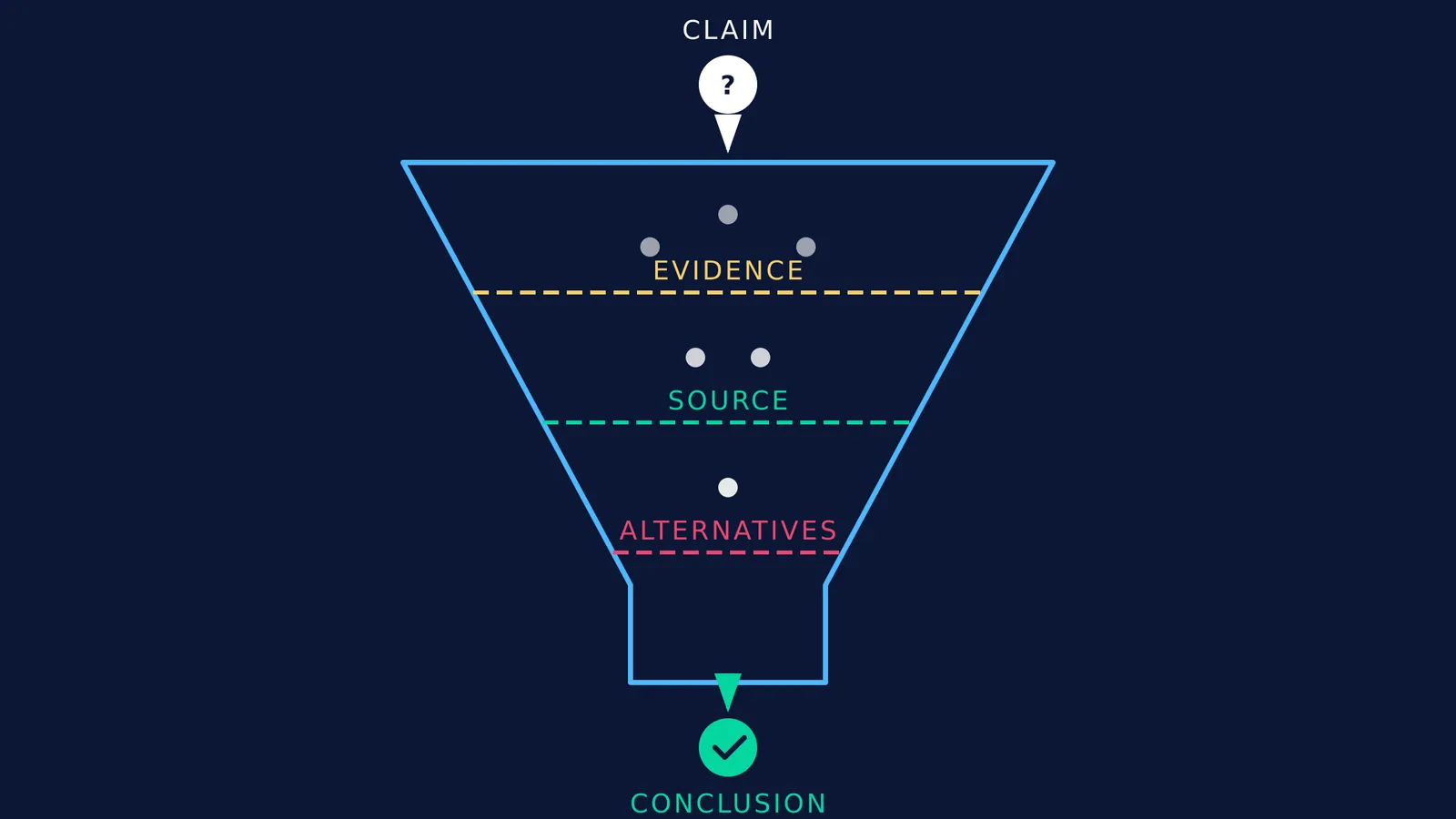
In an era of fast-moving information, media literacy is a core component of critical thinking. To navigate this, students need a repeatable framework for questioning claims they read online or in the news:
Identify the claim: What exactly is the author stating as a fact? Strip away the adjectives and isolate the core assertion.
Examine the evidence: Does the article cite a primary source, such as a peer-reviewed journal? What was the sample size, and was there a control group? (A classic lesson in checking evidence is Francesco Redi and the covered jars of rotting meat).
Evaluate the source: Who is making the claim, and what is their intention? It is vital to distinguish between verified information, personal opinion and interpretive narratives driven by engagement algorithms.
Look for alternative explanations: Are there other reasons for the observed result? Correlation does not equal causation. For an elegant example of looking beyond the obvious, see Abraham Wald and the bullet holes: how survivorship bias works.
How can you practise with science articles?
One of the best ways to improve critical thinking is to practise with current science journalism. When a news article reports that a study "proves" a new medical treatment, students can apply their framework directly.
Imagine an article titled: *New Study Shows Chocolate Improves Memory*.
The claim: Eating chocolate causes better memory retention.
The evidence: The student clicks through to the original paper and finds it was a small study over a short period. There was no control group of non-chocolate eaters.
The source: The research was funded by a confectionery company, which introduces potential bias.
Alternative explanations: Perhaps the participants who ate chocolate also slept better during that time, or were naturally younger.
If students hit a wall with the underlying science—perhaps they do not understand the statistical methods or the biology behind memory formation—they can use the Concept Library to grasp the background concepts.
By pulling apart authentic examples regularly, students move from passive reading to active evaluation. They begin to see that critical thinking is not about being cynical, but about demanding good evidence before updating their view of the world.


