

On this page
What is the Hubble tuning fork diagram?
In December 1926, astronomer Edwin Hubble published "Extragalactic Nebulae" in The Astrophysical Journal. At the time, astronomers debated whether fuzzy celestial patches were local gas clouds or independent star systems outside the Milky Way. After measuring distances using Cepheid variable stars, Hubble sorted a statistical sample of 400 galaxies to organize their visual diversity.
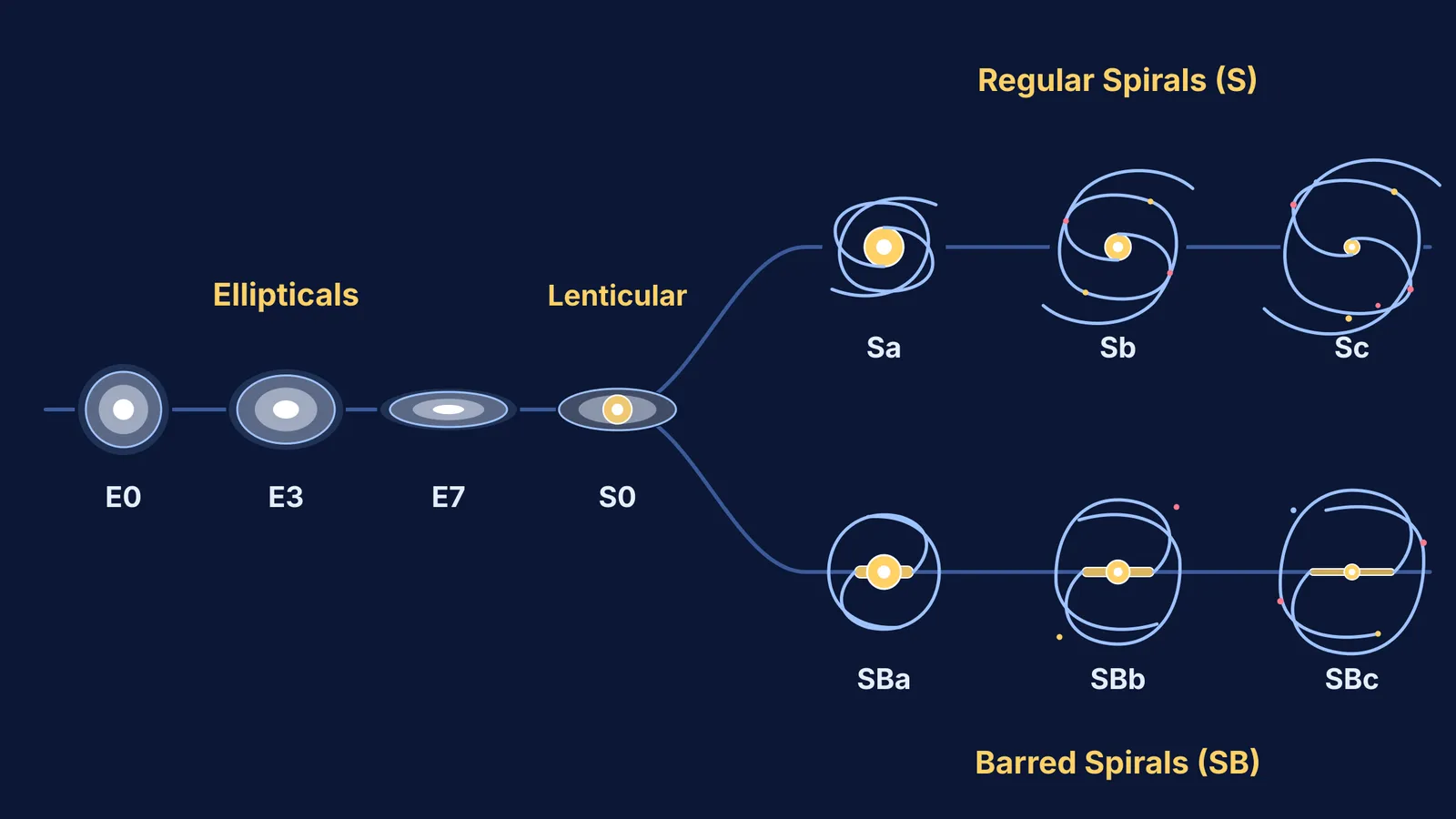
In his initial survey published in The Astrophysical Journal, roughly 17% of galaxies were smooth ellipsoids, 80% were spirals, and about 3% were irregular systems without symmetry. Hubble arranged these shapes into a diagram shaped like a musical tuning fork. Like other visual physics diagrams, the tuning fork diagram turned messy photographic plates into an ordered taxonomy. The handle contains elliptical galaxies, the junction holds lenticular galaxies, and the prongs divide into normal spirals and barred spirals.
How did Edwin Hubble sort elliptical galaxies?
Elliptical galaxies form the handle of the tuning fork and carry the letter E followed by a number from 0 to 7. Hubble defined this number with an empirical formula based on apparent shape:
n = 10 × (1 − b/a)
Here a is the semi-major axis and b is the semi-minor axis. An E0 galaxy appears circular because a equals b, giving 10 × (1 − 1) = 0. An E7 galaxy is the most elongated elliptical observed, where the minor axis is 30% of the major axis (b/a = 0.3), giving 10 × (1 − 0.3) = 7, as established in The Astrophysical Journal.
As detailed in the ESA/Hubble elliptical galaxy guide, this number measures projected shape from our vantage point on Earth. A round-looking E0 may actually be an elongated ellipsoid viewed end-on. Elliptical galaxies consist primarily of old, low-mass stars with little cold gas, leaving them with negligible star formation.
What separates regular spirals from barred spirals?
At the fork's junction sits the lenticular galaxy (S0), possessing a bright central bulge and a disk but no spiral arms. Beyond S0, the sequence splits into two distinct branches:
Normal spirals (S): Arms wind outward directly from the central bulge.
Barred spirals (SB): A central bar of stars runs through the bulge, with arms starting at the bar ends.
According to the ESA/Hubble spiral galaxy guide, approximately two-thirds of all spiral galaxies, including our Milky Way, have a central bar. Both branches use lowercase letters a, b, and c to classify structure:
Sa and SBa: Dominant central bulges with tightly wound, smooth spiral arms.
Sb and SBb: Moderate bulges with intermediate arm winding.
Sc and SBc: Small bulges with open, loosely wound arms resolved into bright star clusters.
Why is the tuning fork diagram not an evolutionary path?
Hubble called ellipticals "early-type" and spirals "late-type." Because the diagram reads left to right, many concluded that galaxies evolve from smooth spheres into loose spirals.
These terms came from stellar spectroscopy, where astronomers once thought stars followed a linear life cycle, an idea connected to Antonia Maury's work on stellar spectral classification. Hubble explicitly warned against this reading. In a 1927 paper in The Observatory, Hubble wrote: "The nomenclature, it is emphasized, refers to position in the sequence, and temporal connotations are made at one's peril."
Modern astrophysics shows that galaxy evolution often runs in reverse. In 1972, Alar Toomre and Juri Toomre published simulations in The Astrophysical Journal proving that colliding spiral galaxies merge into giant spheroidal ellipticals through gravitational tidal forces. Deep observations also show that star-forming spirals existed in the early universe, explaining why space telescopes observe in the infrared to study them.
How can you classify a galaxy with Hubble's criteria?
You can classify an unfamiliar galaxy image with a straightforward four-step checklist:
Check for disk features: If the system is a featureless oval, measure major axis a and minor axis b, then compute n = 10 × (1 − b/a) to find its class from E0 to E7.
Check for spiral structure: If a disk surrounds the central bulge but lacks spiral arms, classify it as lenticular (S0).
Look for a central bar: If spiral arms emerge directly from a round nucleus, follow the normal branch (S); if they emerge from a straight bar, follow the barred branch (SB).
Gauge bulge size and arm winding: Match the galaxy to tight arms with a large bulge (type a), moderate winding (type b), or loose, clumpy arms with a tiny core (type c).
Mastering rotational mechanics and gravitational orbits helps build intuition for why cosmic structures form disks and bars. If you want to connect these shapes to physical laws, the Fermi Concept Library covers every concept in physics, chemistry, biology, mathematics and computing, each with its own lesson and its place in the map. To see how angular momentum and central mass govern orbits interactively, the Fermi Simulation Lab provides interactive simulations for ideas that are easier to see than to read. For practice with rotational dynamics and center-of-mass questions, the Fermi Problem Library offers worked problems with a step-by-step solver that explains the reasoning rather than printing an answer.


