

On this page
When you look at the stunning images from the James Webb Space Telescope (JWST), you are not seeing the universe exactly as your eyes would. Unlike the Hubble Space Telescope, which primarily observes visible and ultraviolet light, Webb is built to capture infrared radiation. This design choice was not accidental. It is the key to uncovering the oldest and most hidden secrets of the cosmos. By shifting our view into the infrared, astronomers can pierce through opaque veils of gas and look back in time to the very first galaxies.
Why does the James Webb telescope use infrared light?
The primary reason the James Webb Space Telescope uses infrared light is to solve problems that visible-light telescopes simply cannot. The universe presents three major physical hurdles to optical astronomy: cosmic dust blocks our view, the expansion of space stretches old light beyond visibility, and many fascinating objects are simply too cold to shine.
To overcome this, Webb is equipped to detect wavelengths ranging from 0.6 to 28.5 microns, spanning the near-infrared and mid-infrared spectrum NASA. By observing at these longer wavelengths, Webb acts as a powerful, heat-seeking eye in the sky.
How does infrared light see through cosmic dust?
Space is not perfectly empty. Vast regions, especially where new stars are born, are filled with cosmic dust made of tiny carbon and silicate particles. When visible light from young stars hits these particles, it scatters in all directions. To optical telescopes, these star-forming regions appear as dark, empty voids.
Infrared light behaves differently because of its longer wavelength. Instead of bouncing off the microscopic dust grains, infrared waves are long enough to slip past them almost entirely undisturbed. This allows the infrared radiation to travel straight out of the nebula and reach Webb's mirrors. By tuning into these wavelengths, astronomers can strip away the dust clouds and see the bright, forming stars hidden inside. If you have ever wondered how light behaves when moving through different materials, the principles are closely tied to how light entering glass changes its properties.
What is cosmological redshift?
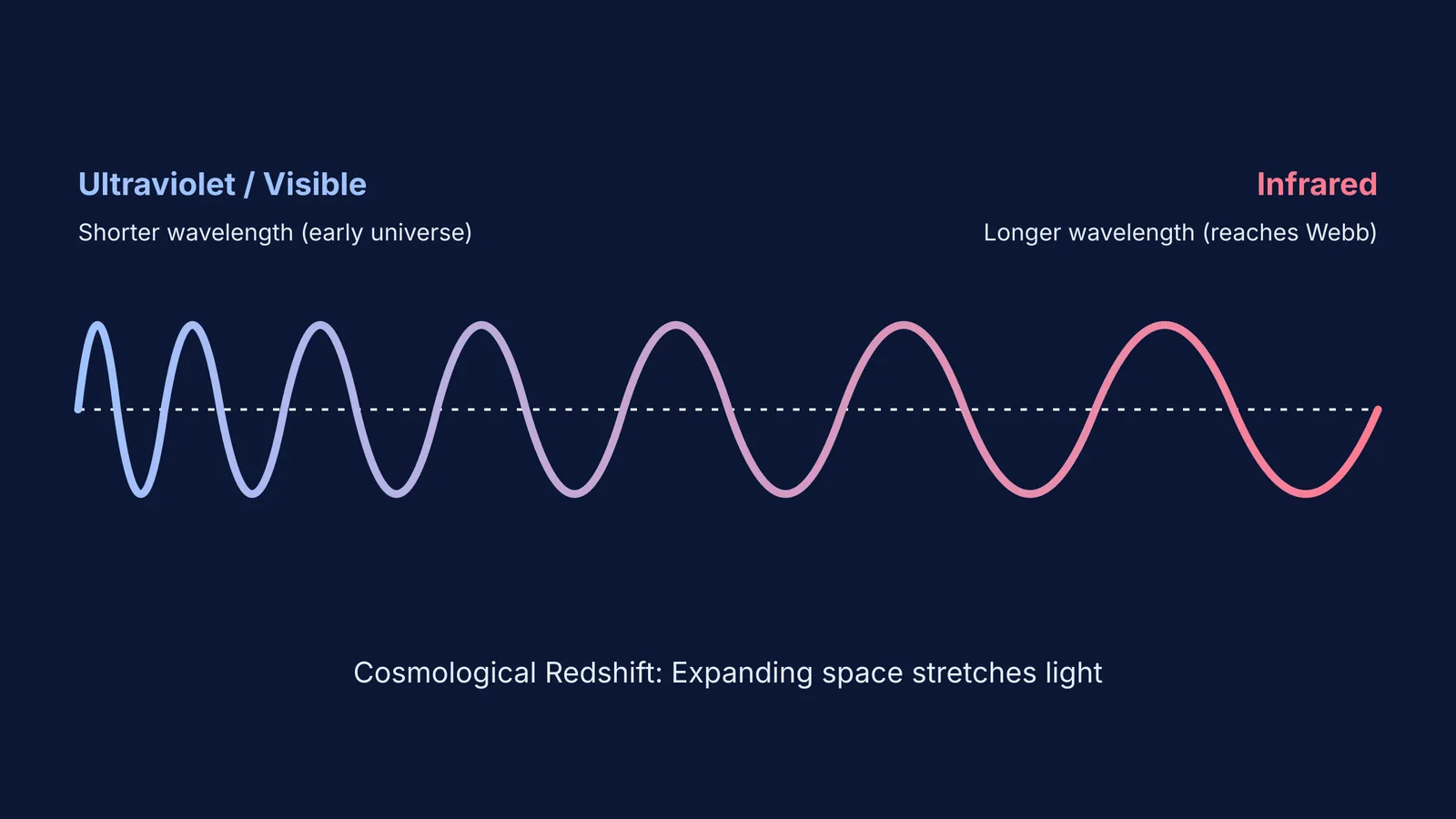
The most ambitious goal of the JWST is to see the first stars and galaxies that formed after the Big Bang. However, the universe has been expanding ever since. As light travels across this expanding space, the space itself stretches, and the light wave stretches with it.
Light that was originally emitted as short, energetic ultraviolet or visible light billions of years ago is pulled into longer, lower-energy wavelengths by the time it reaches Earth. This phenomenon is known as cosmological redshift. The first galaxies are moving away from us so fast, and their light has been travelling for so long, that their visible light has shifted entirely into the infrared.
You can trace the history of this discovery back to astronomers like Vesto Slipher and the first redshifts of galaxies. For physical ideas like wave stretching that are easier to see than to read, the Fermi Simulation Lab provides interactive simulations to help you visualise the change in wavelength.
Why are some objects only visible in infrared?
Even without dust or redshift, visible light is not always the best way to see the universe. Objects only emit visible light if they are extremely hot, like stars. But many celestial bodies—such as exoplanets, asteroids, and "failed stars" known as brown dwarfs—are far cooler.
These cooler objects emit almost all of their energy as heat, which takes the form of mid-infrared radiation. Webb’s instruments are so sensitive that they can detect the faint thermal glow of a planet orbiting a distant star. To do this, the telescope itself must be kept incredibly cold. Its mid-infrared instrument is cryogenically cooled to −266 °C so that the telescope's own heat does not drown out the faint signals from deep space ESA.
A study plan for physics students
If you are preparing for exams like JEE or NEET, the physics behind the JWST is an excellent way to test your understanding of waves and thermodynamics. Here is a quick checklist to connect the telescope's engineering to your syllabus:
The electromagnetic spectrum: Memorise the order of wavelengths, from gamma rays down to radio waves. Know exactly where visible light sits relative to infrared.
Heat and radiation: Review Wien's displacement law, which states that the peak wavelength of emission shifts to longer (infrared) wavelengths as an object's temperature drops.
Scattering of light: Look over Rayleigh scattering, which explains why shorter wavelengths scatter more easily than longer ones, and apply it to cosmic dust.
The Doppler effect: Compare the cosmological redshift to the Doppler effect for sound and light that you learn in class.
By seeing how the physics you learn in the classroom is used to look at the edge of the universe, the concepts and formulas become much easier to remember.


