

On this page
When you first encounter astronomical distances in physics or for an exam like JEE Main, the numbers can be overwhelming. Writing out the distance to the nearest star in metres requires too many zeros to be practical. That is why astronomers use three distinct units: the astronomical unit, the light year, and the parsec.
Understanding how each is defined and how they convert into metres is a standard requirement for competitive exams.
What is an astronomical unit (au)?
The astronomical unit was originally defined as the average distance between the Earth and the Sun. Because the Sun's mass is slowly decreasing, causing the Earth's orbit to slowly expand, the International Astronomical Union (IAU) redefined the au in 2012. Today, one astronomical unit is exactly 149,597,870,700 m (Source).
For most calculations, you can approximate this as: 1 au ≈ 1.5 × 10¹¹ m
Astronomers use the au primarily to measure distances within our solar system. Because the Earth is 1 au from the Sun, it provides a convenient yardstick for planetary distances.
How many metres are in a light year (ly)?
A light year is the distance that light travels in a vacuum in one Julian year of exactly 365.25 days (Source). Since the speed of light in a vacuum is exactly 299,792,458 metres per second, we can calculate this distance precisely.
One light year is exactly 9,460,730,472,580,800 m.
For exams, the standard approximation is: 1 ly ≈ 9.46 × 10¹⁵ m
This unit is most commonly used by the general public to describe distances to stars and other galaxies, as it makes it easy to understand how long light from those objects takes to reach us.
What is a parsec (pc) and how is it defined?
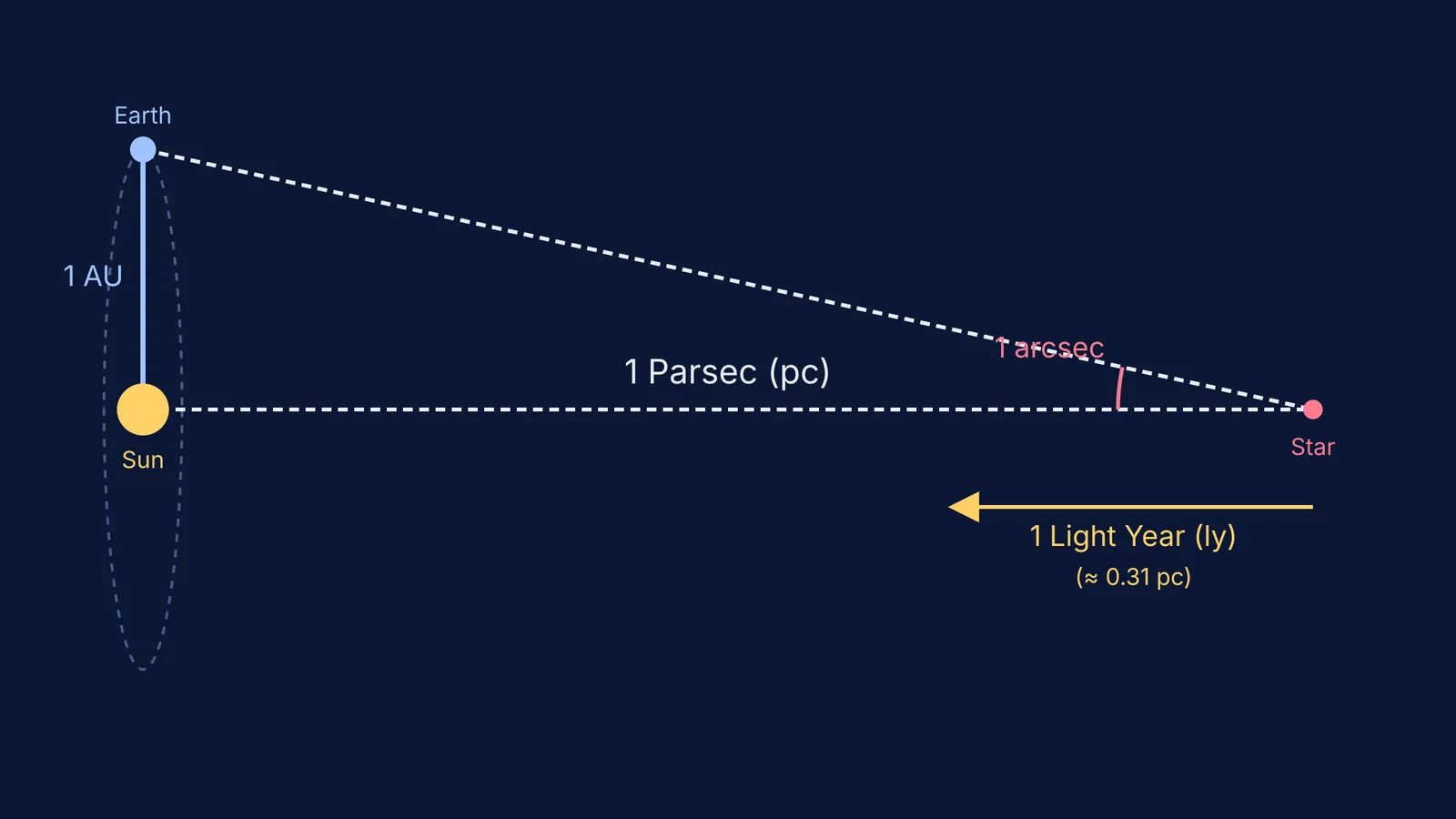
The parsec is the preferred unit of distance for professional astronomers. The word itself is a portmanteau of "parallax of one arcsecond". It is defined geometrically as the distance at which one astronomical unit subtends an angle of one arcsecond.
In 2015, the IAU defined the parsec as exactly 648,000/π au (Source).
Converting this to metres gives approximately 30,856,775,814,913,673 m, which is usually rounded to: 1 pc ≈ 3.1 × 10¹⁶ m
The concept of parallax is something you experience every day. If you hold your finger in front of your face and close one eye, then the other, your finger appears to jump back and forth against the background. Astronomers use this exact same effect to measure distances to nearby stars. By measuring a star's position in the sky, and then measuring it again six months later when the Earth is on the opposite side of its orbit, they can calculate the angle of the shift. This angle is the parallax. The parsec is the distance at which this shift would be exactly one arcsecond when viewed from an orbit of 1 au.
If you have a concept gap regarding the geometry behind a parsec, the Fermi Concept Library has every concept in physics, chemistry, biology, mathematics and computing, each with its own lesson and its place in the map.
How to convert between these units
Knowing how these units relate to each other is just as important as knowing their values in metres, as exams frequently test these exact ratios (Source).
1 parsec ≈ 3.26 light years: This is the most common conversion you will need. A parsec is slightly more than three times longer than a light year.
1 light year ≈ 63,241 au: Light travels incredibly fast, covering over 63 thousand times the Earth-Sun distance in a single year.
1 parsec ≈ 206,265 au: Because a circle has 360 degrees, and each degree has 3,600 arcseconds, the geometry of the parsec dictates this exact ratio of 648,000/π.
Framework: which unit should you use?
When setting up a problem, choosing the correct unit makes your calculations significantly easier. Here is a simple framework for deciding which unit to use:
Astronomical Unit (au): Use this for orbital mechanics inside our solar system. If you are applying Kepler's laws of planetary motion, or calculating the distance between Earth and Mars, the au keeps the numbers manageable.
Light Year (ly): Use this when the problem involves the time it takes for an event to be observed. If a supernova occurs several light years away, we know the light will take exactly that many years to reach our telescopes.
Parsec (pc): Use this for observational astronomy and absolute magnitude problems. Because it is directly tied to the geometric measurement of parallax, it simplifies the maths when converting an observed angle into a physical distance.
To avoid mistakes in exams, always convert your astronomical distances to metres first, complete your calculation using standard SI units, and then convert back to the required unit at the end. For more guidance on setting up calculations correctly, see our guides on unit conversion using dimensions and significant figures and units.


