

On this page
No two living things are exactly alike. In biology, we call these differences genetic variation. But where do these differences come from? For students tackling genetics, the two main engines of variation are mutation and genetic recombination. They sound similar, but they do completely different jobs in the cell.
What is genetic recombination?
Genetic recombination is the exchange of genetic material between different organisms or chromosomes. It is the reason offspring have combinations of traits that differ from those found in either parent, rather than being an identical clone.
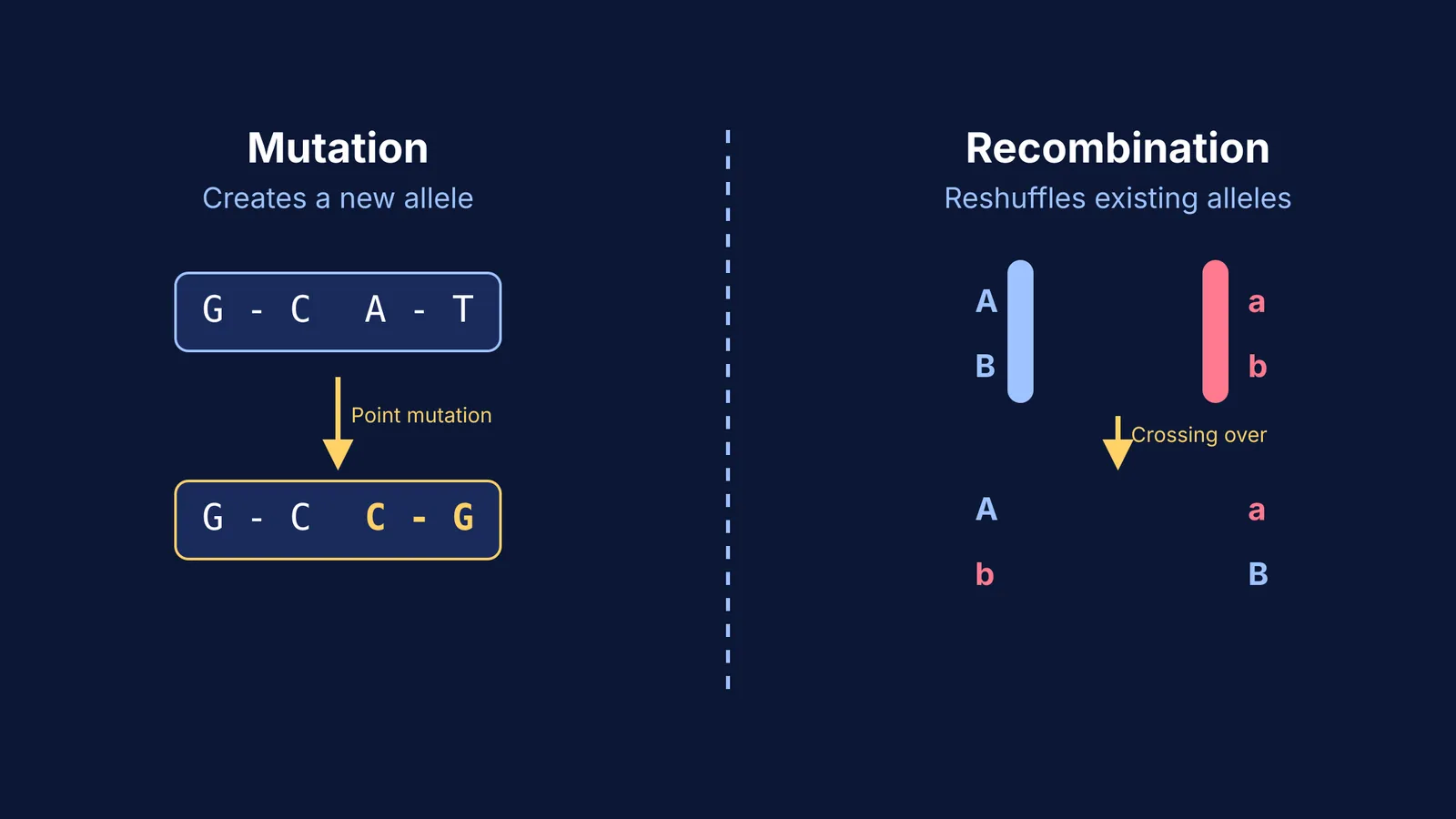
Most natural recombination happens during meiosis, the specialized cell division that produces sperm and egg cells. During this time, non-sister homologous chromosomes pair up closely with one another and physically trade sections of their DNA in a process known as crossing over. This physical exchange creates entirely new combinations of existing genetic information. When these reshuffled chromosomes are passed on to the next generation, they increase the genetic diversity of the population.
Importantly, recombination does not invent new traits. If you think of your genes as a deck of cards, recombination is just a thorough shuffle. It deals a new hand every generation, grouping existing alleles into novel pairings, but it never introduces a new card to the deck.
What is a mutation?
A mutation is a direct alteration in the nucleic acid sequence of an organism's genome. These alterations can happen because of simple copying errors during DNA replication, damage to the DNA from environmental factors, or the insertion and deletion of mobile genetic elements.
Unlike recombination, mutation actually creates new genetic instructions. It is the ultimate source of all genetic variation. When a sequence changes, even by a single nucleotide base pair, it produces a brand-new allele that never existed before. This change can alter the structure and function of the proteins that the gene codes for.
Are these new alleles helpful? Most of the time, no. A 2007 study on *Drosophila* (fruit flies) estimated that if a mutation changes the protein a gene produces, the result is usually harmful, with around 70% of amino acid polymorphisms having damaging effects. The remainder are either neutral or marginally beneficial. However, those rare beneficial mutations are extremely important. They provide the raw material on which evolutionary forces can act, allowing populations to adapt to new challenges over time.
Which one drives Darwin's variation?
When Charles Darwin proposed evolution by natural selection in his 1859 book *On the Origin of Species*, he knew that traits varied within a population and that advantageous traits were passed down to offspring. However, he did not know *how* they were inherited or where these new traits originally came from.
It took decades for biologists to find the complete answer. In the early 20th century, scientists built the modern synthesis), a theoretical framework that combined Darwin's theory of evolution with Gregor Mendel's rules of mathematical heredity. Biologists like Theodosius Dobzhansky helped define this synthesis by establishing that natural selection works on heritable variation supplied primarily by mutation. While recombination spreads these new alleles through a population and creates endless combinations, the raw material for adaptation always begins with a mutation.
A checklist for exam prep
When solving genetics and evolution problems, it is easy to blur these two concepts. Here is a practical way to keep them straight in an exam:
Origin: If a multiple-choice question asks for the "ultimate source" of all genetic variation, the correct answer is mutation.
Process: If a question asks what happens when non-sister homologous chromosomes pair up during prophase I of meiosis, it is referring to recombination or crossing over.
Result: Mutations physically change the DNA sequence itself, producing new alleles. Recombination simply groups existing sequences into new combinations on a chromosome.
Keeping track of how these ideas overlap can be tricky when you are buried in textbook chapters. The Fermi Concept Library contains every concept in physics, chemistry, biology, mathematics and computing, each with its own lesson and its place in the map. It helps you see how cellular processes like meiosis connect directly to large-scale evolutionary theory without getting lost in the details.
If you are currently studying how these traits are inherited, you might also find it helpful to review the difference between a test cross and a back cross, explore specific examples of Mendelian disorders, or read about Theodosius Dobzhansky and his historical role in the modern evolutionary synthesis.


