

On this page
NCERT's Class 12 Evolution chapter gives you natural selection, then the Hardy-Weinberg principle, and leaves you to join them. In the 1930s many biologists could not join them either. Theodosius Dobzhansky did much of that joining. This post covers who he was, what his 1937 book changed, what wild fruit flies showed him, and a worked Hardy-Weinberg problem of the kind his work relied on.
Who was Theodosius Dobzhansky?
The fullest short account is by Francisco Ayala and Walter Fitch, who opened a 1997 National Academy of Sciences colloquium marking the book's 60th anniversary. They record that Dobzhansky was born on 25 January 1900 in Nemirov, a small town about 200 km southeast of Kiev. As a schoolboy he collected butterflies, then switched to ladybird beetles, the subject of his first scientific paper in 1918.
He graduated in biology from the University of Kiev in 1921 and in 1924 joined Yuri Filipchenko's new genetics department in Leningrad, where he started working with Drosophila fruit flies. A Rockefeller fellowship brought him to New York on 27 December 1927 to work with Thomas Hunt Morgan at Columbia University. Our post on Thomas Hunt Morgan's fruit fly work covers what that lab had already found.
He followed Morgan to Caltech in 1928, returned to Columbia in 1940, moved to the Rockefeller Institute in 1962 and to the University of California, Davis, in 1971. He died of heart failure on 18 December 1975. Ayala and Fitch note that he had been working in the laboratory the day before.
What problem did Genetics and the Origin of Species solve?
Darwin's theory had a gap: it had no working theory of inheritance. Ayala and Fitch explain that by the 1930s R. A. Fisher, J. B. S. Haldane and Sewall Wright had shown mathematically that selection acting on small Mendelian differences could produce large changes. But that work had limited impact on biologists, because it was written in mathematics most of them could not follow, had little experimental support and left out questions such as how species form. You can read more about one of those three in our post on J. B. S. Haldane.
Dobzhansky's book, published in 1937, gave what Ayala and Fitch call "a reasonably comprehensive account of the evolutionary process in genetic terms, laced with experimental evidence". In its preface, quoted in the same paper, he wrote that the book was "dedicated to a discussion of the mechanisms of species formation in terms of the known facts and theories of genetics". It moved from mutation to chromosome changes, variation in wild populations, selection and the barriers that keep species apart. Columbia University Press notes that it went through three editions, in 1937, 1941 and 1951.
What did wild fruit flies show him?
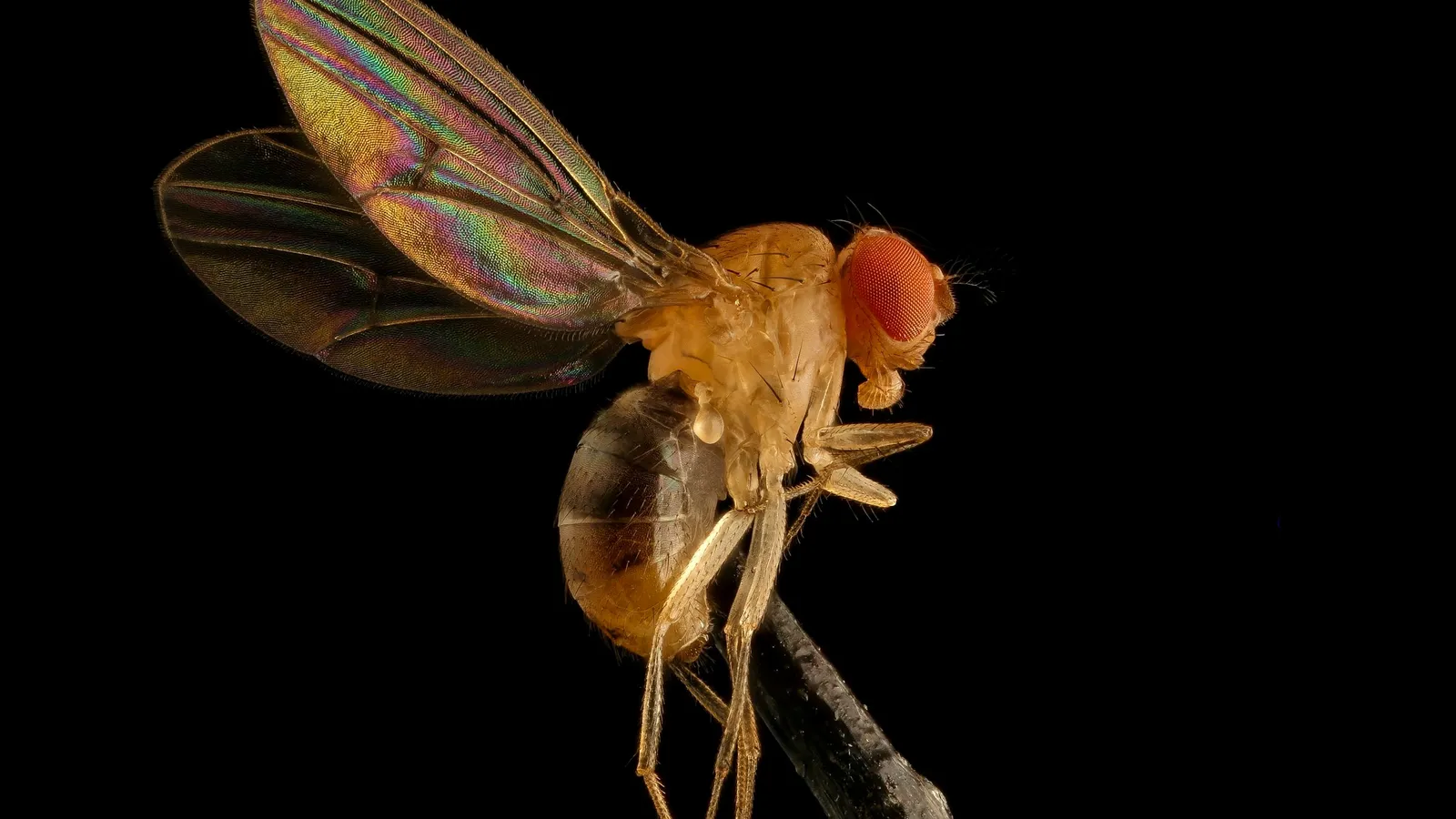
Dobzhansky did not stop at laboratory stocks. With Alfred Sturtevant he published a 1936 paper on inversions in the third chromosome of wild races of Drosophila pseudoobscura, using them to study the history of the species. An inversion is a stretch of chromosome flipped end to end, which can be seen under the microscope, so each fly carries a visible genetic label.
He then ran a long series of papers called Genetics of Natural Populations. The title of number XVI, published in 1948, states its finding plainly: altitudinal and seasonal changes produced by natural selection in populations of two Drosophila species. Ayala and Fitch add that his strength was "a wise blending of field and laboratory research", using laboratory populations to check the causes of patterns found in nature.
Worked example: is a population in Hardy-Weinberg equilibrium?
NCERT states the principle as p² + 2pq + q² = 1 and lists five factors that disturb it: gene flow, genetic drift, mutation, recombination and natural selection (NCERT Class 12 Biology, Chapter 6). Here is the kind of check population geneticists make. The numbers are sample numbers for practice, not Dobzhansky's data.
A sample of 500 flies has two chromosome arrangements, A and B. Counts: 160 AA, 240 AB, 100 BB.
Count alleles. There are 1,000 chromosomes. A appears 2 × 160 + 240 = 560 times, so p = 0.56 and q = 0.44.
Expected AA = p² × 500 = 0.3136 × 500 = 156.8.
Expected AB = 2pq × 500 = 0.4928 × 500 = 246.4.
Expected BB = q² × 500 = 0.1936 × 500 = 96.8.
Check: 156.8 + 246.4 + 96.8 = 500.
Observed and expected counts are close, so this sample shows no sign of disturbance. If p then swung the same way season after season, year after year, that repeated pattern would point to selection rather than chance.
Common mistakes:
Counting heterozygotes twice for one allele. Each AB fly gives one A and one B.
Treating the fraction of AA flies (160 out of 500, or 0.32) as p. That is a genotype frequency, not an allele frequency.
Saying equilibrium means no evolution is possible. It means none of the five factors is acting strongly at that moment.
Where does his famous sentence come from?
In 1973 Dobzhansky published an essay in The American Biology Teacher whose title has become biology's best-known line: Nothing in Biology Makes Sense except in the Light of Evolution. Ayala and Fitch also record that he received the National Medal of Science in January 1964.
What can a student take from his way of working?
Bridge two subjects. He took a theory written in mathematics and showed biologists the evidence for it in living flies.
Find a visible marker. Inversions let him track genetic change in the wild without guessing.
Test field patterns in the lab. A pattern in nature became a hypothesis he could check under controlled conditions.
If allele and genotype frequencies still blur together, the Fermi Concept Library has every concept in biology and mathematics with its own lesson, so you can fix Hardy-Weinberg before returning to the chapter. Our evolution guide for NEET covers the rest of the chapter.
Try it now: redo the worked example with counts of 90 AA, 300 AB and 110 BB, and decide whether the sample looks close to equilibrium.


