On this page
In Class 12 biology you learn that genes sit on chromosomes and that genes close together tend to be inherited together. That sounds obvious now. In 1905 it was not, and one of the people who doubted Mendel's ideas was Thomas Hunt Morgan. He changed his mind because of what he saw in jars of fruit flies. This post tells his story, explains what linkage and recombination mean, and works through the map-distance sums that come straight out of his lab.
Who was Thomas Hunt Morgan?
His Nobel biography records that he was born on 25 September 1866 in Lexington, Kentucky, and as a child collected birds, birds' eggs and fossils. He took a BS at the University of Kentucky in 1886 and a PhD at Johns Hopkins in 1890. He taught at Bryn Mawr College from 1891 to 1904, then became Professor of Experimental Zoology at Columbia University in New York, where he stayed until 1928. He then moved to the California Institute of Technology. He died on 4 December 1945.
Morgan began as an embryologist, and the biography stresses that he was "critical and independent". His early work was critical of Mendelian ideas: in 1905 he challenged the view that germ cells are pure, and he was sceptical that species arise by natural selection.
Why did Morgan choose fruit flies?
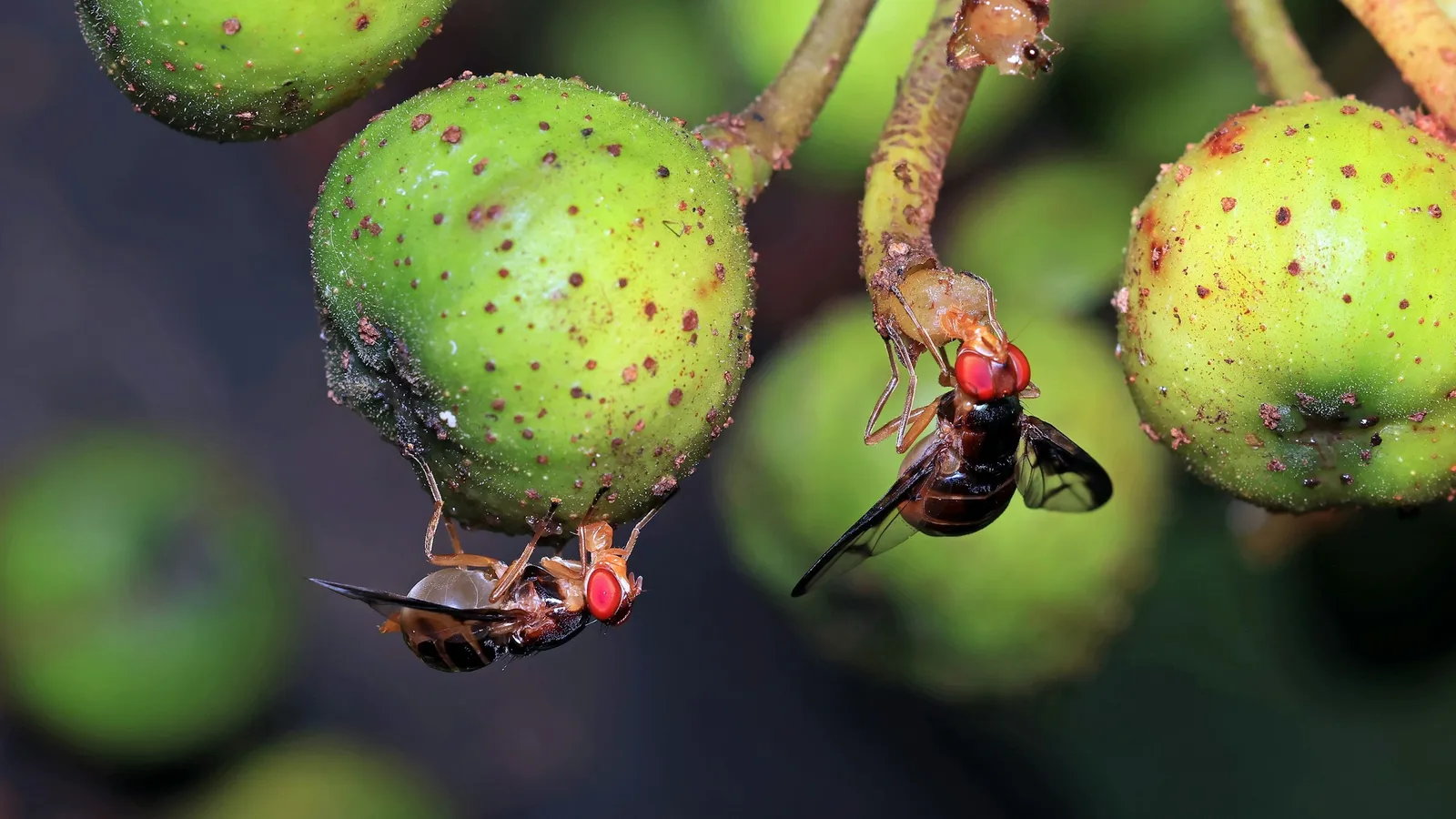
In 1909 he began working with Drosophila melanogaster. The biography says F. E. Lutz introduced him to the fly when Morgan was looking for cheaper material that could be bred in the small space he had. The NCERT Class 12 chapter on inheritance lists why it suited the work:
It grows on a simple synthetic medium in the laboratory.
It completes its life cycle in about two weeks.
A single mating produces a large number of offspring.
Males and females are easy to tell apart.
It has many hereditary variations visible under a low-power microscope.
The flies were bred by the million, and the biography notes that spontaneous mutations kept turning up in the cultures.
What did the white-eyed fly show?
Morgan's first papers dealt with a male fly with white eyes. He reported the unusual pattern of inheritance in Science in 1910 as Sex limited inheritance in Drosophila. The gene for white eyes travelled with the X chromosome, and the male, with one X, is the heterogametic sex. Here was a trait whose inheritance followed a visible chromosome.
What are linkage and recombination?
NCERT describes the crosses. Morgan crossed yellow-bodied, white-eyed females with brown-bodied, red-eyed males and intercrossed their offspring. The F2 generation was far from Mendel's 9:3:3:1 ratio, because both genes are on the X chromosome. Parental combinations turned up much more often than new ones. Morgan coined linkage for the physical association of genes on one chromosome, and recombination for the appearance of non-parental combinations.
Some pairs were tightly linked and some loosely. NCERT gives his figures: white and yellow showed only 1.3 percent recombination, while white and miniature wing showed 37.2 percent. His student Alfred Sturtevant used recombination frequency as a measure of the distance between genes and published the first map in 1913: The linear arrangement of six sex-linked factors in Drosophila. Morgan set out the theory of genes arranged in a line along chromosomes in his 1915 book, The Mechanism of Mendelian Heredity.
Worked example: from offspring counts to a gene map
Suppose a test cross gives 1,000 offspring, of which 13 show (matching the 1.3 percent figure in NCERT) a non-parental combination of yellow and white.
Recombination frequency = recombinants / total × 100 = 13 / 1,000 × 100 = 1.3 percent.
Map distance. Using Sturtevant's idea, 1 percent recombination counts as 1 map unit, so yellow and white are about 1.3 units apart.
A second pair. If 372 of 1,000 offspring are recombinant for white and miniature wing, the frequency is 37.2 percent, about 37.2 units.
Ordering genes. Now suppose (as a made-up figure) yellow and miniature showed 38.5 percent. Since 1.3 + 37.2 = 38.5, white must lie between yellow and miniature.
Common mistakes:
Dividing recombinants by parentals instead of by the total.
Counting the parental types as recombinant because they look "different" from one parent.
Expecting large distances to add up exactly. Crossing over can happen more than once between distant genes, so far-apart genes can look closer than they are.
Practise more crosses with our guide to linkage and crossing over, and see how ratios are built from scratch in our post on Mendel's pea experiments.
How was Morgan recognised?
He won the 1933 Nobel Prize in Physiology or Medicine "for his discoveries concerning the role played by the chromosome in heredity". The biography adds that he became a Foreign Member of the Royal Society in 1919 and received its Darwin Medal in 1924 and Copley Medal in 1939. One of his Columbia collaborators, H. J. Muller, won a Nobel Prize in 1946 for producing mutations with X-rays.
What can a student take from Morgan's way of working?
Let the data change your mind. He started as a critic of Mendelian ideas and ended up giving them a physical basis.
Choose a system that fits the question. A fly with a two-week life cycle let him see many generations in a year.
Count a lot. Large numbers of offspring made small recombination percentages reliable.
Work with students. Sturtevant's map came out of Morgan's lab.
When a genetics problem goes wrong and you cannot see where, the Fermi Problem Library has a step-by-step solver that explains the reasoning rather than printing an answer, so you can find the step where your count went off.
Take three gene pairs from a textbook cross, work out each recombination frequency, and draw the map in the right order.