

On this page
Many antacid tablets list calcium carbonate as the active ingredient. Take a tablet with 500 mg of it: how much acid can it handle? That is a good mole-concept problem, and one balanced equation and a calculator are enough. Below are the full working, a conversion into millilitres and four practice variations.
This is a chemistry exercise, not medical advice. If you get acidity or heartburn often, talk to a doctor or pharmacist rather than working out your own dose.
What happens when an antacid meets stomach acid?
Calcium carbonate is a metal carbonate, so with an acid it gives a salt, water and carbon dioxide. For a refresher, read how acids react with metal carbonates and hydrogen carbonates.
The acid in your stomach is hydrochloric acid. According to Colorado State University's VIVO Pathophysiology notes on the parietal cell, stimulated parietal cells secrete HCl at roughly 160 mM, which is equivalent to a pH of 0.8. A 2019 review in the International Journal of Molecular Sciences by Martinsen, Fossmark and Waldum explains that acid secretion is designed to keep gastric pH below 4, the level needed to kill microbes. (Why that acid does not eat the stomach wall is its own story: the mucus barrier that protects your stomach.)
The balanced equation is:
CaCO3 + 2HCl → CaCl2 + H2O + CO2
How many moles of HCl does a 500 mg calcium carbonate tablet neutralise?
Work it in four steps.
Find the molar mass. PubChem lists calcium carbonate (CaCO3) at 100.09 g/mol.
Convert the mass to moles: 0.500 g ÷ 100.09 g/mol = 0.004996 mol, which is about 5.0 millimoles of CaCO3.
Use the mole ratio. The equation has 1 CaCO3 for every 2 HCl, so 5.0 mmol of carbonate uses 2 × 4.996 = 9.99 mmol of HCl, about 10 millimoles.
Read off the products from the same ratios: about 5.0 mmol of calcium chloride, 5.0 mmol of water and 5.0 mmol of carbon dioxide gas. That gas is the fizz you see whenever a carbonate meets an acid.
Because HCl gives one H+ per molecule, 10 millimoles of HCl is also 10 milliequivalents (mEq), the unit used in the antacid rules below.
How much stomach acid is that in millilitres?
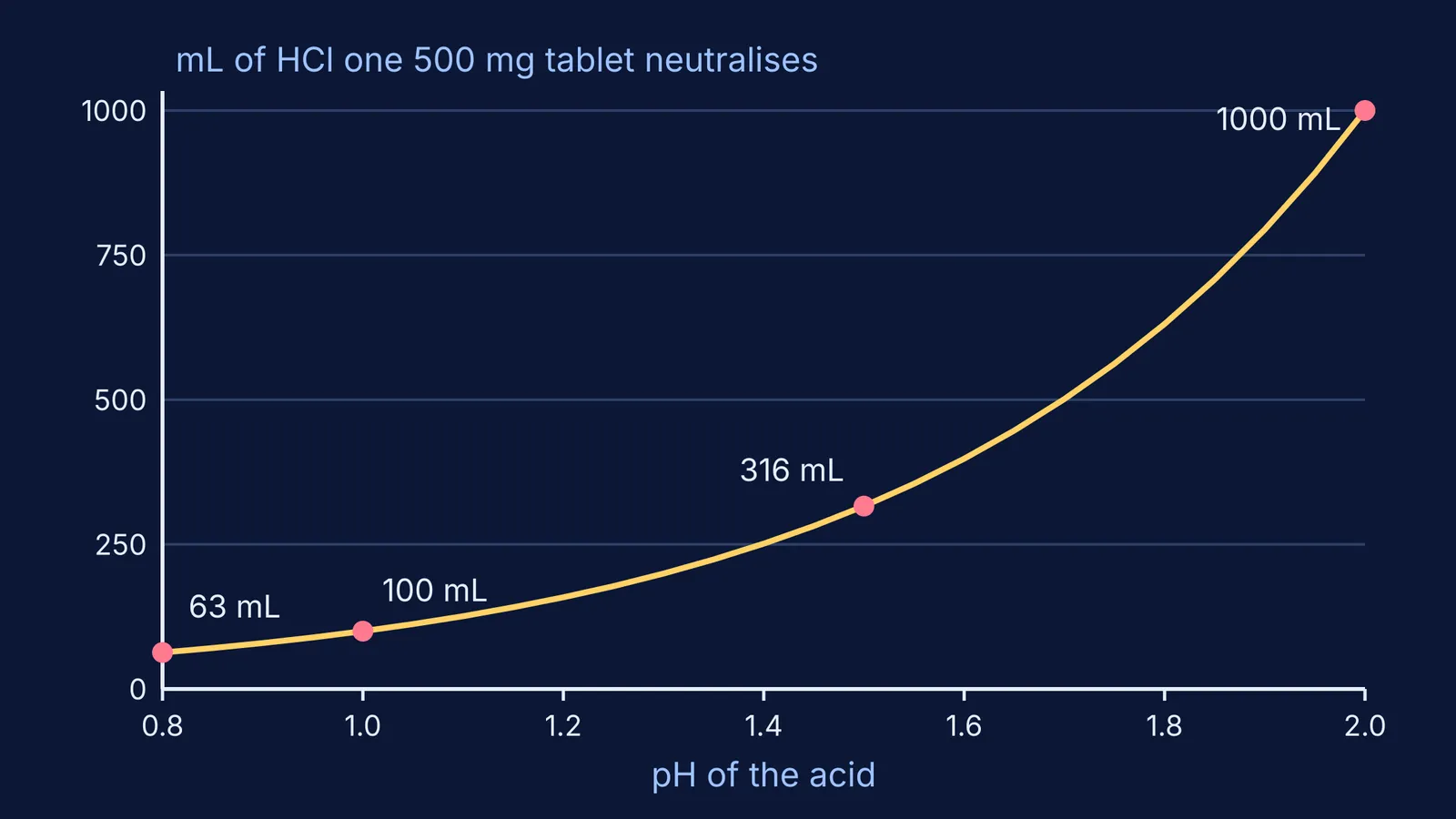
Volume is moles divided by concentration, V = n ÷ c, so the answer depends on how strong the acid is (the curve at the top of this page).
At the 160 mM of freshly secreted acid quoted in the Colorado State notes: 10 mmol ÷ 0.16 mol/L = 62.5 mL, about 63 mL.
At pH 1, where [H+] = 10^-1 = 0.1 mol/L: 10 mmol ÷ 0.1 mol/L = 100 mL.
At pH 2, where [H+] = 0.01 mol/L: 10 mmol ÷ 0.01 mol/L = 1,000 mL.
One pH unit changes the volume tenfold, because pH is a log scale. Treat these as beaker numbers: a real stomach keeps secreting acid, so it is not a fixed flask of HCl.
Does 10 mEq meet the official standard for an antacid?
In the United States, the FDA rule for over-the-counter antacids, 21 CFR 331.10, requires a finished product to contain at least 5 mEq of acid neutralising capacity, measured by the United States Pharmacopeia procedure. By our working, a 500 mg calcium carbonate tablet supplies about 10 mEq in theory, roughly twice that minimum.
The same rules, at 21 CFR 331.11, set a maximum daily dosage limit of 160 mEq for calcium as carbonate or phosphate, giving "8 grams calcium carbonate" as the example. You can check that figure yourself: 160 mEq ÷ 2 = 80 mmol of CaCO3, and 80 mmol × 100.09 g/mol = 8.0 g. That is a US limit. In India, follow the pack label and your doctor or pharmacist.
Try it yourself: four variations
Cover the answers and work each one with the same four steps.
A 750 mg calcium carbonate tablet. Answer: 7.49 mmol CaCO3, so 15.0 mmol HCl.
A tablet with 1.25 g of calcium carbonate, in acid at pH 1. Answer: 12.49 mmol CaCO3, so 25.0 mmol HCl, which is 250 mL at 0.1 mol/L.
The reverse problem: what mass of CaCO3 neutralises 50 mL of 0.1 mol/L HCl? Answer: 5.0 mmol HCl needs 2.5 mmol CaCO3, which is 250 mg.
A 500 mg tablet dropped into 50 mL of 0.1 mol/L HCl. Answer: the acid (5.0 mmol) runs out first, and 2.5 mmol (250 mg) of carbonate is left over.
Variation 4 is a limiting-reagent question. If that feels shaky, try the limiting reagent simulation where you predict product and leftovers.
If you got a step wrong and are not sure why, the Fermi Problem Library has worked problems with a step-by-step solver that explains the reasoning rather than printing an answer. If the gap is further back, in moles, molar mass or pH itself, each of those has its own lesson in the Fermi Concept Library.


