

On this page
The reaction between acids and carbonates is a cornerstone of Class 10 chemistry, appearing in everything from baking soda to stomach antacids. It follows a predictable pattern, giving you a reliable way to spot a carbonate compound in the lab.
What is the general equation?
Every metal carbonate and metal hydrogen carbonate (also called bicarbonate) reacts with dilute acids to produce a salt, water, and carbon dioxide gas (Wikipedia). This general rule holds whether you use a strong acid like hydrochloric acid or a weak one.
The basic word equations are: Metal carbonate + Acid → Salt + Water + Carbon Dioxide Metal hydrogen carbonate + Acid → Salt + Water + Carbon Dioxide
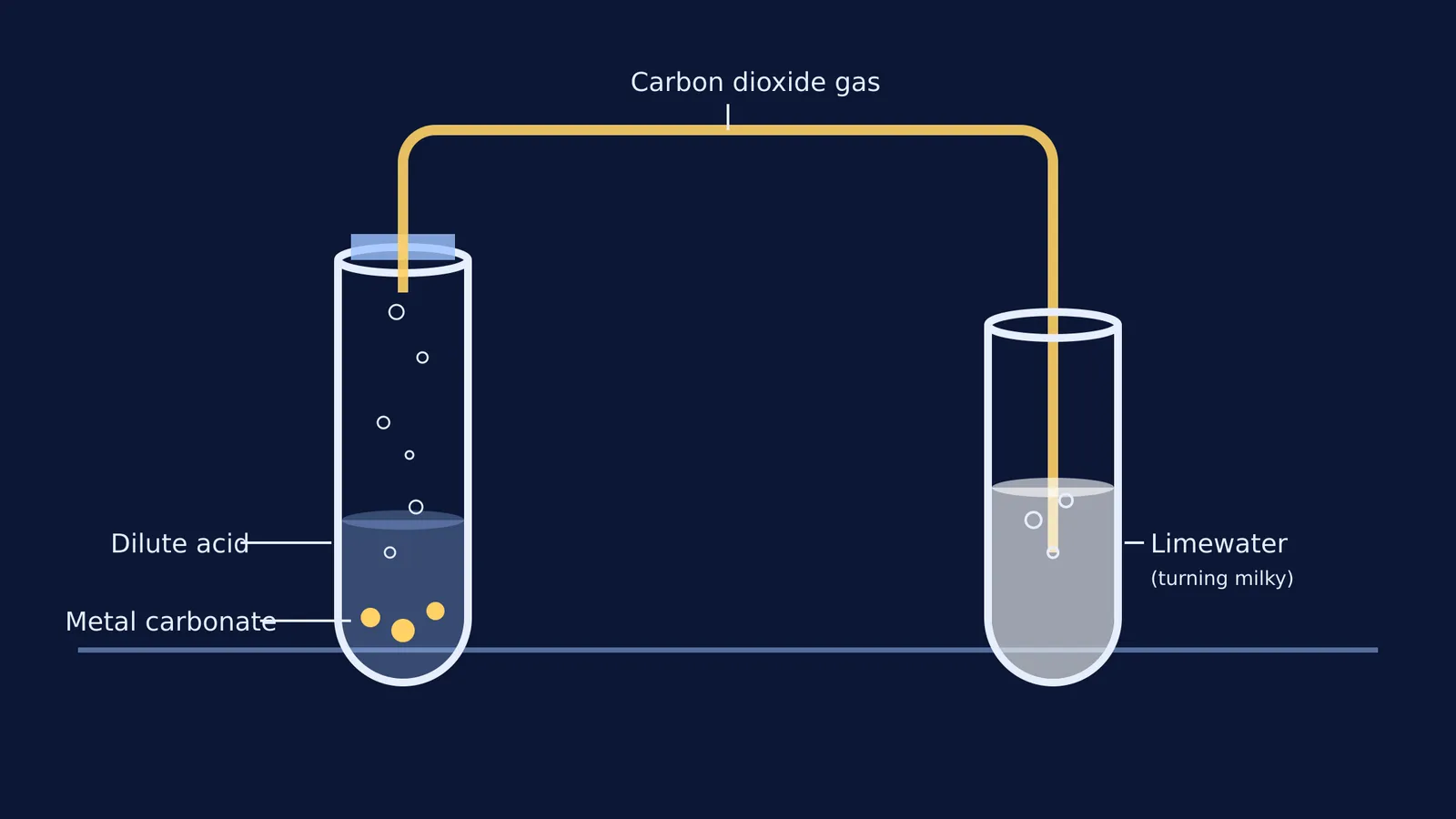
For example, when calcium carbonate (the main component of limestone, chalk, and marble) reacts with hydrochloric acid, it produces calcium chloride, water, and carbon dioxide. Because carbon dioxide is a gas, you will immediately see effervescence (fizzing) as the reaction takes place.
If you struggle to remember which salt is formed, look at the acid. Hydrochloric acid always forms chlorides, sulphuric acid forms sulfates, and nitric acid forms nitrates. You can explore how different families of compounds behave in the Fermi Concept Library, which maps out every concept in chemistry with its own lesson and its place in the syllabus.
How do you test for carbon dioxide gas?
When fizzing happens during a reaction, you need to prove the gas is carbon dioxide. This is where the limewater test comes in.
Limewater is a saturated aqueous solution of calcium hydroxide (Ca(OH)₂). When you bubble carbon dioxide through limewater, the clear solution turns milky because it forms calcium carbonate (CaCO₃), an insoluble white precipitate (Wikipedia).
The reaction is: Ca(OH)₂(aq) + CO₂(g) → CaCO₃(s) + H₂O(l)
This test is a favourite of examiners because it has a distinct, visual result that is easy to write about.
What happens when excess CO2 is passed through limewater?
If you keep passing carbon dioxide through the milky limewater for a longer time, a surprising change occurs: the milkiness disappears, and the solution becomes completely clear again.
This second step often trips students up. The clear solution returns because the insoluble calcium carbonate reacts with excess carbon dioxide and water to form calcium hydrogen carbonate, which is soluble in water (Wikipedia).
The equation for this second step is: CaCO₃(s) + H₂O(l) + CO₂(g) → Ca(HCO₃)₂(aq)
Because Ca(HCO₃)₂ dissolves completely, the white precipitate vanishes. If you are practising these stepwise reaction chains and need someone to walk you through the logic, Fermi's AI tutor can work out what you already know, build a plan for the session, and teach through it until the final answer is clear.
A worked example: Sodium carbonate and hydrochloric acid
To apply the general equation to a specific problem, consider the reaction of sodium carbonate (Na₂CO₃) with dilute hydrochloric acid (HCl).
Identify the reactants: Sodium carbonate and hydrochloric acid.
Apply the rule: The products must be a salt, water, and carbon dioxide.
Determine the salt: The metal is sodium, and the acid is hydrochloric, so the salt is sodium chloride (NaCl).
Write the balanced equation: Na₂CO₃(s) + 2HCl(aq) → 2NaCl(aq) + H₂O(l) + CO₂(g)
If we used sodium hydrogen carbonate (NaHCO₃) instead, the products would be exactly the same, but the balancing of the equation changes: NaHCO₃(s) + HCl(aq) → NaCl(aq) + H₂O(l) + CO₂(g)
The fact that both the carbonate and hydrogen carbonate yield the exact same products is a useful shortcut for exam day.
Where do we see this reaction in everyday life?
These reactions are not just lab exercises; they occur constantly in biology and daily life.
In the human body, the reaction of acids with bicarbonates acts as a critical part of the blood's buffering system. When the blood becomes too acidic, the bicarbonate ion (HCO₃⁻) reacts with excess hydrogen ions to form carbonic acid, which then breaks down into water and carbon dioxide to be exhaled by the lungs (Wikipedia).
In your kitchen, baking soda (sodium hydrogen carbonate) acts as an antacid. When you swallow it for indigestion, it reacts with the excess hydrochloric acid in your stomach, producing sodium chloride, water, and carbon dioxide, safely neutralising the acidity. Similarly, household acidic cleaners use this reaction to dissolve limescale (calcium carbonate) build-up on taps and kettles, turning the hard, insoluble crust into soluble salts that easily wash away.


