

On this page
Dilute a strong acid ten times and its pH goes up by one. That rule handles most dilution questions, but it has a limit, and the classic test case is 10⁻⁸ M HCl (aqion). Here are the numbers for both cases and a quick test for telling them apart.
Why does a tenfold dilution raise pH by exactly one?
Start from the definition. OpenStax Chemistry 2e defines pH as pH = −log[H₃O⁺], where [H₃O⁺] is the molar concentration of hydronium ions.
A strong acid is one that ionises completely in water, and HCl, HBr, HI, HNO₃ and HClO₄ are among the common strong acids listed in OpenStax Chemistry 2e. So in a solution of HCl at concentration C, [H₃O⁺] = C.
When you dilute ten times, C becomes C/10. Taking logs, −log(C/10) = −log C + 1. The pH rises by exactly one unit, whatever concentration you started from, as long as the acid is the only real source of H₃O⁺.
How does pH change as you keep diluting HCl?
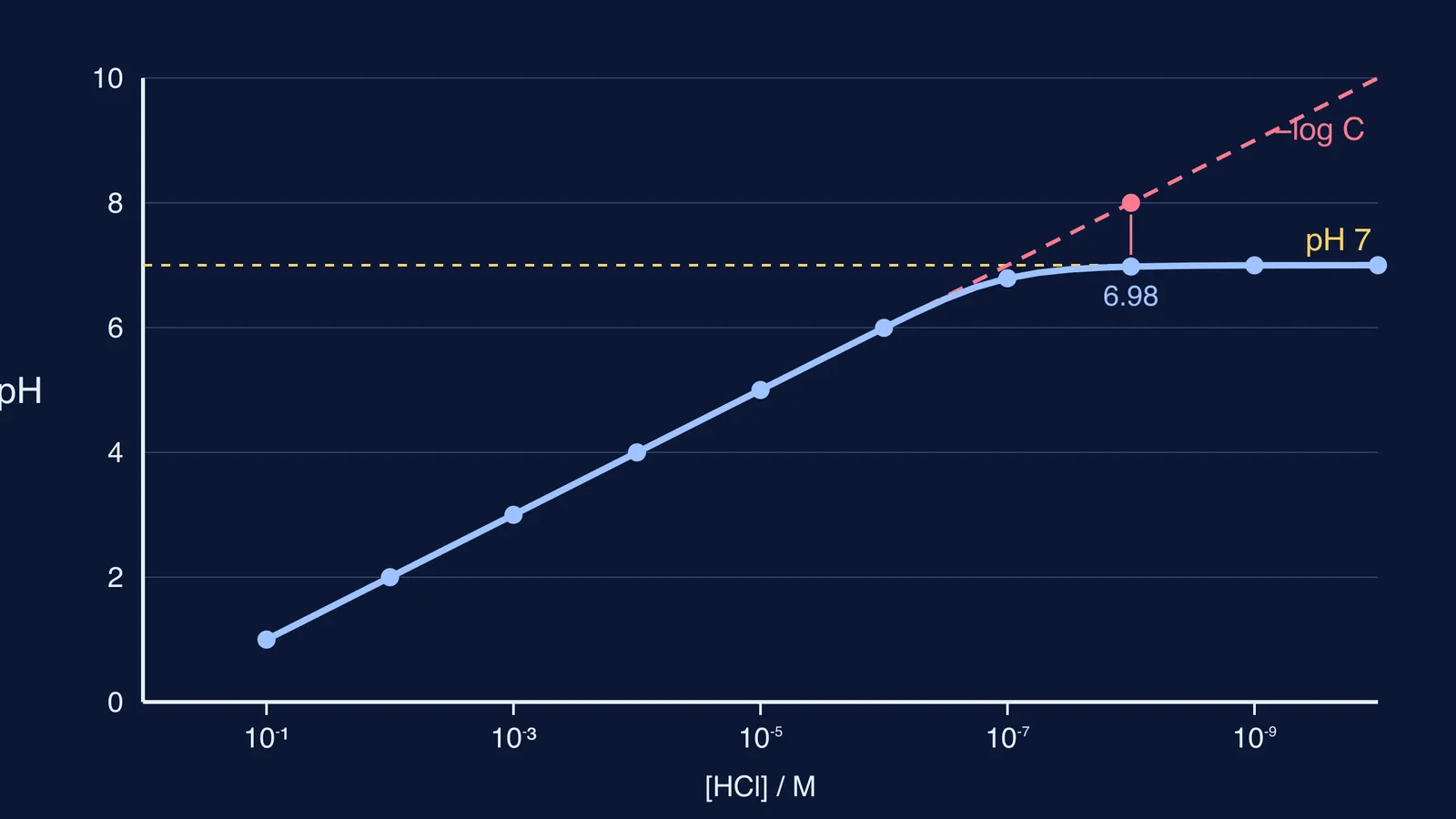
Here is the same sample diluted again and again by a factor of ten. We calculated each value with the full equation in the next section, using Kw = 1.0 × 10⁻¹⁴ at 25 °C from OpenStax.
0.1 M HCl: pH 1.00
0.01 M: pH 2.00
0.001 M: pH 3.00
10⁻⁴ M: pH 4.00
10⁻⁵ M: pH 5.00
10⁻⁶ M: pH 6.00 (5.996 if you keep three decimals)
10⁻⁷ M: pH 6.79, not 7
10⁻⁸ M: pH 6.98, not 8
10⁻⁹ M: pH 7.00 to two decimals (6.998)
10⁻¹⁰ M: pH 7.00
The first six steps follow the rule. After that, each step adds less than one, then almost nothing, and the pH creeps up to 7 without ever crossing it. Diluting an acid with water can never make it basic.
What is the pH of 10⁻⁸ M HCl, and why isn't it 8?
At 25 °C, pure water already contains 1.0 × 10⁻⁷ M of H₃O⁺ from its own ionisation (OpenStax). A 10⁻⁸ M acid adds only a tenth of that. The acid is no longer the main source of H₃O⁺; water is.
The aqion worked example sets this up with three equations. Here is the same method step by step.
Strong acid: [Cl⁻] = C = 1.0 × 10⁻⁸ M.
Charge balance: [H⁺] = [OH⁻] + [Cl⁻].
Water: Kw = [H⁺][OH⁻] = 1.0 × 10⁻¹⁴.
Put x = [H⁺]. Then [OH⁻] = Kw/x, and the charge balance becomes x = Kw/x + C, or x² − Cx − Kw = 0.
Take the positive root: x = (C + √(C² + 4Kw))/2 = 10.51 × 10⁻⁸ M = 1.051 × 10⁻⁷ M.
pH = −log(1.051 × 10⁻⁷) = 6.98.
The same aqion page gives x = 10.51 × 10⁻⁸ M and a pH of 6.978, which matches. Working with x² − Cx − Kw = 0 is more reliable than simply adding 10⁻⁷ and 10⁻⁸. That shortcut gives 1.1 × 10⁻⁷ M and a pH of 6.96, because the acid pushes water's own ionisation back a little.
When can you ignore water, and when must you include it?
You don't need the quadratic for every question. Use this test before you start.
Work out the acid's contribution, C.
If C is at least 10⁻⁶ M, ten or more times water's 10⁻⁷ M (OpenStax), use pH = −log C. The error is under 0.01, as the 10⁻⁶ M line above shows.
If C is close to 10⁻⁷ M or below, solve x² − Cx − Kw = 0.
Check your answer: an acid's pH must come out below 7, and a base's above 7.
The same reasoning works for very dilute strong bases with [OH⁻] in place of [H⁺], so 10⁻⁸ M NaOH has a pH just above 7, not 6. Kw also changes with temperature, so pH 7 is neutral only at 25 °C; our post on whether pH 7 is neutral at all temperatures explains why.
How is this different for weak acids and buffers?
A weak acid does not follow the one-unit rule. Diluting it ten times raises its pH by less than one, because more of it ionises as it gets more dilute. To see the two curves side by side, read what a pH simulation shows about diluting strong vs weak acids. A buffer resists the change almost completely, and our explainer on why a buffer's pH does not change on dilution works through the ratio that keeps it steady.
To practise, try a few dilution questions in the Fermi Problem Library. Its step-by-step solver explains the reasoning, so you can see where water starts to matter instead of just reading off the final pH. If logarithms or Kw still feel shaky, the Fermi Concept Library has a lesson for each one.


