

On this page
Is pH 7 neutral at all temperatures?
If you ask any high school student what the pH of neutral water is, they will often say 7. This is true under standard laboratory conditions, but it is not a universal law.
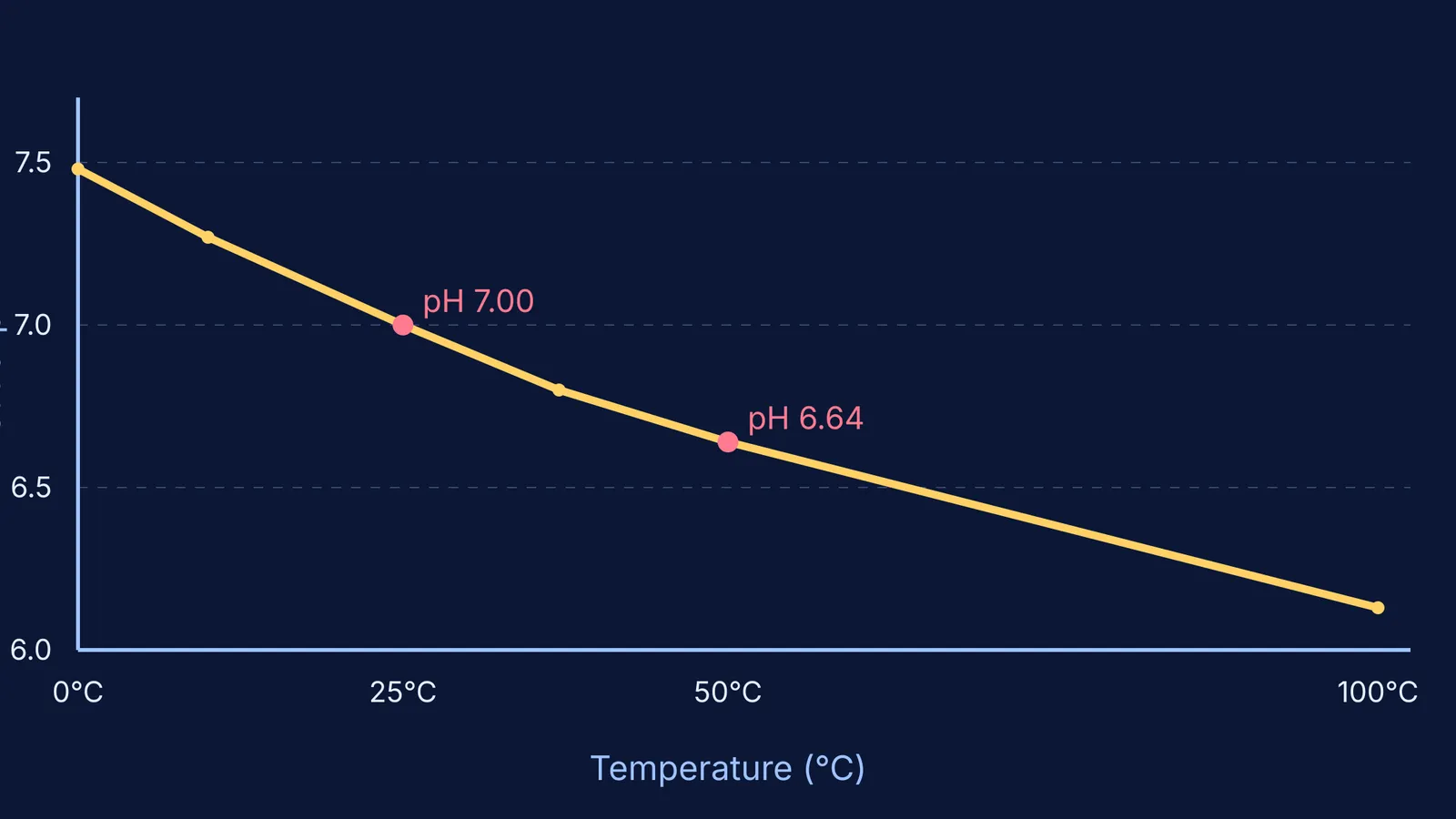
To understand why, we need to look at what neutrality actually means. A chemical solution is neutral when the concentration of hydrogen ions ($H^+$) is exactly equal to the concentration of hydroxide ions ($OH^-$). It does not mean the pH is permanently locked at 7. The pH value of pure water is 7.00 only at a standard temperature of 25 °C according to the OpenStax Chemistry 2e textbook. If you change the temperature of the water, the pH will shift up or down, even though the water remains completely neutral. This is a subtle but fundamental concept that often surprises students during their first major chemistry tests.
Does pH change with temperature?
Yes, the pH of pure water changes with temperature because the splitting of water molecules is an endothermic process.
Water naturally breaks down into ions in a process called autoionization: $H_2O \rightleftharpoons H^+ + OH^-$. Because this reaction absorbs heat, adding thermal energy by heating the water pushes the chemical equilibrium to the right. When you heat water, more water molecules break apart, creating a higher concentration of both hydrogen and hydroxide ions.
This behaviour illustrates Le Châtelier's principle. This principle states that if a system at equilibrium experiences a change in temperature, it will shift its equilibrium to counteract that change. Because breaking down water into ions requires heat, providing extra heat to the system forces the water to absorb it by breaking more bonds. This is why the concentration of both ions increases, lowering the pH value while preserving the neutral balance between them.
The OpenStax Chemistry 2e textbook states that at 50 °C, the ion-product constant of water ($K_w$) increases to $5.30 \times 10^{-14}$. Because the concentration of hydrogen ions has increased, the pH drops. In pure water at 50 °C, the pH is approximately 6.64. The water is still neutral because the number of hydroxide ions increased by the exact same amount to balance the extra hydrogen ions.
How do you calculate the pH of pure water at 50 °C?
Instead of just memorising that the pH drops, let us work through the actual math. This is a common question pattern in advanced chemistry.
Identify the ion-product constant ($K_w$): At 50 °C, the given constant is $5.30 \times 10^{-14}$ based on OpenStax data.
Set up the equilibrium expression: The formula for the ion-product constant is $K_w = [H^+][OH^-]$.
Equate the ions: Because the water is pure and neutral, the concentrations of both ions are equal ($[H^+] = [OH^-]$). We can rewrite the equation as $K_w = [H^+]^2$.
Solve for the hydrogen ion concentration: Substitute the $K_w$ value into the equation to get $[H^+] = \sqrt{5.30 \times 10^{-14}}$, which equals $2.30 \times 10^{-7}$ M.
Calculate the final pH: Use the formula $pH = -\log([H^+])$ to find that $pH = -\log(2.30 \times 10^{-7}) = 6.64$.
You can explore interactive models of energy and temperature in Fermi simulations. Building an intuition for these dynamic systems makes the mathematical steps clearer.
What does this mean for biological systems?
When we study biology and human anatomy, we often assume that pH 7 is the neutral baseline for all cellular processes. However, human body temperature is around 37 °C, which is warmer than a standard laboratory bench. At this temperature, the ion-product constant of water is slightly higher than it is at room temperature. The neutral pH of pure water at 37 °C is actually around 6.8, according to OpenStax data.
This slight but measurable shift is critical for biochemists and medical researchers. When they measure the pH of blood or cellular fluid in a laboratory, they must calibrate their instruments to account for the actual temperature of the biological sample. In more extreme environments, such as natural hot springs where water temperatures regularly exceed 50 °C, the neutral point is even lower. Organisms living in these pools have evolved to maintain chemical neutrality at a pH that we would normally consider acidic at room temperature. Understanding this temperature dependence ensures that scientists and students alike do not mistakenly classify a neutral hot spring as an acidic environment.


