

On this page
You pour 10 mL of acid into a flask and top it up to 100 mL. The concentration is now one-tenth. The usual first guess is that the pH goes up by one. That is right for hydrochloric acid and wrong for ethanoic acid, the acid in vinegar. A pH simulation shows the difference quickly, as long as you predict before you click.
What is pH, and why does tenfold dilution matter?
pH is minus the logarithm of the hydrogen ion concentration, pH = −log[H⁺] (chemrevise acid-base equilibria notes). Because the scale is logarithmic, a tenfold change in [H⁺] moves pH by exactly one unit. So the real question is: did [H⁺] actually fall tenfold?
How much does pH change when you dilute a strong acid?
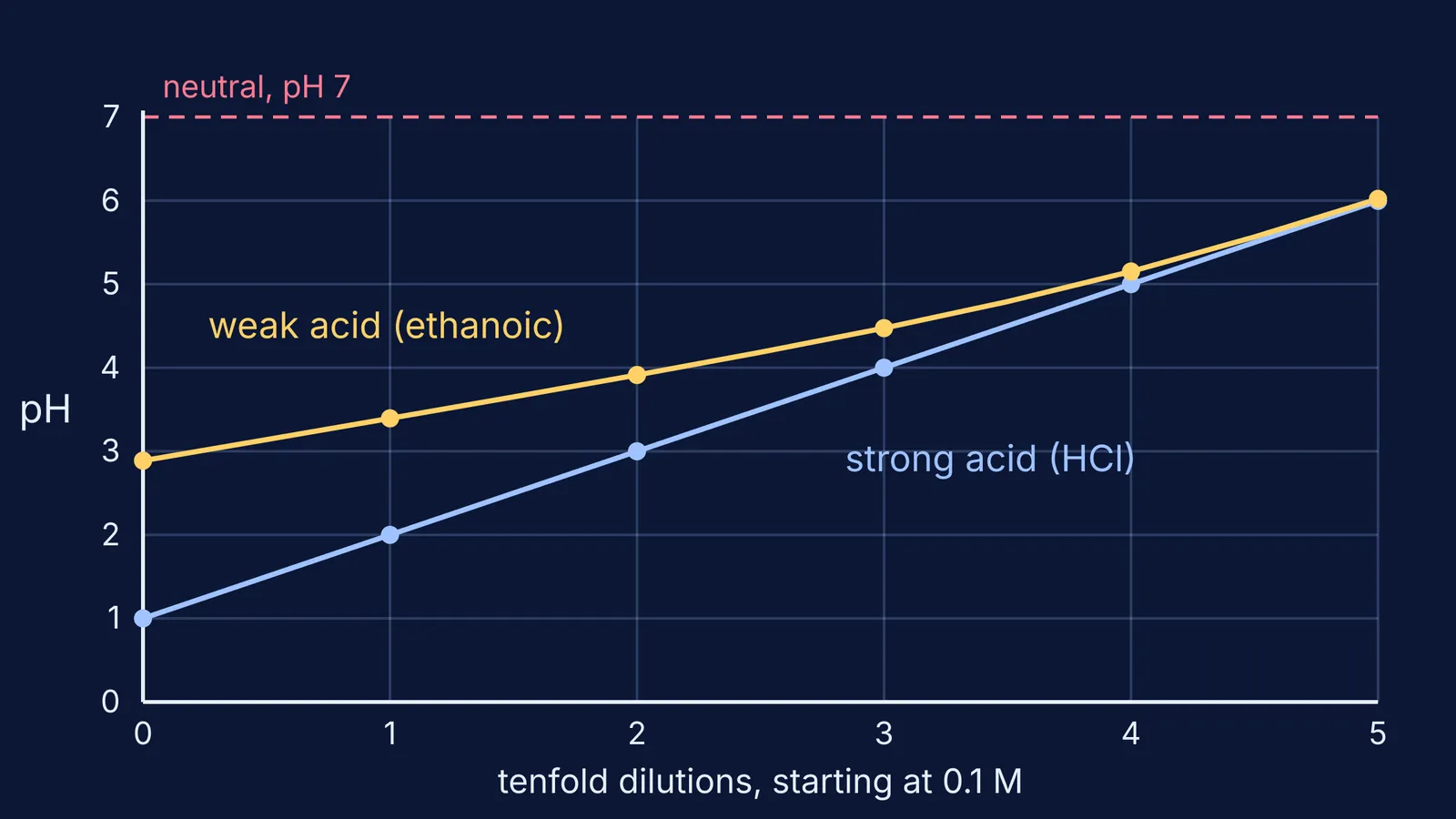
A strong acid is one that is virtually 100% ionised in solution (Chemistry LibreTexts/Equilibria/Acid-Base_Equilibria/2._Strong_and_Weak_Acids)). For HCl, [H⁺] equals the acid concentration, so 0.1 mol dm⁻³ HCl has pH 1.00 (chemrevise). Dilute it tenfold and [H⁺] falls tenfold, giving pH 2.00. The same notes put it plainly: diluting a strong acid 10 times raises its pH by one unit, and 100 times by two units.
Why does a weak acid's pH change by only about half a unit?
A weak acid only partly ionises: in a typical ethanoic acid solution, only about 1% of the molecules are ionised at any one time (Chemistry LibreTexts/Equilibria/Acid-Base_Equilibria/2._Strong_and_Weak_Acids)). The Ka of ethanoic acid is 1.7 × 10⁻⁵ mol dm⁻³ (chemrevise). When you dilute a weak acid, the equilibrium shifts to the right, the degree of dissociation increases and more H⁺ is produced, so pH rises by less than one unit, as the same notes explain.
You can put a number on "less than one". When only a little of the acid dissociates, [H⁺]² ≈ Ka × c, the shortcut used in those notes. Take logs of both sides and you get pH ≈ ½pKa − ½log c. Every tenfold drop in c adds ½ to the pH. That is your prediction to test.
Worked example: predict first, then dilute
We calculated these values for HCl and ethanoic acid at 25 °C, using Ka = 1.7 × 10⁻⁵ from the chemrevise notes and solving the equilibrium exactly instead of using the shortcut. Cover the numbers, write your own predictions in a column, then compare.
0.1 M: HCl pH 1.00; ethanoic acid pH 2.89 (about 1.3% ionised)
0.01 M: HCl pH 2.00; ethanoic acid pH 3.39 (about 4% ionised)
0.001 M: HCl pH 3.00; ethanoic acid pH 3.91 (about 12% ionised)
0.0001 M: HCl pH 4.00; ethanoic acid pH 4.47 (about 34% ionised)
Three things to notice. First, at 0.1 M the two acids differ by almost 1.9 pH units, so the strong acid has about 77 times more free H⁺ at the same concentration. Second, the weak acid's steps, worked from unrounded values, are 0.51, 0.52 and 0.56: close to half a unit while ionisation is small, then creeping up as more of the acid ionises. Third, the gap closes as you keep diluting. Very dilute ethanoic acid is mostly ionised, so it starts to behave like a strong acid. Example 5 in the chemrevise notes gives pH 3.38 for 0.01 M using the shortcut; our exact 3.39 shows how small the error is at that concentration.
How do you run this in a pH simulation?
Pick a strong acid and a weak acid at the same starting concentration, 0.1 M if the simulation allows it.
Before touching anything, write your predicted pH for both acids and for three tenfold dilutions.
Dilute one step at a time and record the measured pH next to each prediction.
Wherever you were off by more than 0.1, say which assumption failed: full ionisation, or very little ionisation.
Keep diluting until the two readings almost meet, and explain why.
PhET's Acid-Base Solutions simulation, from the University of Colorado Boulder and listed by the Royal Society of Chemistry, lets you add common solutions and change their concentrations to see the effect on pH.
The Fermi Simulation Lab has interactive simulations for ideas that are easier to see than to read. If you get stuck on step 4, Fermi's AI tutor notices where you are stuck, decides whether to explain, ask or show, and can run the simulation with you while checking your understanding as it goes.
Where does this lead next?
The same equilibrium explains why some solutions resist pH change, covered in our guide to pH, buffers and ionic equilibrium. It also explains the shape of weak-acid curves in acid-base titration curves. And if you wondered why neutral means pH 7 only at 25 °C, read why neutral pH depends on Kw and temperature.
Your next step: write four predictions for each acid, then run them.


