On this page
Goverdhan Mehta is an Indian organic chemist who, in the words of the Royal Society's citation, "has made valuable contributions to the field of molecular synthesis". His speciality is making molecules that nature makes, and some that nature never made, by planning every ring and every bond in order.
Who is Goverdhan Mehta?
Mehta was born in Jodhpur in 1943 and earned his PhD from Pune University in 1967, working with the chemist Sukh Dev (Wikipedia summary). He worked at IIT Kanpur from 1969 to 1977 and then helped build the University of Hyderabad, where he was vice-chancellor from 1994 to 1998, before serving as director of the Indian Institute of Science, Bengaluru, from 1998 to 2005 (Royal Society of Chemistry profile).
The Royal Society lists him as a former President of the Indian National Science Academy, a recipient of the Padma Shri, a Chevalier de la Légion d'Honneur (2004) and the winner of over 40 scientific prizes. The same citation credits him with synthetic pathways to many biologically active compounds, many new molecular structures, and studies of stereoelectronic effects: how the electrons in a molecule shape its structure.
What did Goverdhan Mehta contribute to organic chemistry?
A natural product is a molecule made by a living thing, such as a fungus, a plant or a soft coral.
A triquinane is a carbon skeleton of three five-membered rings fused in a row. Mehta's group made several natural products on this frame. In 1986 he and his co-workers published a general approach to linearly fused triquinane natural products in the Journal of the American Chemical Society, with total syntheses of hirsutene, coriolin and capnellene. The key word is general: one route that reaches several targets, rather than a new plan for each.
In 1997 he and A. Srikrishna surveyed the whole field in Synthesis of polyquinane natural products: an update in Chemical Reviews, a 50-page review of how chemists build these ring systems.
How do you build a ring system from a cage?
Mehta's trick was to build a cage first and then cut it. A 1981 paper in Tetrahedron80021-x) describes making linearly fused three-ring compounds by "photo-thermal olefin metathesis". In it, light turns the Diels–Alder adducts of cyclopentadiene and quinones into five-ring (pentacyclic) cage compounds, and heat then breaks the cage's four-membered ring to give the three-ring frame.
Diels–Alder: cyclopentadiene adds to a p-benzoquinone, giving a three-ring adduct with two C=C bonds.
Light: the two C=C bonds join into a four-membered ring, closing the molecule into a cage.
Heat: the four-membered ring opens along the other pair of bonds, and the cage unfolds into three five-membered rings in a row.
The overall effect swaps double-bond partners, which is why the papers call it olefin metathesis. Mehta's group reported "olefin metathesis in polycyclic frames" in Tetrahedron Letters in 197986734-4) and used it for a synthesis of hirsutene in 1981. Our piece on Yves Chauvin and the olefin metathesis mechanism explains the swap.
A second route, published with K. S. Rao in The Journal of Organic Chemistry in 1985, cut a carbon–carbon bond in a cage by reduction to give cis-syn-cis triquinanes, three rings fused with a fixed 3D shape.
Worked example: how do you read tricyclo[6.3.0.0²,⁶]undecane?
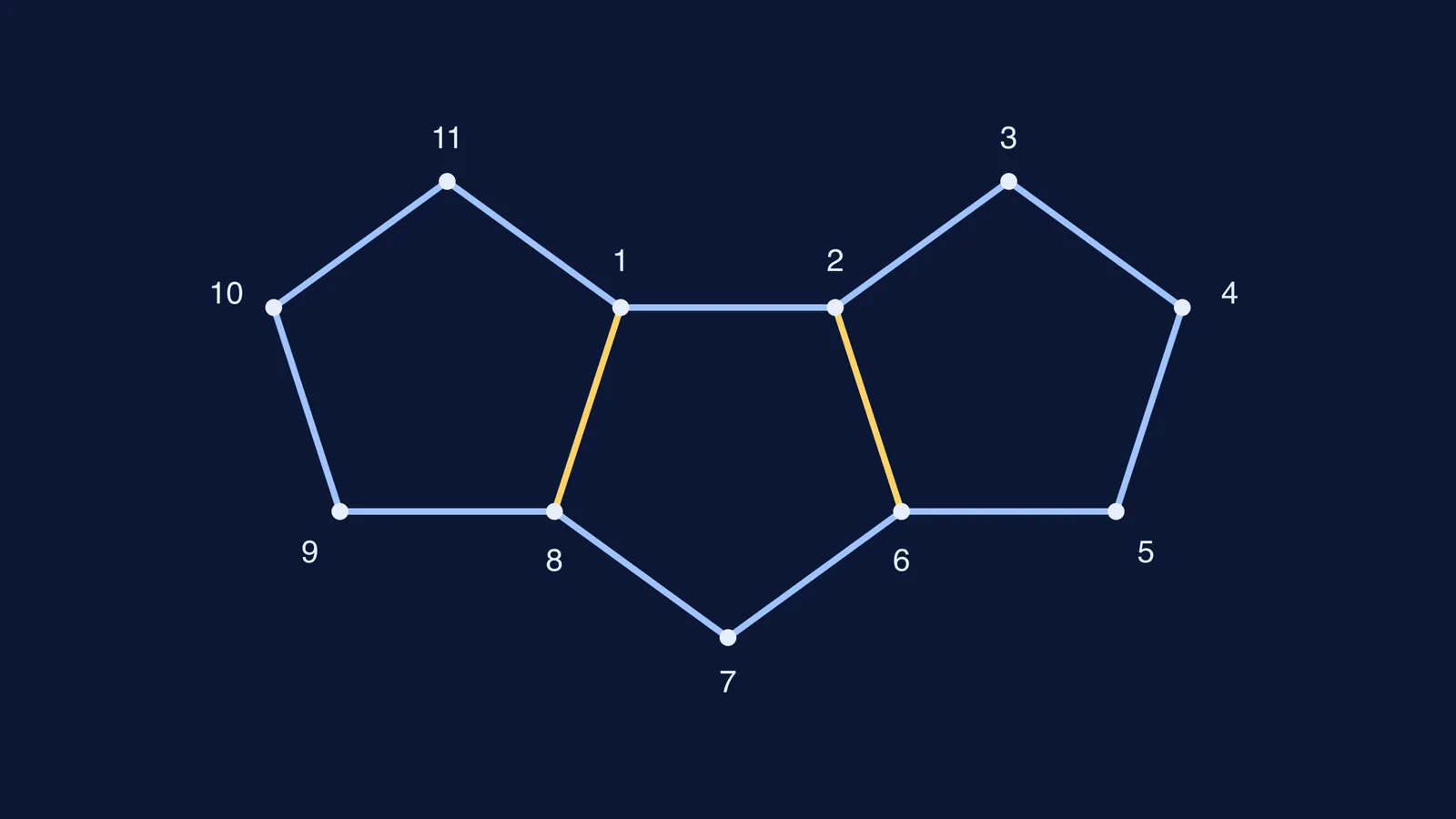
The frame in the diagram above is the parent linear triquinane, and its name follows the same von Baeyer rules as bicyclo names. If those are rusty, start with how to name bicyclic compounds.
"Tricyclo" means three rings; "undecane" means 11 carbons, all single bonds.
The main brackets [6.3.0] are the three bridges between the two main bridgeheads, C1 and C8. Check: 6 + 3 + 0 + 2 bridgeheads = 11.
Number from C1 along the longest bridge (C2 to C7), reach C8, then come back along the three-carbon bridge (C9, C10, C11). The 0 bridge means C1 and C8 are bonded directly.
The superscript part 0²,⁶ is a second bridge of zero atoms between C2 and C6: another direct bond.
Now find the rings: C1-C8-C9-C10-C11, C2-C3-C4-C5-C6 and C1-C2-C6-C7-C8. All three have five members, fused in a row.
Check the formula: three rings and no double bonds give three degrees of unsaturation, so C11H18.
What can a JEE student take from Mehta's way of working?
Find the skeleton first: count rings and ring sizes before you look at functional groups.
Track ring sizes through each step. Light made a four-membered ring here; heat removed it.
Write every step as bonds formed and bonds broken, not as a name to memorise.
Look for one route that reaches several targets.
For olympiad-style practice, see how to prepare organic chemistry for the chemistry olympiad. If bridged-ring names are where you get stuck, the Fermi Concept Library gives every chemistry concept its own lesson and its place in the map, and the Fermi Problem Library has worked problems with a step-by-step solver that explains the reasoning rather than printing an answer.
Try the worked example on a blank page: draw tricyclo[6.3.0.0²,⁶]undecane from its name alone, then check it against the diagram.