

On this page
Board organic rewards you for knowing that a reagent turns X into Y. Olympiad organic hands you a reagent you may never have met, a molecular formula and three test-tube observations, and asks you to work out what must be happening. A real Indian National Chemistry Olympiad (INChO) paper shows the three skills you need. New to olympiads? Start with how school olympiads differ from the HBCSE olympiads.
What makes olympiad organic different from board organic?
According to the HBCSE olympiad syllabus page, the syllabi for NSEC and INChO are broadly equivalent to the senior secondary level, up to and including CBSE Class 12. What changes is how it is tested.
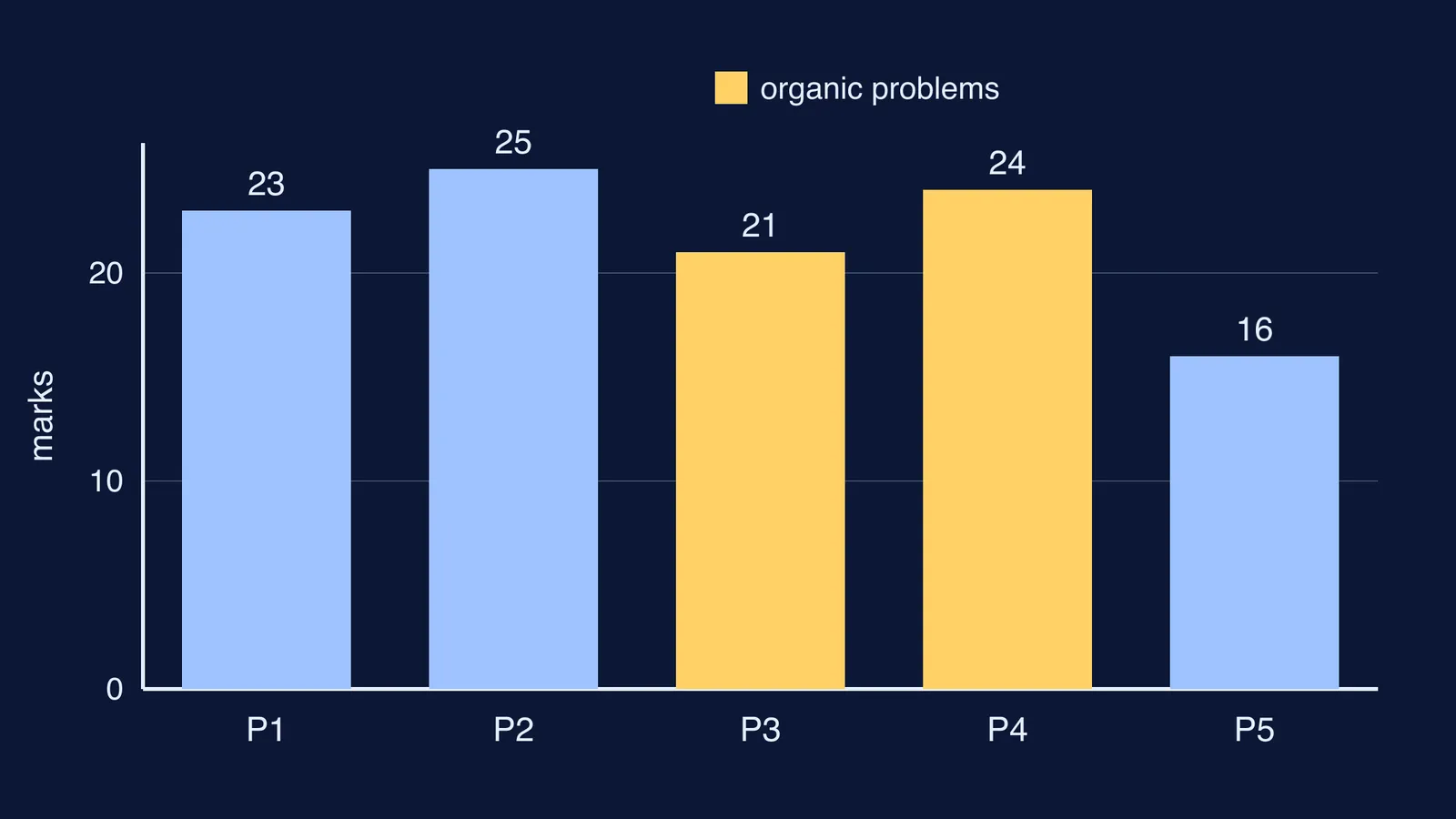
The INChO 2025 theory paper ran for 3 hours and carried 109 marks across five problems. Problem 3, "Structure Elucidation of a Drug" (21 marks), starts from a molecular formula, C16H18O4N2S, and a handful of observations. Problem 4, "An acid from sugar" (24 marks), asks for stereoisomers, tautomers and structures worked out from elemental analysis. Neither can be answered by recalling a single named reaction.
How do you practise mechanism reasoning?
An arrow starts at electrons (a lone pair or a bond) and ends at an atom that can take them. Charges must balance at every step. Before drawing anything, name the nucleophile, the electrophile and the leaving group.
In Problem 3.4, the paper introduces DCC (dicyclohexylcarbodiimide), a reagent used in peptide synthesis, outlines its mechanism with a carboxylic acid and an amine, and asks for the missing species. You have probably never studied DCC. Reason it out:
Acid plus DCC gives M and N, which the paper says are both ionic. The acid is the only proton donor and the DCC nitrogen has a lone pair, so step one is a proton transfer: a carboxylate ion and a protonated DCC.
The carbon between the two nitrogens in protonated DCC is electron-poor. The carboxylate oxygen attacks it, giving the O-acylisourea that the paper draws for you. That match is your check.
The amine attacks the carbonyl carbon of that intermediate, as in any acyl substitution. After a proton transfer, the intermediate collapses to an amide and a urea.
Then compare with HBCSE's model solution. A reaction you have never met still follows rules you already know. For a structured way to drill this, see how to practise writing organic mechanisms with AI.
How do you crack a structure-elucidation puzzle?
Keep a clue ledger: each piece of data, and what it rules in or out. From the same INChO problem:
Formula C16H18O4N2S: degree of unsaturation = (2×16 + 2 + 2 − 18) ÷ 2 = 9 rings or pi bonds. Oxygen and sulfur do not change the count.
Fizzes with sodium bicarbonate: a carboxylic acid is present.
No gas with nitrous acid: no free primary amine (-NH2) group.
No colour with aqueous FeCl3: no phenol, and the paper tells you this also rules out a free thiol.
Hydrolysis gives B (C5H11O2NS), C (C10H11O2N) and CO2: count atoms. Carbon is 5 + 10 + 1 = 16. Hydrogen is 11 + 11 = 22, which is 18 plus the 4 from two waters. B, C and CO2 account for every atom, so you can solve the two halves separately.
Propose a structure only when the ledger is full. If it contradicts one line, it is wrong.
How do you handle reactions you have never seen?
The preface to the IChO 2025 theory preparatory problems says the committee prepared 30 theoretical problems and 7 practical tasks. The booklet listed fields of advanced difficulty beyond the core syllabus, including Newman projections and the Felkin-Anh and Zimmerman-Traxler models in stereochemistry, and named topics that would not appear that year, such as NMR spectroscopy and pericyclic mechanisms. That list changes every year, so read the current year's preparatory problems before you plan.
When a reagent is new, sort it: acid or base, nucleophile or electrophile, oxidant or reductant. Find the nearest reaction you know, then check each step against what the problem gives you.
What should a weekly practice plan look like?
A review of ten study techniques by Dunlosky and colleagues (2013) rated practice testing and distributed practice as high utility. For olympiad organic, that means problems over notes, spread across the week:
Monday: one organic problem from the HBCSE past papers, which cover INChO from 2008 to 2025 with model solutions. Timed, closed book.
Tuesday: mark it against the model solution. Log each error as mechanism, structure or unfamiliar reagent.
Thursday: redo only the parts you got wrong, from a blank page.
Saturday: one problem from the current IChO preparatory set, untimed.
Sunday: pick next week's focus from the error log.
If your error log keeps pointing to the same gap, such as why a carbonyl carbon is electrophilic, the Fermi Concept Library has a lesson for each chemistry concept. When you are stuck on one step, the Fermi Problem Library has worked problems with a step-by-step solver that explains the reasoning rather than printing an answer.
If you are also writing JEE, fit these sessions into a plan for preparing for olympiads along with JEE.


