

On this page
What is the difference between school olympiads and national olympiads?
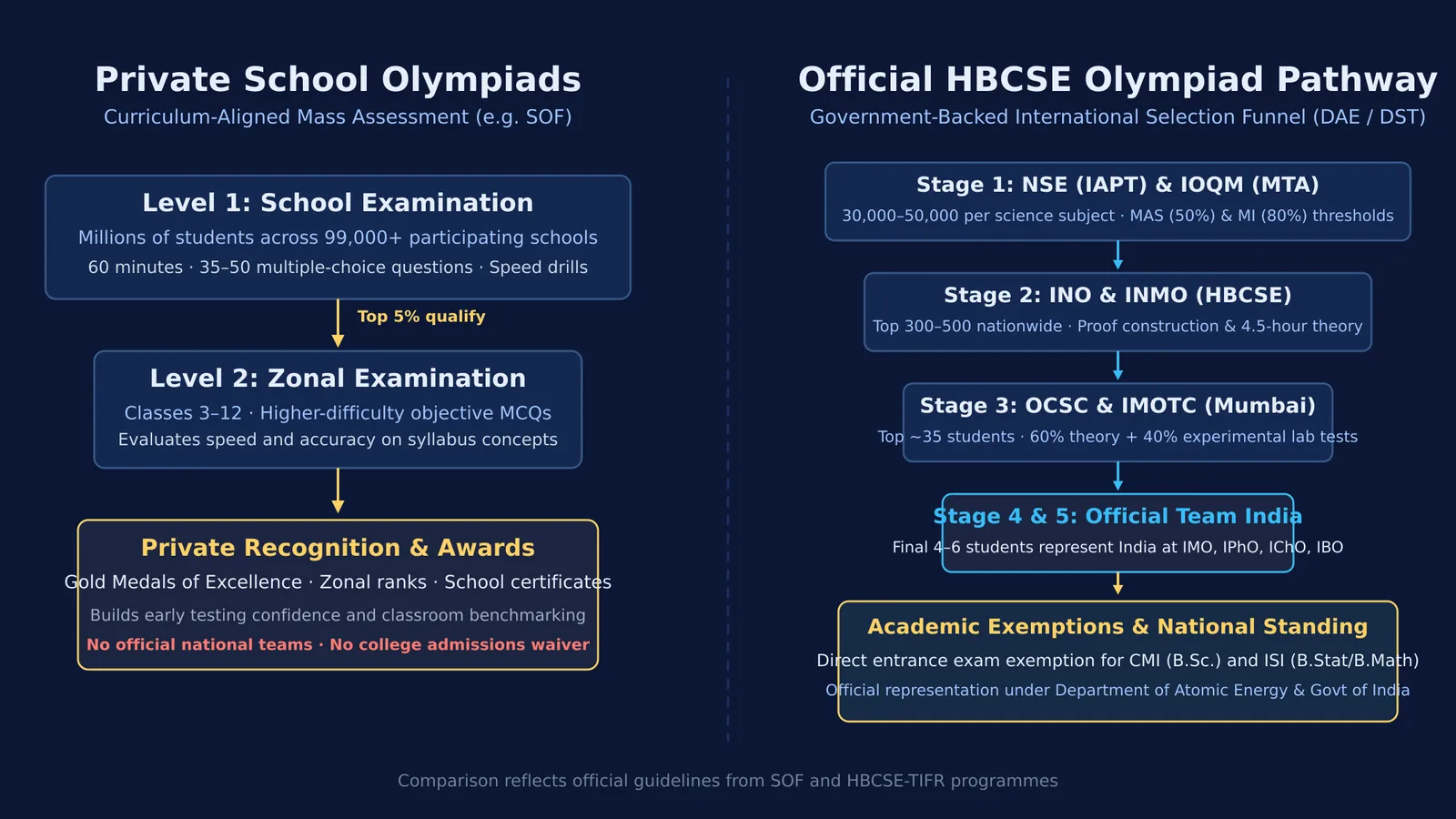
Across Indian schools, millions of pupils sit for annual competitions branded as olympiads, bringing home certificates and medals. Yet there is a fundamental difference between private school competitions and India's official national olympiad programme. Private competitions, run by bodies such as the Science Olympiad Foundation (SOF), are designed for large-scale academic participation, evaluating school curriculum recall and speed.
In contrast, the official national olympiad programme is coordinated by the Homi Bhabha Centre for Science Education (HBCSE), a National Centre of the Tata Institute of Fundamental Research (TIFR). Funded by the Department of Atomic Energy, the Department of Science and Technology, and the Ministry of Education, this programme identifies gifted STEM students and selects national teams for international competitions.
How does the HBCSE national olympiad pathway work?
The HBCSE olympiad structure follows a five-stage selection funnel in sciences and mathematics. Stage 1 consists of the National Standard Examinations (such as NSEP, NSEC, or NSEB) organized by the Indian Association of Physics Teachers (IAPT), and the Indian Olympiad Qualifier in Mathematics (IOQM) organized by the Mathematics Teachers' Association (India). Around 30,000 to 50,000 students appear for each science subject nationwide according to the HBCSE Olympiad Programme.
To qualify from Stage 1 to Stage 2, candidates must cross rigorous statistical thresholds: the Minimum Admissible Score (50% of the top-ten average score nationwide) and the Merit Index (80% of that average), as specified in the HBCSE selection criteria. This narrows applicants to approximately 300 to 500 qualifiers per subject for the Indian National Olympiads. Preparing for these stages requires moving from speed drills to rigorous proofs, as outlined in our guide on writing proofs for INMO.
From Stage 2, roughly 35 students in each subject reach the Orientation-cum-Selection Camp (OCSC) at HBCSE in Mumbai according to HBCSE camp regulations. At the science camps, theoretical tests combine with university-level laboratory experiments, which carry 40% of the selection weightage while theory carries 60%. The top 4 to 6 performers across each subject form India's delegation for the International Olympiads (such as IPhO, IChO, or IMO).
Qualifying through advanced HBCSE stages carries immense academic weight. Candidates qualifying for training camps earn written test exemptions or direct interview calls at premier institutes, including the Chennai Mathematical Institute (CMI) and the Indian Statistical Institute (ISI).
How do private school olympiads compare in structure and awards?
Private school olympiads operate on an entirely different scale. The Science Olympiad Foundation alone reports participation from over 99,000 schools across more than 70 countries annually (Science Olympiad Foundation). These examinations take place directly within school classrooms.
According to SOF exam guidelines, a typical paper spans 60 minutes with 35 to 50 multiple-choice questions aligned with NCERT, CBSE, and ICSE textbooks, plus a logical reasoning section. For classes 3 to 12, the top 5% of participants from Level 1 qualify for a second-level examination.
Awards in private olympiads are distributed broadly. Gold Medals of Excellence go to section toppers, alongside zonal medals and international percentiles. These accolades encourage young learners and benchmark classroom learning. However, they are commercial credentials; they do not lead to official national teams and carry no formal standing in university admissions.
How do syllabus depth and problem style differ?
The contrast between the two formats is rooted in cognitive demand. School olympiads emphasize speed, computational fluency, and spotting known patterns under SOF time limits of roughly one to two minutes per question.
HBCSE papers evaluate deep theoretical reasoning and proof construction. In mathematics, which begins with getting started with IOQM, the national paper (INMO) presents only 6 proof-based problems over 4.5 hours according to the HBCSE Mathematical Olympiad archive. In physics and chemistry, problems require deriving solutions from first principles rather than matching formulas.
For students transitioning to deep non-routine problems, the Fermi Problem Library has worked problems with a step-by-step solver that explains the reasoning rather than printing an answer. Furthermore, the Fermi Simulation Lab offers interactive simulations for ideas that are easier to see than to read.
Which olympiad should a student focus on?
Choosing where to invest effort depends on your child's age, aptitude, and academic milestones. For parents balancing preparation routines, our overview of supporting your child's olympiad preparation provides guidance on managing workload and expectations.
Classes 1 to 7: Focus on curiosity. Private school olympiads serve as low-stakes introductions to objective tests without requiring coaching.
Classes 8 and 9: Begin non-routine problem solving. Students with strong aptitude can prepare for foundational HBCSE gates like IOQM or junior science (NSEJS).
Classes 10 to 12: Align goals with STEM pathways. Serious aspirants should focus on the official HBCSE pathway (NSEP, NSEC, NSEB, or IOQM), which sharpens analytical depth for entrance exams and scientific research.
Keep perspective on certificates: Never sacrifice fundamental conceptual learning or board preparation for private trophies. Treat school olympiads as friendly practice, and view HBCSE olympiads as a dedicated pursuit of scientific problem-solving.


