

On this page
Organic chemistry is often taught as a visual language. To master it, you have to learn how to track where electrons move by using curved arrows. While digital tools and applications exist, drawing on physical paper remains one of the best ways to train your brain to see these invisible changes.
Why is drawing mechanisms on paper so important?
The goal of learning mechanisms is not to memorize the product of a reaction, but to understand the "why" and "how" of the electron flow. A 2012 study in the Journal of Chemical Education found that many organic chemistry students treat curved arrows as "decorations," drawing the final product from memory first and then adding the mechanism arrows as an afterthought. This product-first thinking causes students to fail when they are given unfamiliar reactions on exams, because they never learned to use the arrows as a predictive tool.
To truly learn, you must use the arrows to predict the product. Drawing on physical paper forces you to slow down, write every atom out explicitly, and think deeply about the physical bonds breaking and forming. For instance, when mapping out a Williamson ether synthesis, writing out the exact structure of your alkoxide and alkyl halide makes it much easier to see why a specific bond will break rather than guessing the outcome.
What are the most common curved-arrow mistakes?
When you practice mechanism writing on paper, errors often fall into three predictable traps that are easy to overlook.
Moving atoms instead of electrons: The tail of a curved arrow must always start at an electron source (a lone pair or a bond), never at an atom like a hydrogen proton.
Violating the octet rule: If an arrow forms a new bond to a carbon that already has four bonds, another bond must break simultaneously to make room. Forgetting this rule leads to impossible structures with five bonds, often called "Texas carbons."
Forgetting formal charges: The total charge of your reactants must equal the total charge of your products in every single step of a reaction.
Spotting these mistakes yourself is difficult when you are studying alone, especially when tracking complex carbocation rearrangements where hydrogens or methyl groups shift rapidly to stabilize the molecule. Without a teacher looking over your shoulder, it is easy to reinforce bad habits.
How to practice writing organic mechanisms with AI?
Instead of just staring at the textbook's final answer and hoping your drawing matches, you can get interactive feedback on your attempts. However, simply taking a photo of your handwritten mechanism for an AI often leads to mixed results. Messy handwriting, overlapping lines, and faint arrows can be misread by computer vision models, leading to confusing feedback.
Instead, use a "draw and describe" method. Draw the mechanism on paper first, and then describe your exact arrow movements in words. When you explain your drawing to Fermi, it holds a line of reasoning across the session, notices where you are stuck, and decides whether to explain or ask a guiding question. It checks your understanding as it goes, pointing out if you missed an intermediate, forgot a formal charge, or started an arrow at the wrong place.
Translating your drawing into words is a powerful active-learning tool in itself. It forces you to name the electron source, the electron sink, and the leaving group out loud, which reinforces the chemical principles behind the visual symbols.
What is a good script for checking your mechanism?
Here is a step-by-step framework to translate your physical paper drawing into a clear prompt that an AI can easily check. This structured approach ensures that you provide enough detail for the AI to catch subtle errors.
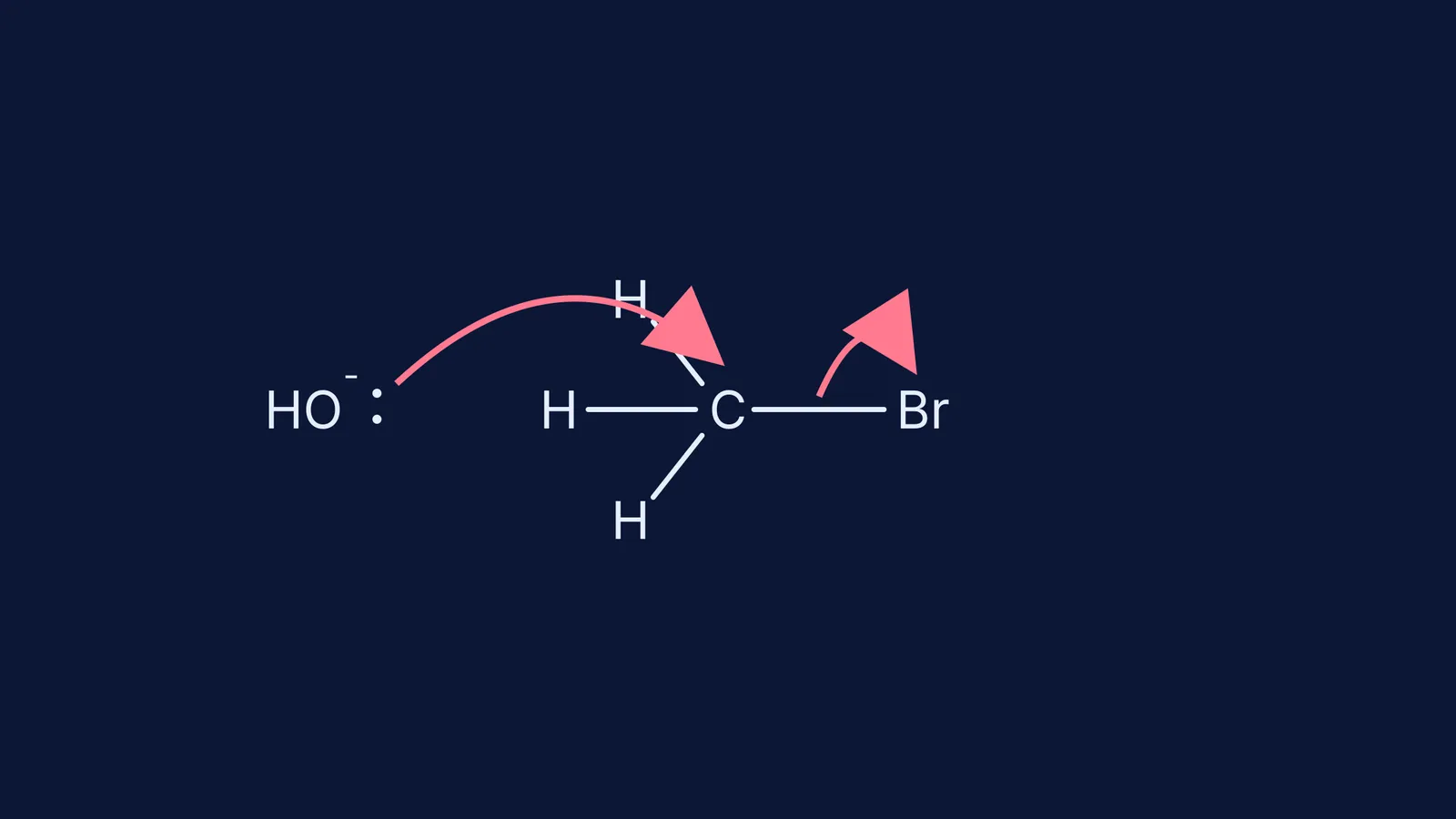
State the reactants: Begin by naming the molecules you are working with. For example: "I am reacting hydroxide with methyl bromide."
Describe the electron source: Tell the AI exactly where your first arrow starts. "I drew an arrow starting from the lone pair on the oxygen of the hydroxide ion..."
Describe the electron sink: Explain where that arrow points. "...pointing to the partially positive carbon on methyl bromide."
Describe the breaking bond: Account for any leaving groups to satisfy the octet rule. "I drew a second arrow from the C-Br bond pointing to the bromine atom."
Ask for targeted feedback: End with a specific question. "Is this step correct, and what should the formal charges of my products be?"
By combining the physical act of drawing with the verbal act of explaining, you bridge the critical gap between rote memorization and true chemical reasoning.


