

On this page
Bicyclic names look like a code, but they are built from one simple count. If you can name substituted cycloalkanes, you already know most of what you need. This guide shows the counting, the brackets and the numbering, using one molecule you will meet again and again: bicyclo[2.2.1]heptane.
What is a bicyclic compound in IUPAC naming?
A bicyclic compound has two rings that share at least two atoms. The two shared atoms at the junctions are the bridgeheads. Between them run three paths of atoms, called bridges. IUPAC names these ring systems with the von Baeyer system, whose current rules were documented and extended in Moss, Pure and Applied Chemistry, 1999.
Under those rules, a bicyclic system is named with the prefix bicyclo-, then the bridge lengths in square brackets, then the alkane name for the total number of skeletal atoms (IUPAC von Baeyer rules, VB-1 to VB-5).
How do you count the carbons in each bridge?
Find the two bridgeheads first. Then walk each of the three paths from one bridgehead to the other and count only the atoms in between. Do not count the bridgeheads themselves.
Then check yourself with one sum: the three bridge numbers plus 2 (for the bridgeheads) must equal the total number of ring carbons.
A bridge can have zero atoms. A 0 means the two bridgeheads are bonded directly, with no atoms between them. [PubChem names one such compound bicyclo[1.1.0]butane, C4H6](https://pubchem.ncbi.nlm.nih.gov/compound/135973): 1 + 1 + 0 + 2 = 4 carbons. The zero still goes in the brackets, and still comes last.
How to name bicyclo[2.2.1]heptane, step by step
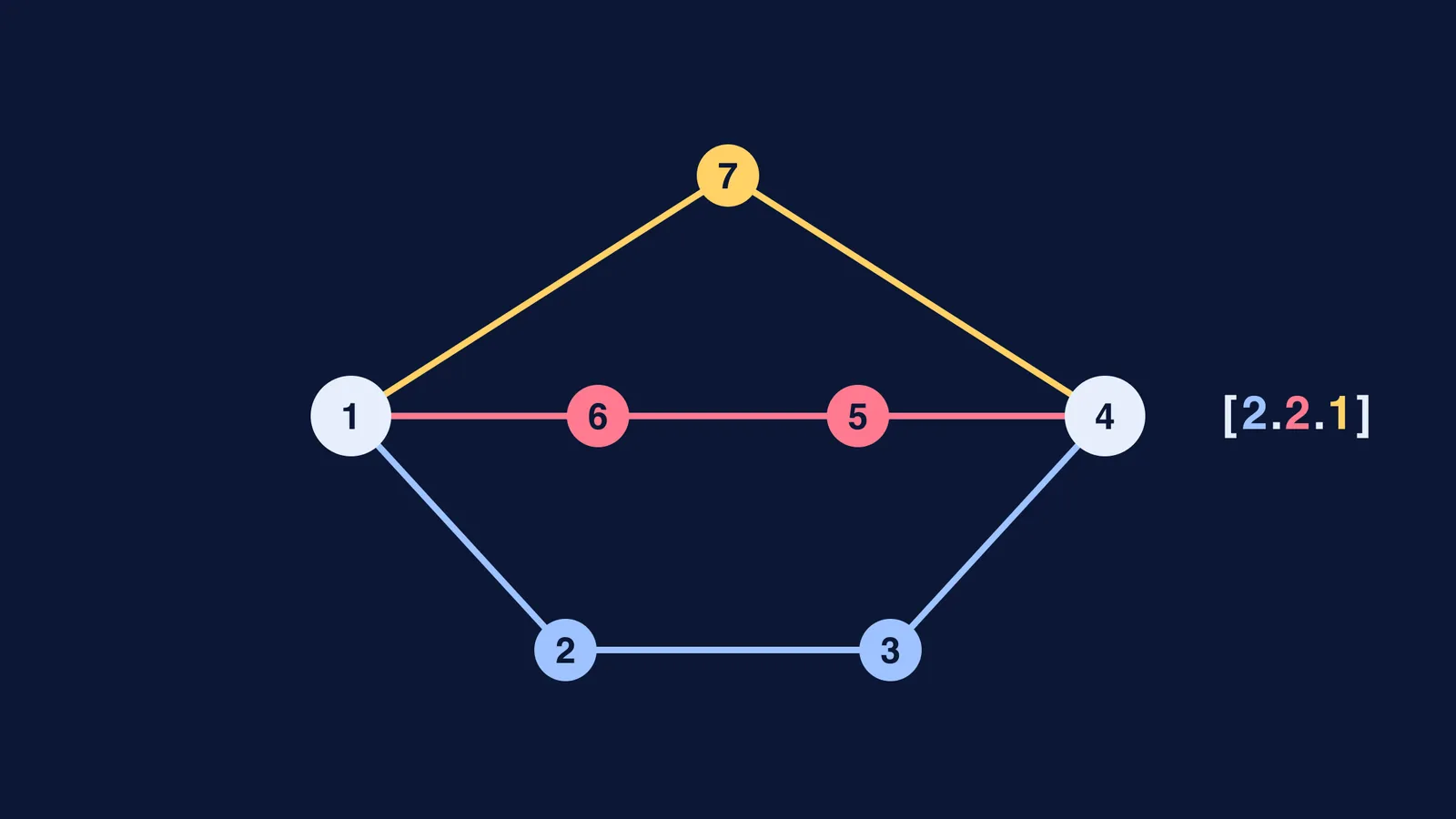
Take norbornane, the cage of seven carbons in the diagram above. [PubChem lists its IUPAC name as bicyclo[2.2.1]heptane, formula C7H12](https://pubchem.ncbi.nlm.nih.gov/compound/9233).
Spot the bridgeheads. They are the two carbons bonded to three ring carbons each.
Count the bridges. Two paths have 2 carbons each; the top path has 1 carbon.
Write the numbers largest first, separated by full stops: [2.2.1]. The rules say the three numbers are "cited in decreasing order of size" (IUPAC VB rules).
Add up: 2 + 2 + 1 + 2 = 7 carbons, so the parent is heptane.
Join it up: bicyclo[2.2.1]heptane. No spaces, no commas inside the brackets.
How do you number a bicyclic compound?
Numbering follows a fixed route. The rule is to number "from a bridgehead atom via the longest path to the second bridgehead atom", continue round the main ring, and then number the main bridge starting from the lower-numbered bridgehead (IUPAC VB rules; also in the IUPAC 2013 Blue Book, P-23.2.3).
In plain steps:
Call one bridgehead C1.
Go along the longest bridge to the other bridgehead.
Come back to C1 along the next-longest bridge.
Number the shortest bridge last, starting from the atom next to C1.
For bicyclo[2.2.1]heptane this gives C1, then C2 and C3, then the second bridgehead C4, then C5 and C6, and finally the one-carbon bridge, C7.
Try a bigger one: bicyclo[3.2.1]octane, an example in the IUPAC rules. Here C1 is a bridgehead, C2 to C4 are the three-carbon bridge, C5 is the other bridgehead, C6 and C7 are the two-carbon bridge, and C8 is the single-carbon bridge. Check: 3 + 2 + 1 + 2 = 8, octane.
When you still have a choice (which bridgehead is C1, which way round), pick the numbering that gives the lowest locants first to heteroatoms, then to the suffix, then to double or triple bonds, then to substituent prefixes. The Blue Book sets out that order in section P-14.4. If you are unsure which group is the suffix, our guide to IUPAC functional group priority covers it.
A worked example: camphor
[PubChem gives camphor's IUPAC name as 1,7,7-trimethylbicyclo[2.2.1]heptan-2-one](https://pubchem.ncbi.nlm.nih.gov/compound/2537). Read it back:
bicyclo[2.2.1]heptan: the same seven-carbon cage as norbornane
-2-one: a C=O on C2, right next to a bridgehead
1,7,7-trimethyl: one methyl on bridgehead C1 and two on the one-carbon bridge, C7
Notice why C1 is the bridgehead next to the ketone. Starting there lets the -one take locant 2, the lowest it can have.
Common mistakes to check before an exam
Counting the bridgeheads inside a bridge number
Writing the numbers smallest first, as in [1.2.2]
Using commas instead of full stops inside the brackets
Naming the alkane from the bracket sum without adding 2
Starting numbering on a non-bridgehead carbon
Numbering the short bridge before finishing the main ring
Drawing from the name is a skill of its own, and our step-by-step guide on how to draw a structure from its IUPAC name walks through it. If a numbering question keeps going wrong, the Fermi Problem Library has worked problems with a step-by-step solver that explains the reasoning rather than printing an answer. For a refresher on ring nomenclature as a whole, the Fermi Concept Library gives each chemistry concept its own lesson.


