

On this page
When you name an organic molecule that contains more than one functional group, you face an immediate choice: which group defines the main name?
According to the IUPAC Nomenclature of Organic Chemistry, every molecule can have only one principal functional group. This senior group determines the suffix of the compound's name. All other groups are relegated to junior status and become prefixes (substituents).
Choosing the correct suffix requires knowing the exact functional group priority order. The rule loosely follows the oxidation state of the carbon atom, placing highly oxidised groups with multiple oxygen bonds at the very top.
What is the functional group priority order for IUPAC naming?
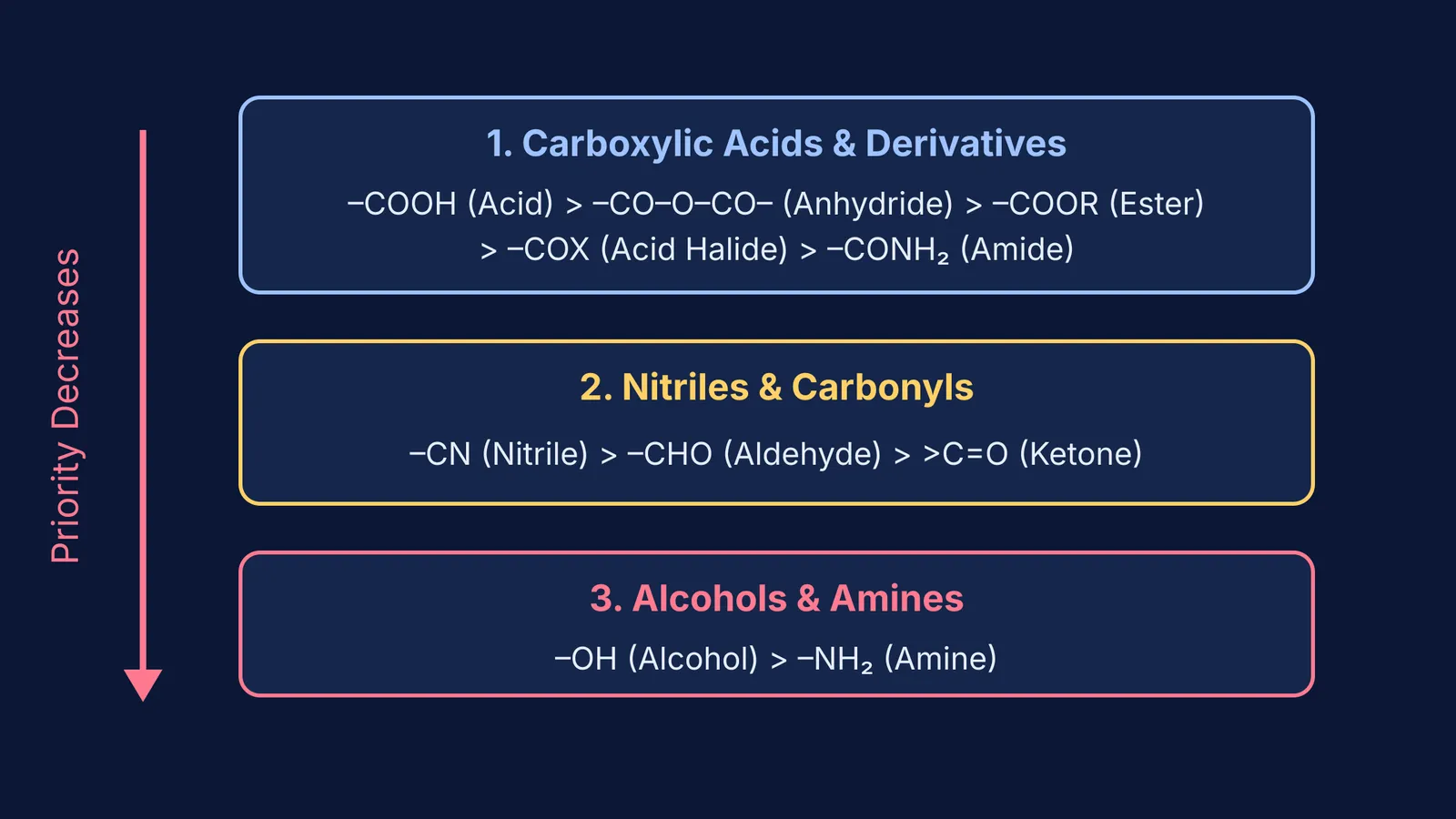
If a molecule contains two or more functional groups from the list below, the group highest on the list gives the suffix, and the others are named as prefixes.
Here is the exact priority order of common functional groups, from highest (1) to lowest (10), as defined in the IUPAC Nomenclature of Organic Chemistry:
Carboxylic acid (–COOH): Suffix is *-oic acid* (prefix: *carboxy-*).
Acid anhydride (–CO–O–CO–): Suffix is *-oic anhydride*. (For symmetric and mixed cases, see IUPAC Rules for Naming Symmetric and Mixed Acid Anhydrides).
Ester (–COOR): Suffix is *-oate* (prefix: *alkoxycarbonyl-*).
Acid halide (–COX): Suffix is *-oyl halide* (prefix: *halocarbonyl-*).
Amide (–CONH₂): Suffix is *-amide* (prefix: *carbamoyl-*).
Nitrile (–CN): Suffix is *-nitrile* (prefix: *cyano-*).
Aldehyde (–CHO): Suffix is *-al* (prefix: *formyl-* or *oxo-*).
Ketone (>C=O): Suffix is *-one* (prefix: *oxo-*).
Alcohol (–OH): Suffix is *-ol* (prefix: *hydroxy-*).
Amine (–NH₂): Suffix is *-amine* (prefix: *amino-*). (For substituted amines, see How to name primary, secondary, and tertiary amines using IUPAC rules).
How do you apply the priority order?
Naming a polyfunctional compound becomes straightforward when you use a systematic three-step framework:
Find the senior group: Scan the molecule for all functional groups. Compare them against the priority list above. The highest-ranked group is your principal group.
Number the parent chain: Find the longest continuous carbon chain that includes the principal group. Number this chain from the end that gives the principal group the lowest possible number. If your chain also contains double or triple bonds, they are considered part of the parent chain but are junior to the principal group (see IUPAC Numbering for Enynes: Resolving Double and Triple Bond Ties).
Prefix the juniors: Treat all remaining functional groups as substituents. Write them as prefixes, arrange them in alphabetical order, and attach their position numbers.
Keeping these rules straight takes practice. If you want to review the underlying ideas, the Fermi Concept Library has a lesson for every concept in chemistry, including functional group priority, and shows its place in the map.
How do you name a polyfunctional compound?
Let us apply the framework to a specific molecule: CH₃–CH(OH)–CH₂–COOH.
First, identify the functional groups. We have an alcohol group (–OH) and a carboxylic acid group (–COOH).
Second, consult the priority order. The carboxylic acid (priority 1) outranks the alcohol (priority 9). This means the suffix of the molecule must be *-oic acid*, and the alcohol must be treated as a substituent using the prefix *hydroxy-*.
Third, number the chain. The longest carbon chain containing the acid group has four carbons, making it a butane derivative. We start numbering from the carboxylic carbon to give it the lowest locator (carbon 1). This places the –OH group on carbon 3.
Putting it all together, the correct IUPAC name is 3-hydroxybutanoic acid.
What happens if a molecule has two of the same principal group?
If a molecule contains two identical principal functional groups—such as two carboxylic acid groups or two alcohol groups—they share the priority. In this case, you use a multiplier like *di-*, *tri-*, or *tetra-* before the suffix.
For example, a molecule with two –OH groups on a two-carbon chain (CH₂OH–CH₂OH) is named ethane-1,2-diol. Notice that we keep the "e" in ethane because the suffix starts with a consonant ("d" in diol). The principal functional group still dictates the parent name, but the numbering must give the lowest possible locators to both groups simultaneously.
When do you use oxo- versus formyl- for aldehydes?
Aldehydes have a special quirk in IUPAC naming. When an aldehyde (–CHO) is a junior group in the presence of a higher-priority group (like a carboxylic acid), it must be named as a prefix.
If the carbon atom of the aldehyde group is part of the numbered parent chain, it is called an *oxo-* group. However, if the aldehyde carbon cannot be included in the longest numbered chain, the entire –CHO group is treated as a single branch and named with the prefix *formyl-*. Ketones (>C=O), on the other hand, are always part of the chain and always take the *oxo-* prefix when junior.
Which groups are never the suffix?
You will often encounter molecules containing halogens (like fluoro- or chloro-), ethers (alkoxy-), and nitro groups (–NO₂). According to IUPAC rules, these groups do not have a priority ranking against each other because they are never chosen as the principal functional group.
They are always treated as substituents and named as prefixes. When multiple such groups are present, you simply list them in alphabetical order.
By memorising the ten-step priority ladder from carboxylic acids down to amines, you ensure that every complex organic molecule gets its single, unambiguous IUPAC name.


