

On this page
An acid anhydride is a functional group formed when two carboxylic acid molecules join together, losing a molecule of water in the process. The word "anhydride" literally means "without water."
Because they are derived directly from carboxylic acids, IUPAC nomenclature for acid anhydrides is straightforward: you simply name the parent acids. If you are still reviewing basic nomenclature rules, refreshing your memory on naming carbon compounds in Class 10 is a good starting point. For more advanced rules, the Fermi Concept Library covers every concept in chemistry, each with its own lesson and its place in the map.
How do you name symmetric acid anhydrides?
A symmetric anhydride is formed from two identical carboxylic acid molecules (Chemistry LibreTexts/Anhydrides/Nomenclature_of_Anhydrides)). To name them, you take the name of the parent acid and replace the word "acid" with "anhydride."
Ethanoic anhydride: If you take two molecules of ethanoic acid (commonly known as acetic acid) and remove water, you get ethanoic anhydride. Its structure is CH₃-C(=O)-O-C(=O)-CH₃.
Benzoic anhydride: Similarly, combining two molecules of benzoic acid yields benzoic anhydride, which features two phenyl rings connected by the central anhydride bridge.
Propanoic anhydride: Two molecules of propanoic acid form propanoic anhydride.
In many textbooks and exams, you will also see common names used interchangeably. Ethanoic anhydride is very frequently called acetic anhydride.
How do you name mixed acid anhydrides?
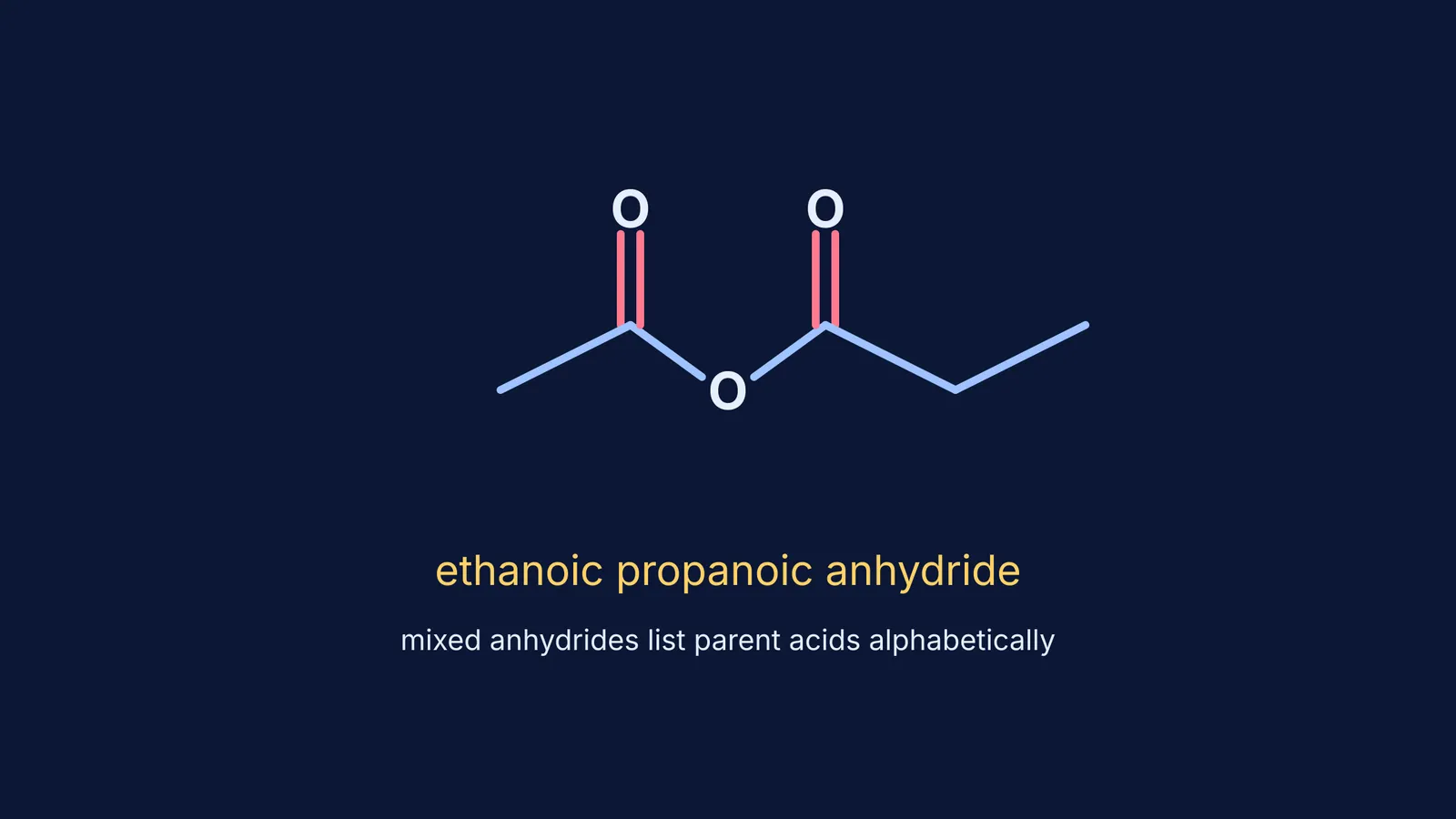
Mixed (or unsymmetrical) anhydrides are formed from two different carboxylic acid molecules. According to IUPAC rules, you list the names of the two parent acids in alphabetical order, drop the word "acid" from both, and add "anhydride" at the end (Chemistry LibreTexts/Anhydrides/Nomenclature_of_Anhydrides)).
Ethanoic propanoic anhydride: This is formed from one molecule of ethanoic acid and one molecule of propanoic acid. Alphabetically, "ethanoic" comes before "propanoic," so it is written as ethanoic propanoic anhydride (and not propanoic ethanoic anhydride).
Acetic propanoic anhydride: This is the common name equivalent, following the same alphabetical rule for the common acid names.
How do you name cyclic acid anhydrides?
Cyclic anhydrides are formed when two carboxylic acid groups on the same molecule (a dicarboxylic acid) lose a molecule of water to form a ring (Chemistry LibreTexts/Anhydrides/Nomenclature_of_Anhydrides)).
To name them, you start with the name of the parent dicarboxylic acid and replace the word "acid" with "anhydride."
Butanedioic anhydride: Formed from butanedioic acid. It is more commonly known by its common name, succinic anhydride.
1,2-benzenedicarboxylic anhydride: Formed from 1,2-benzenedicarboxylic acid, though you will almost always see it called phthalic anhydride.
Properties and uses you should know for exams?
Acid anhydrides are polar molecules, but unlike carboxylic acids, they cannot form hydrogen bonds with themselves. Because they lack hydrogen bonding, they have lower boiling points than acids of similar size; for example, ethanoic anhydride boils at 140 °C (Chemguide).
They also behave differently in water. Acid anhydrides do not dissolve in water; instead, they react chemically with it to reform the parent carboxylic acids (Chemguide). When you add ethanoic anhydride to water, it slowly hydrolyses to form two molecules of ethanoic acid.
When practicing for JEE or NEET, you will often see acid anhydrides used as acylating agents. They behave similarly to acyl chlorides but are generally slower to react. For example, ethanoic anhydride is used industrially to make aspirin by reacting with salicylic acid, because it is cheaper and less reactive than ethanoyl chloride, making the reaction easier to control without producing corrosive fumes.
To master their reactions, comparing their mechanisms with other derivatives, such as carbonyls with ammonia derivatives, will help consolidate your understanding. If you are struggling with a mechanism where an anhydride attacks an alcohol to form an ester, Fermi's AI tutor works out what you already know, builds a plan for the session, and teaches through it — writing on a board, drawing the figure, running the simulation, and checking understanding as it goes.


